顯示包含「public housing」標籤的文章。顯示所有文章

2025年4月11日星期五

Macro – Tariff wars: property impact (mostly HK) 20250411

The Trump style of governance by social media makes it a very effective way to play out his Art of the Deal techniques, for example, this is his announcement of the latest rules overnight, from his Truth Social post:
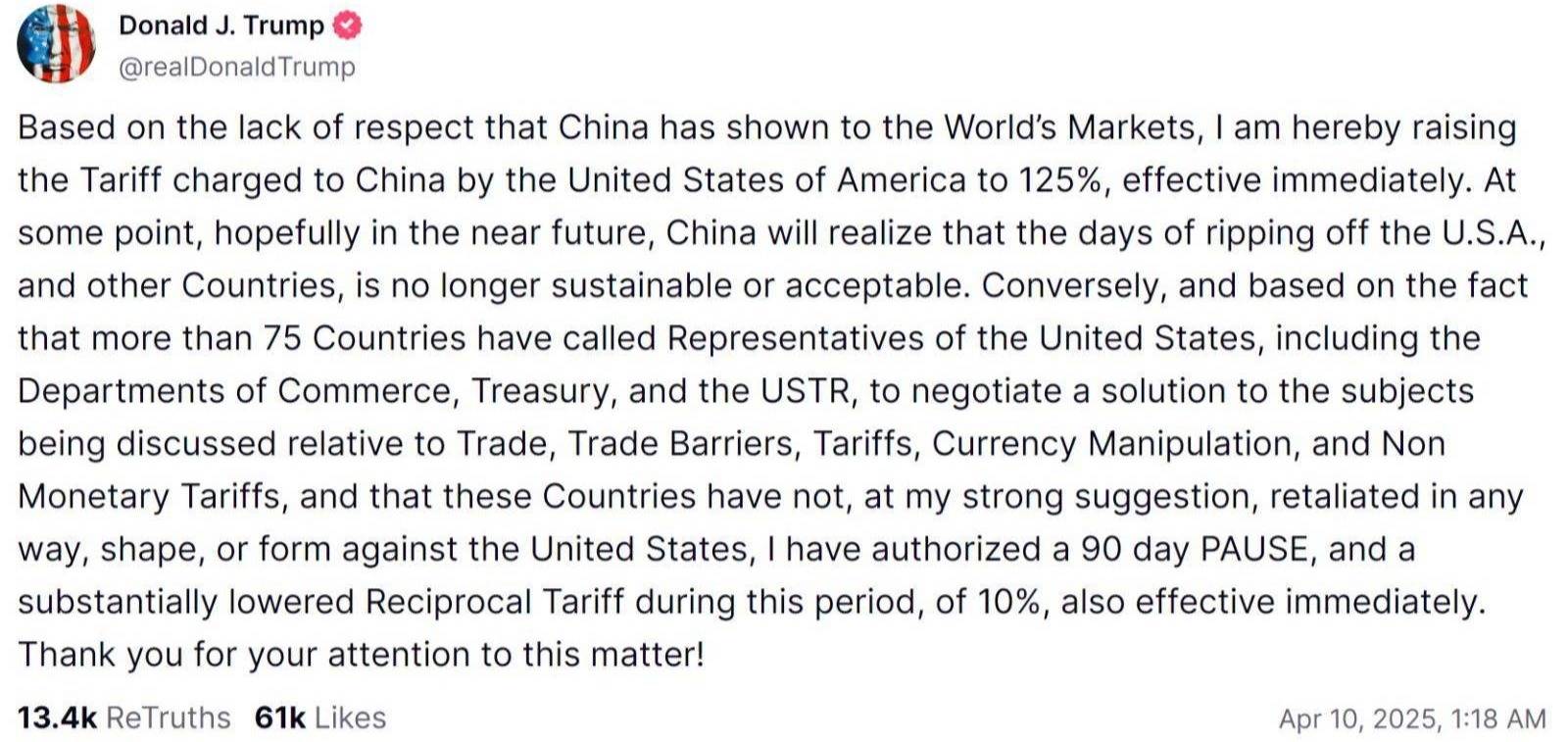


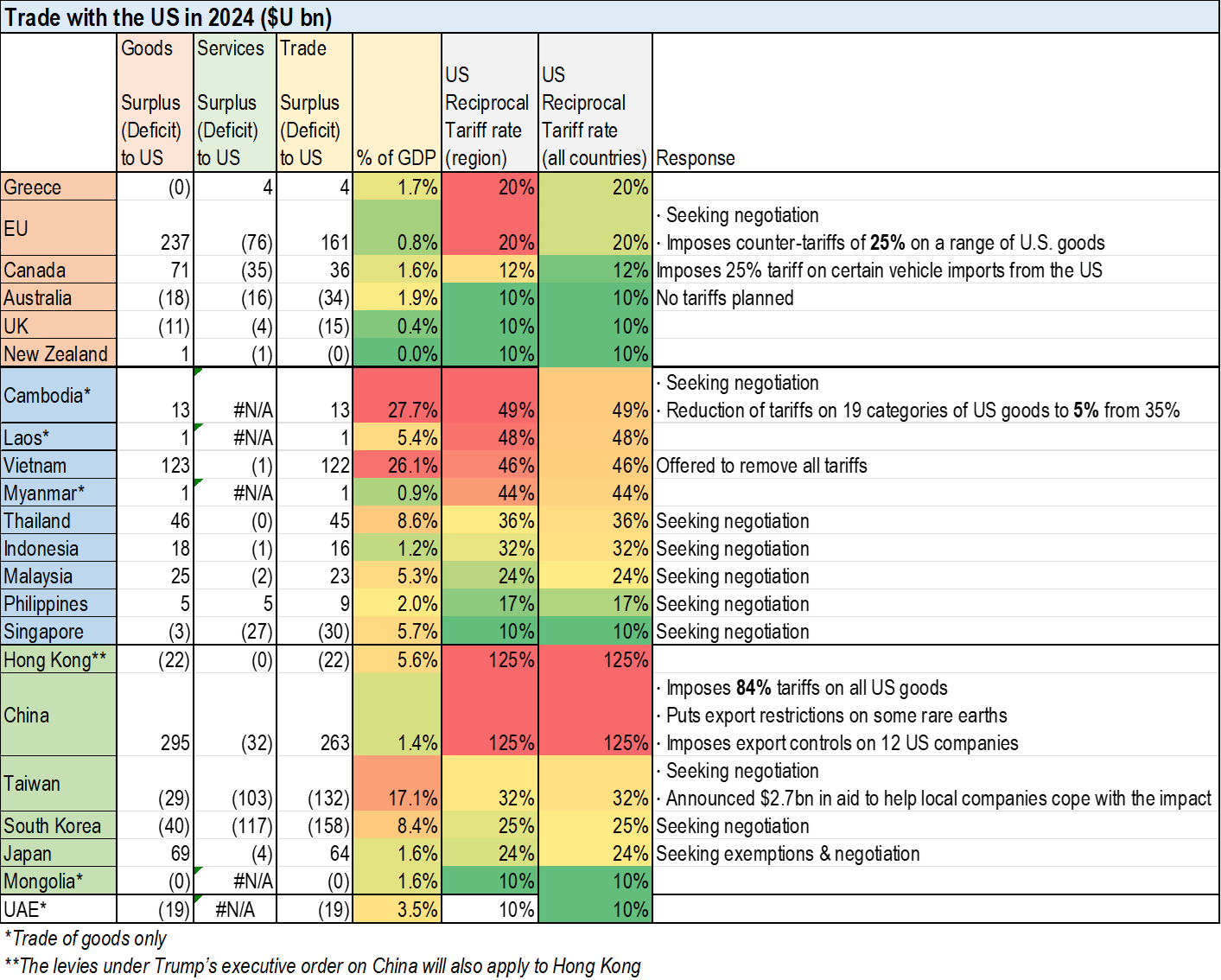
By throwing his weight around, initially with Canada and Mexico, then with EU, and now with rest of the world, it shows how powerful the US, as what I would call ‘the global consumer of last resort’, can really force agenda changes around the world, and how so many other countries buckled immediately (see updated response column):


Not only is Trump quick to mount his assaults, he is equally rapid in retreating, hence today’s latest round of 90-day suspension reversal:
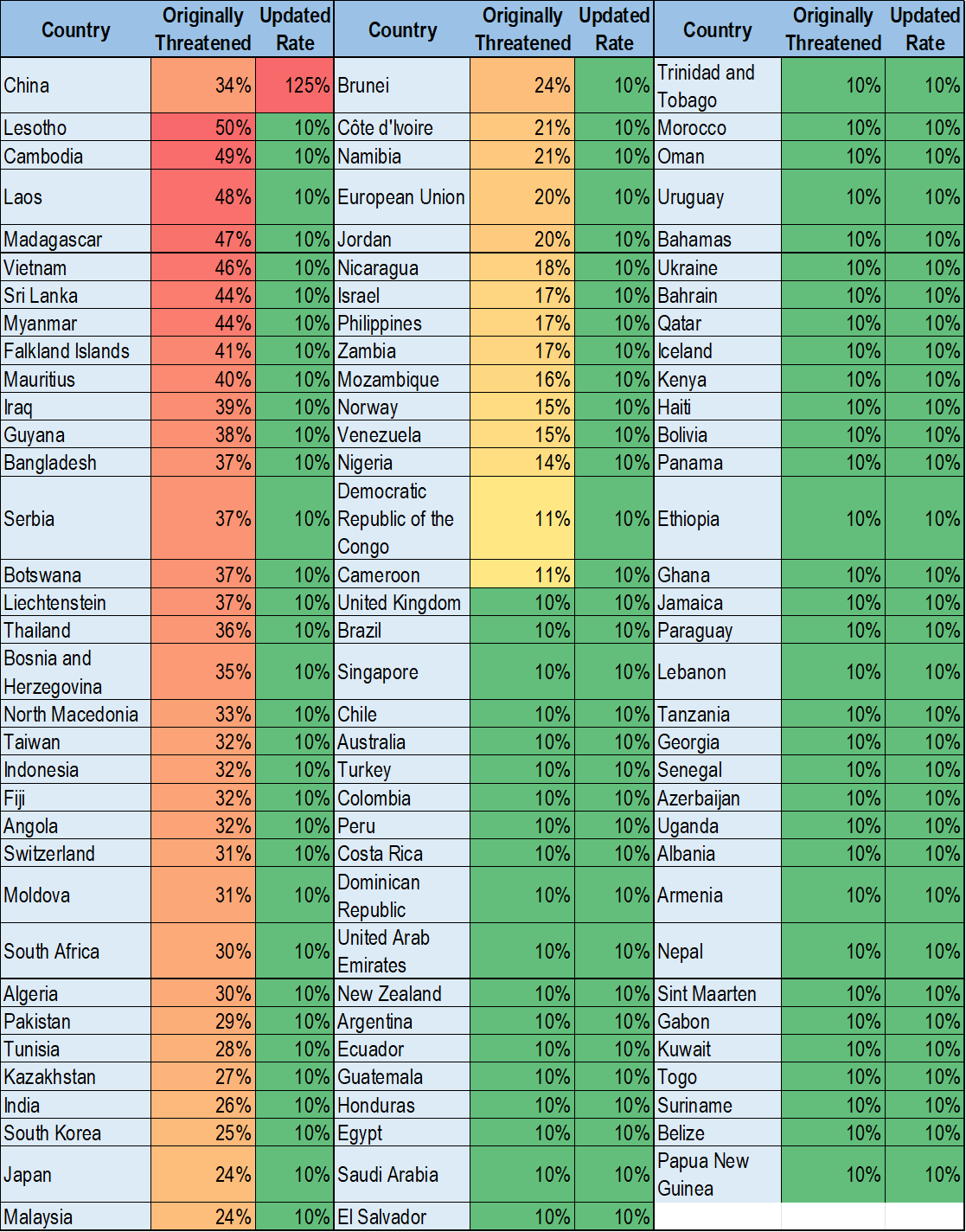


The violent reactions in the market is a good indicator we are in unchartered territory on this tariff issue. And the policy flipflops in the US is also contributing to the volatility.


We will chronicle the recent progress in section 1, before assessing the new geopolitical reality and how it will impact HK assets.


Fast draw, quick fire, and swift win?

Sole push-back from PRC – may still end in a deal?

The only one remaining resistance to the US tariffs is China. And what an escalation it has been (article 2, 5):


We are obviously worried this will escalate further, which will hurt everyone in the world, but are also quietly hopeful that rationality will prevail and a deal will eventually be struck. China does indeed have some powerful weapons in its arsenal, including:

a) dominant global trade position now – where it has the bulk of the international market as its partner, compared to the US, in other words, most other countries will suffer if they do not trade with China:


b) China’s large US treasuries holdings – some commentators worry about a sustained sale wreaking havoc on US’s debt and interest management:


But on closer inspection, CN’s holding of U$0.7trn of treasuries (red line above, is only 2.2% of total – red shade above), and even if they sold everything in one day, the impact would be less than 70% of the daily trade volume (black line below):


As a result we do not expect this as a meaningful lever to pull in the current trade dispute. The bigger worry should rather be how the rest of the world can keep increasing its appetite to accommodate the ever ballooning US treasury supply – now at close to $30trn a year in annual issues (bars in chart above).

c) RMB depreciation – basically for all countries facing tariff hikes, the easier route to offset (the obvious side effects of importing inflation aside), in fact, for low cost manufacturing nations, even triple digit tariffs may not result in manufacturing jobs shifting back to the USA (see article 7).

A likely outcome of the tariff war may well be the start of competitive devaluation to gain edge over other exporters. In the meantime, fast moving companies are already trying to beat the deadlines, but making dramatic moves like this:


d) escalation beyond trade – besides just tariff, both sides could get so entrenched as to start other forms of mutual sanctions, such as suggestion that US might delist PRC companies from US stock exchanges (article 6). This is where we worry most as the impact can spiral out of just trade, and hit many other sectors – eg the biggest risk to HK could be its open capital account needing access to the USD – in the most extreme case, could the HKD need to be depegged due to punitive measures from the US?

In fact smart US companies may already be plotting their exit of the HK/CN markets, and when sufficient proportions of the US corporate world have retracted (see article 4 where JP Morgan has sold its HK custody business), more severe sanctions would be much easier to be effected. Even countries are starting to view Chinese connection as a disadvantage, and siding with US in a potential geopolitical standoff (see article 1).


HK fundamentals – not too good either

Here are some factors that puts HK at risk and property prices on a downward bias:

a) Trade still too important a sector – with import/export accounting 9% of all employment in HK (light blue line), any trade spat is likely cause disproportionate amount of harm to local jobs and spending:


Total export has been seen to drive HK’s rents, and with trade falling, rents could also weaken:


b) Strong USD to depress local consumption further – it is already well aired that HK consumers are now spending weekends and holidays in cheap currency neighbours given the strong USD of the last few years. In a competitive devaluation scenario, this trend will undermine further HK’s domestic consumption – eg RMB is already down to its weakest level since 2008!

c) massive public housing supply about to hit the market – Yep, whatever the private developers hold back in supply, the govt’s usual pro-cyclical public housing policy will come to wreck the party: look at how strong the red and blue bars will surge in the next five years to take total supply in HK to the highest level since 2001:


We can only say – good luck to home buyers…

What are the possible good news from this?

This tariff episode may have its bright spots, however, such as:

– with tariff income, US can reform and abolish income tax as Trump promised;

– global markets cut domestic regulation / indirect taxes to appease the US, is structurally bullish for promoting free trade;

– China to launch massive credit easing to soften the blow => consumption spending up, trickle effect down to HK perhaps…

– HK and China both work harder to developer global South markets (article 3), opening up more diverse revenue streams in the process


=====================Article 1====================

Sino Chairman Robert Ng, Children Named Under Singapore Foreign Influence Law

2025/04/07 by Michael Cole

Singapore is set to declare one of its wealthiest property tycoons and three of his children as “politically significant persons” under a law designed to prevent foreign meddling in the country’s politics.

[…]

https://www.mingtiandi.com/real-estate/people/singapore-names-sinos-robert-ng-under-foreign-influence-act/

======================Article 2===================

China sticks to its guns as fresh US tariff threat pushes tension to the brink


BEIJING/SHANGHAI, April 8 (Reuters) – China vowed on Tuesday to “fight to the end” against U.S. tariffs as some citizens railed against President Donald Trump after he singled out Beijing for further levies, setting the stage for a standoff between the world’s two largest economies.

[…]

https://www.reuters.com/world/china-says-it-will-never-accept-us-blackmail-escalated-tariff-threats-2025-04-08/

======================Article 3===================

Hong Kong eyes Southeast Asian, Middle Eastern business ties in next chapter of belt and road plan

William Yiu 17 Feb 2024

Hong Kong will focus on business collaborations with Southeast Asian and Middle Eastern countries under the country’s belt and road plan, the head of the initiative’s local wing has said amid plans to launch a festival championing the scheme among residents.

[…]

https://www.scmp.com/news/hong-kong/hong-kong-economy/article/3252271/hong-kong-eyes-southeast-asian-middle-eastern-business-ties-next-chapter-belt-and-road-plan

======================Article 4===================

JPMorgan picks HSBC, StanChart to run $500 bln custody business in Hong Kong, Taiwan

By Selena Li March 1, 2024

HONG KONG, March 1 (Reuters) – JPMorgan Chase (JPM.N), opens new tab has selected HSBC (HSBA.L), opens new tab and Standard Chartered (STAN.L), opens new tab to operate its custody businesses in Hong Kong and Taiwan, with assets worth more than $500 billion, a spokesperson for the U.S. bank said.

[…]

https://www.reuters.com/business/finance/jpmorgan-picks-hsbc-stanchart-run-500-bln-custody-business-hong-kong-taiwan-2024-03-01/

======================Article 5===================

Beijing prepared for US tariff retaliation: Regina Ip

2025-04-08

The central government is well prepared and has a broad arsenal to respond to any further tariff escalation by US President Donald Trump, according to Executive Council convenor Regina Ip.

[…]

https://gbcode.rthk.hk/TuniS/news.rthk.hk/rthk/en/component/k2/1799392-20250408.htm

=====================Article 6====================

Delist Chinese stocks from US indices? Trump administration says ‘everything’s on the table’

9 Apr 2025

US’ Secretary of the Treasury Scott Bessent has said that “everything’s on the table” when it comes to removing Chinese companies from American stock exchanges, amid the ongoing tariff war between Washington and Beijing.

[…]

https://economictimes.indiatimes.com/news/international/global-trends/delist-chinese-stocks-from-us-indices-trump-administration-says-everythings-on-the-table/articleshow/120128240.cms?from=mdr

=====================Article 7====================

Trump’s tariff own-goal

David Webb 3 April 2025

He apparently has no idea how much this will hurt US consumers and how little it will affect the trade deficit. Asian manufacturers and their investors can, to a large extent, sleep easy tonight.


[…]

https://webb-site.com/articles/trumptariff.asp

2024年3月4日星期一

Key comments on the 2024/5 Budget (香港2024/5預算案點評) 20240304

Your correspondent has made various comments in several media interviews relating to the budget measures. The most ‘uncut’ must go to the live interview on RTHK programme:

1) 《理財新世代》 - 預算案全面撤辣是否有助樓市走出困局

listen to RTHK here or on my own Youtube, followed by

2) Oriental Daily interview: 財赤嚴重勿只靠舉債 搞花招無助振經濟 (here) and then on the paper’s B1 section coverage, extracts of which reproduced here:

    東方日報B1:大屋苑車位狂冧價 街舖蝕讓激增1.4倍 (link)

    Bricks & Mortar Management主席兼總裁王震宇認為,息口高企,投資物業回報追不上存款利息,樓價難見起色,就算買部分高息地產股,回報也遠高於物業。假設租金上升,回報率要由約3厘上升至4.5厘,才可追近現時市場5厘息口。在息口未有回落情況下,整體樓市格局不會改變。


And finally

3) Feature article text from iMoney front cover story (link):

    《全徹辣 鬆按揭 樓市轉勢在望?》王震字:短時間反彈5%至7%

    瑞銀前房地產研究領主管·Bricks & Mortar Management主席兼總裁王震宇說樓價已經去到極度超賣水平,相信短期內一定反彈,預計升5%至7%,但「可能第四季調頭向下」,又強調「若非中國『印銀紙』,美元這段時間弱,以及全世界覺得美國短期內不能加息,香港樓價很難反彈。不應該覺得今次樓價反彈,全由政府『撒辣』所致。」

    他續說,「徹辣」雖令置業成本減少,但未必釋放很多購買力,「買樓的原因是因為覺得樓價會升。但如果樓價長遠仍跌,是不會有人因為成本少了,而擁入來買樓。」他又指經濟及政治環境才是左右樓市的主要因素,但前景不是得好,「中美角力這件事是最大問題,加上歐洲戰事令美元再升,令香港出口,或是賺匯能力會繼續跌下去。」

北水不會大舉重臨

    部分本地買家或看淡經濟前景而無意置業,但今次「徹辣」不只本地買家受惠,海外買家也包括其中,稅率與港人睇齊。事實上,港樓向來受內地投資者歡迎,政府未推出「辣招」前,部分發展商甚至安排專車,接送內地買家來港睇樓。王震宇認為目前大形勢已改變,相信北水不會大舉重臨,「內地炒家也不想來香港,如果在港沒有資產,可能會有興趣,但如果已經來港,或有能力出資來港的,一早留意更遠的地方」

搶人才或成新動力

    雖說北水難以大舉重臨,但政府過去一年積極搶人才,當中不少為中高收入人士,有望成為樓市新動力。王震宇明言,這些專才對樓市有些幫助,但暫時很難量化,又指如果「高才通」都是高資產人士,相信他們與投資者一樣都是看回報,「到底放錢落美元收息好,還是買樓收租,賺兩厘多回報?」

    外圍環境複雜多變,世界經濟復甦速度不似預期,香港作為外向開放型的經濟體,難免受影響,樓市自然受累,但這是否意味香港樓市黃金時期已成歷史?王震宇認為,這視乎香港如何重拾競爭力,「暫時來說,美國的打壓不會放鬆」,而香港要避免財政儲備被慢漫陰乾,要找方法抵禦下個風浪,「不停發債不是一個解決方法。」

香港自保勒緊褲頭

    被問到有何政府有何保救之法,他坦言可做不多,亦非香港可以控制,「現在打杖,怎樣保救?」」但建議政府避免破壞既有優勢,盡快減少過太多的福利及經常性支出,將編制減低,「要勒緊褲頭,未來一段時問是非常難頂的時候。」

    他又說,今次《財政預算案》將香港簡單稅制摧毀得體無完膚,皆因薪俸稅本來是單一稅率,但將變成兩級制,又要實施差餉累進制,導致香港減低簡單低稅率優厚條件。更壞的是,政府推進落實經濟合作與發展組織(OECO)的稅率方案,令香港低稅率優勢失去,相信對香港長遠競爭力造成非常大的打擊。

    王震宇說,目前樓價去到極度超賣水平,短期一定反彈,但受外圍環境影響,而且非香港可以控制,所以樓市長遠始終不穩,「如果以6個月為期限,就是入市時機,但若看遠一點就不好」,無論是投資者,抑或買家,情況亦一樣。他又建議,若打算賣樓套現,可以「趁高鬆綁」。


As we keep emphasising, the poorly thought out decimation of HK’s simple and low tax system is the biggest concern from this year’s budget, followed by a departure from HK’s traditional prudent financial disciplines – more welfare spending, zero scaling back of government expenditures, which resulted in the need to raise large amounts of new debts. No wonder former Financial Secretary John Tsang is also worried (see:曾俊華憂香港將要借貸度日)

Below was our original comment on the say of budget speech, plus extracts of relevant texts from the speech:

Very simply, the various property support measures come at a time when Chinese credit easing, temporary pause in US rate hikes, and technically oversold condition in local property prices (RSI at multi-year low):

​

This suggests whatever budget measures will only add to the bigger picture favourable tail winds. In the next 6-9 months, expect high single digit rebound in home prices and volumes, but by late 2024 we think the resuming USD strength and European wars to again weaken local property demand, with possible finish by early 2025 at levels below current prices.

Extracts of budget speech below, with emphasis from your correspondent, and comments in []:

------------most disappointing measures relating to HK’s tax system------------------

234. …implement a two‑tiered standard rates regime for salaries tax and tax under personal assessment starting from the year of assessment 2024/25. … the first $5 million of their net income will continue to be subject to the standard rate of 15 per cent, …portion exceeding [at] 16 per cent. It is expected that about 12 000 taxpayers will be affected, accounting for 0.6 per cent of the total number of taxpayers … revenue will increase by about $910 million each year.

[for a puny little increase, why destroy HK's simple income tax regime?]

235. …implement the progressive rating system for domestic properties, …effect from the fourth quarter of 2024‑25 onwards. …properties with rateable value over $550,000, which account for about 1.9 per cent of the relevant properties. It is estimated that the system will contribute to an increase of about $840 million in government revenue annually.

[for another puny increase, why destroy HK's simple rates system?]

238. …global minimum tax …by the OECD to address base erosion and profit shifting. …apply the global minimum tax rate of 15 per cent on large multinational enterprise groups with an annual consolidated group revenue of at least EUR 750 million and impose the Hong Kong minimum top‑up tax starting from 2025. …bring in tax revenue of about $15 billion for the Government annually starting from 2027‑28.

[for rubbing shoulders with mostly overleveraged / wanton spending bureaucrats elsewhere this is a big loss for HK's competitiveness (yes I know the pressures of being put on 'grey lists' etc - get big bro China to back us instead of bowing to profligate tyrannies elsewhere might be a better option?]

----------------------other important initiatives--------------------------

Re-domiciliation Mechanisms

36… putting in place user‑friendly fund re-domiciliation mechanisms for Open-ended Fund Companies and Limited Partnership Funds. … will submit a legislative proposal enabling companies domiciled overseas, especially enterprises with a business focus in the Asia-Pacific region, to re-domicile in Hong Kong.

Lifting all punitive stamp duties

43. …cancel all demand-side management measures for residential properties with immediate effect, that is, no SSD, BSD or NRSD needs to be paid for any residential property transactions starting from today.

Likely lifting of LTV/DSR restrictions too

44. …now room to make further adjustments to …property lending …The HKMA will make announcements later today.

Deduction of Expenses and Allowances under Profits Tax

54. …Profits-tax payers will be granted tax deduction for expenses incurred in reinstating the condition of the leased premises to their original condition. …the time limit for claiming the allowances will be removed. This will allow the new owner to claim allowances for the property after a change of ownership …take effect from the year of assessment 2024/25. [seems applicable to new purchases rather than new tenancies for existing owners - impact limited]

Tax / rates concessions

72.

    (a) rates concession for domestic properties for the first quarter of 2024/25, subject to a ceiling of $1,000 for each rateable property;

    (b) rates concession for non‑domestic properties for the first quarter of 2024/25, subject to a ceiling of $1,000 for each rateable property;

    (c) reduce salaries tax and tax under personal assessment for the year of assessment 2023/24 by 100 per cent, subject to a ceiling of $3,000. …This measure will benefit 2.06 million taxpayers and reduce government revenue by $5.1 billion;

    (d) reduce profits tax for the year of assessment 2023/24 by 100 per cent, subject to a ceiling of $3,000. …benefit 160 000 businesses and reduce government revenue by $430 million; and

    (e) allowance to eligible social security recipients, equal to one half of a month of the standard rate Comprehensive Social Security Assistance (CSSA) payments, Old Age Allowance, Old Age Living Allowance or Disability Allowance, while similar arrangements will apply to recipients of the Working Family Allowance, altogether involving an additional expenditure of about $3 billion.

Lower bribes for EVs

87. The first registration tax (FRT) concessions for electric vehicles, due to terminate at the end of March, will be extended for two years. …will reduce the concessions by 40 per cent. …At the same time, e‑PCs valued at over $500,000 before tax will not be entitled to concessions [good to see govt stepping back from mad rush to net zero, but can do more - scrap all concessions!]

'high' tech grants everywhere - really should scale back?

[109 & 113 & 119 & 123.... $3bn to Cyberport, $6bn to universities on biotech, $10bn on New Industrialisation Acceleration Scheme (NIAS), $2bn on InnoHK research clusters, etc... blind throwing of money at problems that may not need govt intervention? ]

HK to consolidate its #1 RMB hub status

131. As the world's largest offshore RMB business hub, Hong Kong processes about 75 per cent of global offshore RMB settlement. We also have the world's largest offshore RMB liquidity pool, at over RMB 1 trillion.

Lower patent tax

160. ...amend the Inland Revenue Ordinance ...implementing the "patent box" tax incentive, which will reduce substantially the tax rate for profits derived from qualifying IP to five per cent.

Increase ship register in HK

164. In addition, Hong Kong's ship registration regime is widely recognised internationally. Hong Kong ranks fourth in the world in terms of gross tonnage, ...port state control detention rate of Hong Kong registered ships is much lower than the global average. ...to offer block registration incentive to attract shipowners to register ships in Hong Kong extensively. The Government will amend the relevant regulations regarding this incentive starting this year.

Oversupply of public housing continues: 31k vs 16k private p.a. starter home collapse to continue

184. We will make available land for the production of no less than 80 000 private housing units in the coming five years.

185. On public housing supply, the Government has identified sufficient land for meeting the supply target of 308 000 public housing units over the next ten years (from 2024‑25 to 2033‑34).

No sign of fiscal restraint, big disappointment

208. Total government expenditure for 2024‑25 will increase by about 6.7 per cent to $776.9 billion, with its ratio to nominal GDP projected to increase slightly to 24.6 per cent.

209. Recurrent expenditure will increase by seven per cent to $580.2 billion. Of this, substantial resources will still be allocated to livelihood‑related policy areas including health, social welfare and education, involving a total of $343.7 billion, representing 59.3 per cent of recurrent expenditure.

211. ...will be a deficit of $48.1 billion for the year, and fiscal reserves will decrease to $685.1 billion. [time to take back many crowd pleasing non-means tested giveaways - eg the Joy You scheme)

212. In 2024‑25, the Government will maintain its target of zero growth in the civil service establishment. [should cut civil service size!]

[whilst forecasting 26/27 budget surplus, we believe this is overly optimistic, including on land sale projections as well as not factoring in global geopolitics]

So there you have it, short term asset positive, but may be a good opportunity to lighten up given decoupling uncertainties in the wider macro environment...

2023年8月4日星期五

Too much policy meddling trashes HK housing market 20230804

The SAR government’s launches of new housing policies have reached fever pitch in recent years: from Chief Executive Lee’s “Light Public Housing (LPH)” initiative from his 2022 Policy Address to this year’s resumption of “Private Sector Participation Scheme (PSPS)” that was abandoned in 2002, to the launch of Transitional Housing (TH)… All this begs the question of whether the government has a well laid plan for the long term, or just reacting furiously to show it is doing something to the rising home prices (which has now turned down)?

The stronger the price rises, the bigger the temptation to interfere

Your correspondent has charted all the major public housing initiatives of the past 60 years so as to demonstrate cause and effect, and to illustrate the motives and timing of their launches. The result is clear: whenever major tinkering is made to housing policies, it is often after sharp surges (see brown arrows in Chart 1) or falls (green arrows) in home prices, for example:

a)      The introduction in 1977 of the Home Ownership Scheme (HOS) / PSPS (brown arrow A) was after some 133% rise in home prices between 1971 and 1976 (see dotted line 1 on the property price line); this was followed by

b)      The Middle Income Housing launch in 1980 coinciding with the end of another period of strong price increases (dotted line 2), but then hastily cancelled in 1984 (green arrow B) when the upcycle turned downwards after a final surge towards the 1981 peak (dotted line 3); likewise,

Chart 1: A timeline of Hong Kong’s major public housing schemes changes

a)      The continued home price surge between 1985 and 1994, catalysed several further housing schemes (Home Purchase Loan Scheme, Sandwich Class Housing, see brown arrows C-D), as well as the final blast to mark the peak: the Tenants Purchase Scheme, Buy or Rent Option, and even Mortgage Subsidy (arrow E), all launched before the bubble burst in 1997 (dotted line 5);

d)      It was only after the 70% the collapse in home prices around the SARS bottom that the government hurriedly withdrew as many as five housing interventions (green arrow F)!

New up cycles, new intervention temptations

Since the 2003 lows, the return of a housing upcycle (dotted lines 6+7) yet again lured the authorities to launch several rounds of new measures in an attempt to be seen as ‘doing something about affordability’, these included My Home Purchase and the so called ‘practical but not extravagant’ new variety of HOS  (brown arrows G+H)… go figure the multitude of nuances in all these fancy layers of welfare!

Sadly for the mandarins in charge, the global zero interest rate environment pushed property prices to even loftier heights, to finally reach a triple top in 2019-2022. This unacceptable situation had to be stopped, so in a flurry of new initiatives, we saw Green Form HOS, White Form Secondary Market, followed by LPH/ Private Sales Subsidised Sale Flat Pilot Scheme/TH amongst others (brown arrow I). All this illustrates is how confusing and short-sighted our housing policy has been, with disappointing absence of logical philosophy on housing welfare provision.

Recent months, the increasing intensity and proliferation of initiatives echoes the same panic last saw in the 1997 peak, presaging that another major top may be in place for this cycle (cf arrow E vs arrow I): at the time of writing, prices have fallen by 12% from the September 2021 highs. Your correspondent fears that in another year or two, there may be a repeat of policy U turns saw at the last major bottom (ie green arrow F vs arrow J)…

In order to illustrate the point on this predictable cycle, we plotted the cause of policy actions (i.e. private home prices, see the blue line in Chart 2) against the symptoms as expressed through the political pressure (quantified by say the PRH waiting time, see green line), and then the result being the number of government interventions (red line). There is an eery correlation of the three:

Chart 2: Home prices leads PRH waiting time, which impacts the intensity of government’s meddling in the housing market

The general pattern seems to be that the number of public housing schemes (i.e. the frequency of market interventions) fluctuates with the length of PRH waiting time; and the latter reflects of the swing between greed and fear as property price fluctuates. The blue line in Chart 2, being a lead indicator, suggests that as the decline in property prices continues, average waiting time will also recede, to be followed by the phasing out of various government schemes around 2025-7 (ie red line will turn down too).

What the above chart also suggests is that government policies are always too little too late, what the various recent interventions/initiatives are already 3-4 years too late, and the drop in home prices will mean that these policies are yet again pro-cyclical, ie increasing price/demand volatility rather than solving the root cause of the problem.

Simple is beautiful – learn from Shenzhen?

Hong Kong’s housing welfare policy/administration has long been held hostage by various vested interest groups, leading to endless proliferation of conflicting policies which only complicate and confuse the people. But across the Shenzhen River, our neighbour has a much simpler public housing set up, with only three layers and minimal overlap with the private market. This enables much more focused welfare delivery with less wastage – a real breath of fresh air indeed:

Chart 3: A timeline of Shenzhen’s major public housing schemes changes

Even though housing policies in Shenzhen seem to be driven strong property price moves just like in Hong Kong (see arrows a-c), but changes to old schemes are accompanied by abolition of obsolete schemes that no longer work. This is strong contrast to the dazzling array of overlapping complexities that typify Hong Kong’s set up.

As a further example, Shenzhen plans to supply/allocate 80,000 welfare housing units (c. 4 million square metres in gross floor area) and 60,000 private units (c. 6 million square meters) in 2023. This translates to a public : private unit and floor area ratio of 4:3 and 4:6 respectively; compared with Hong Kong's overkill target ratio of 7:3, Shenzhen appears to have a freer housing market!

Policy back to basics: abolish HOS, reduce PRH

Since 1965, Hong Kong has launched a total of 18 public housing schemes, of which 10 are still in force (Chart 1), but the housing problem has only worsened. Not only has public housing policy been widely criticised for exacerbating housing shortage, but has had the adverse effect of HOS breeding more of the “poor” and the “lazy”; this is detrimental to social mobility, but also wastes vast amounts of social and monetary resources.

In view of this quagmire, the government should radically reform as soon as possible:

a)      to make available all HOS stock to the private market, this will immediately enlarge supply and can rapidly bring property prices back to more affordable levels; and

b)      limit scope of PRH to the most needy, vulnerable group in society (rather than the current 35% of all population!); by releasing land to the private leasing market, even the high rents we see now stand a chance of moderating, thus lessening the pressure on the government to engage in counterproductive market interference.

Chart 4: existing housing benefits a sore sight of complete mess


Chart 5: rationalised housing benefits led by private sector removes need for intervention 

If only the government would allow the invisible hand to allocate supply/demand and prices in housing like so many other commodities are permitted to, then the reason for the existence of such a mess and policy nightmare as shown in Chart 4 vanishes. When returned back to basics, the government’s role will shrink to operating a basic safety net (red area in Chart 5) of physical shelter provision, and perhaps as a transition into the private market, a limited extension into rental vouchers but limited to say 10% of population. This way, even the voucher recipients get freedom of choice in finding the right homes in the right districts, and at the right prices according to the welfare beneficiary. Such an elegant solution will also forever eliminate the endless expansion of bureaucracies, sluggish liquidity/mobility in the housing market, and of course the constant exploitation of an unfair welfare system – a blessing for Hong Kong from every angle one views.

A truly flexible, effective and fair proportion of housing provision by the public sector should be as low as possible, and by no means the 7:3 ratio under current policies (as indicated by the red arrow in Chart 6), by providing low-level safety net physical housing (green arrow) coupled with monetary subsidy for the next poorest group. If Hong Kong continues to imitate badly what Singapore does for its own specific social political reasons, it will only be further left in the dust by a younger, more dynamic neighbour in Shenzhen!

Chart 6: The proportion of public housing is surging again, bad news for future freedom of Hongkongers…

For a revision of some of your correspondent’s past analyses on Hong Kong’s housing welfare, here are the links to recent publications for your reference:

HK’s Ever Ballooning Public Housing Addiction Cycle 11/2021 (Web, Blog, LinkedIn)

as well as some earlier writings in Chinese:

《居屋政策 好心做壞事 2014年7月》English Google translation (Web, Blog)

《公屋改革面面觀─租金偏離市場2014年9月》English Google translation (Web, Blog)

《公屋改革面面觀─結構性自我膨脹 2014年9月》English Google translation (Web, Blog)

《公屋改革面面觀─公屋「豪宅化」2014年10月》English Google translation (Blog)


The author would like to thank Alice Yurong Zeng from the Chinese University of Hong Kong majoring in International Business and Chinese Enterprise for assisting in data collection, analysis, and drafting this article.


2022年10月19日星期三

2022 HK policy address speech - Pro property and pro industrial 20221019

Key points of the policy speech are as follows:

a) all out attracting talent to HK - a must do given the loss of 140k population in the past 2-3 years, this is contained in divider a) below;

b) more drive for family office hub as well as other small measures of business support see divider b);

c) housing bad policy continues - i) plundering private market share with every rising PRH/HOS supply, resulting in every higher private home prices and ever more public housing slaves - what a missed opportunity! ii) displacing brownfields into new built industrial - likely insufficient vs demand; iii) private supply low, but development process shortening. see divider c);

d) major speeding up of infrastructure build out - mostly roads and rails, very positive and lots of opportunities opening up for the smart property investor see divider d).

In summary - talent will not come unless we lift the lockdowns, but otherwise by and large a pro property speech with lots of bright spots, but sadly will not help affordability of housing, which is unsurprising given how entrenched the public-housing vested interest groups is!

below are extracts of the speech, emphasis are mine, with odd comments thrown in:

-----------------------------------------------------a) Talent------------------------------------------------------------

Attract Enterprises, Investment and Talents to Enhance Competitiveness

26. …new institutional setups and implement an array of new initiatives targeted at attracting enterprises, investment and talents:

establish the Office for Attracting Strategic Enterprises (OASES), led by the Financial Secretary, for attracting strategic enterprises …offering them special facilitation measures and one-stop services;

establish the Talents Service Unit, led by the Chief Secretary…formulating strategies to recruit talents;

set up Dedicated Teams for Attracting Businesses and Talents …reach out to target enterprises and talents and persuade them to pursue development in Hong Kong;

set aside $30 billion from the Future Fund to establish the Co-Investment Fund for attracting enterprises to set up operations in Hong Kong and investing in their business;

launch the Top Talent Pass Scheme;

enhance existing talent admission schemes; and

upon becoming permanent residents, apply for a refund of the extra stamp duty paid for purchasing residential property in Hong Kong.

27. The OASES will:

1. draw up a list of target enterprises …to reach out to and carry out negotiations with the enterprises;

2. measures covering aspects such as land, tax and financing that are applicable exclusively to target enterprises, and …tailor-made plans to facilitate the setting up in Hong Kong; and

3. provide the employees …one-stop facilitation services in areas such as visa application and education arrangement for their children.

Trawl for Talents

29. Over the past two years, the local workforce shrank by about 140 000. … We will:

1. launch the Top Talent Pass Scheme for a period of two years. Eligible talents will include individuals whose annual salary reached HK$2.5 million or above in the past year, and individuals graduated from the world's top 100 universities with at least three years of work experience over the past five years. …two-year pass …not subject to any quota. Individuals who graduated from the world's top 100 universities in the past five years and have yet to fulfil the work experience requirement will also be eligible, subject to an annual quota of 10 000;

2. streamline the General Employment Policy (GEP) and the Admission Scheme for Mainland Talents and Professionals (ASMTP), vacancies under the 13 professions in the Talent List with annual salary of HK$2 million or above, employers are not required to provide proof to substantiate their difficulties in local recruitment;

3. suspend the annual quota under the Quality Migrant Admission Scheme (QMAS) for a period of two years;

4. relax the Immigration Arrangements for Non-local Graduates (IANG) by extending the limit of stay from one year to two years …expand to cover the GBA campus of a Hong Kong university on a pilot basis for a period of two years.

5. enhance the Technology Talent Admission Scheme (TechTAS) by lifting the requirement for technology firms to employ additional local employees;

6. extend the limit of stay of employment visas … will be valid for a maximum period of three years; and

7. refund the extra stamp duty …become a permanent resident …can apply for a refund of the Buyer's Stamp Duty and the New Residential Stamp Duty paid for the first residential property purchased which they still own, while the Ad Valorem Stamp Duty at Scale 2 rates is still payable such that the overall stamp duty charged will be on par with that charged on first-time home buyers who are ordinary permanent residents.

30. waive the requirement of applying for an employment visa for more visitors participating in short-term activities in Hong Kong. …will expanding to more categories.

---------------------------------------------------b) Business Freebies--------------------------------------------

International Financial Centre

37. …strengthen asset and risk management – …to offer tax concession for eligible family offices. The target is attracting no less than 200 family offices to establish or expand their operations in Hong Kong by end-2025.

45. support the convention and exhibition (C&E) industry …new $1.4 billion scheme …to subsidise more than 200 exhibitions to be staged in Hong Kong over three years.

46. To provide further support for SMEs, we will:

extend concessions of government fees and charges –reduce 75% of water and sewage charges for non-domestic accounts for eight months from 1 December 2022 to 31 July 2023, subject to a monthly ceiling of $20,000 and $12,500 respectively per household. …provide 75% rental or fee concessions …tenants of government premises and eligible short-term tenancies and waivers under the Lands Department for six months from 1 January 2023 to 30 June 2023.

----------------------------------------c) Housing Madness Continues-----------------------------------------

63. The Steering Committee on Land and Housing Supply and the Task Force on Public Housing Projects …submitted …reports. set the following key strategies and targets:

1. introduce the new Light Public Housing (LPH), with about 30 000 units to be built in the coming five years; [ed: only bureaucrats know how to create more complex structures over already bewildering complicated infrastructure]

2. increase public housing production by about 50% in the coming five years (from 2023-24 to 2027-28);

3. cap the waiting time for PRH immediately. …6 years and shorten it to about 4.5 years in four years' time (i.e. in 2026-27);

4. saleable area of all subsidised sale flats completed from 2026-27 onward will be no less than 26 square metres [ed: public housing becoming ever more luxurious and ever larger – no longer a safety net];

Private Housing Supply

66. …the demand for private housing in the next 10 years will be 129 000 units. …providing no less than 72 000 residential units in the next five years. [ed: private ownership is now an after thought in the bureaucratic housing steam roller]

69. …plan to make available land in Yuen Long and Hung Shui Kiu for development of multi-storey industrial buildings from next year, with lease conditions requiring a certain portion of floor area to be set aside for leasing to the affected brownfield operators below market rent.[ed: supply will be much less than displaced brown field site GFA by far, good for industrial property]

70. Tseung Kwan O (TKO) Area …provide 50 000 residential units with the first population intake in 2030 at the earliest. [ed: not a pleasant district – ultra high density dormitory town]

71. To substantially compress the time required for land production, we will:

1. streamline statutory procedures – …bill to amend the Town Planning Ordinance, the Land Resumption Ordinance, the Foreshore and Sea-bed (Reclamations) Ordinance, the Roads (Works, Use and Compensation) Ordinance and the Railways Ordinance, as well as amendment to the Schedules to the EIA Ordinance …the time required …reduced from at least 6 years to 4 years, …large-scale projects from 13 years to 7 years, of which the time for the EIA process will be compressed to within 18 to 24 months;

2. …charging land premium at standard rates for redevelopment of industrial buildings. …extend this approach, [from] only industrial buildings and in-situ land exchange applications in NDAs, to cover agricultural land in the New Territories located outside NDAs to compress relevant workflow; [ed: will speed up industrial revitalisation speed]

3. …lowering the compulsory sale application thresholds for private buildings aged 50 or above but below 70 from 80% to 70% of ownership, and further to 60% for those aged 70 or above. For industrial buildings in non-industrial zoning, the threshold will be lowered to 70% of ownership for those aged 30 years or above; [ed: great for industrial, bad for minority private ownership rights]

----------------------------------------------------d) Infra Galore-----------------------------------------------------

Drive Development by Transport Infrastructure

76. The six major transport infrastructure projects are:

1. Northern Metropolis Highway – It will facilitate east-west connectivity in the New Territories North between Tin Shui Wai in the west and Kwu Tung North in the east via San Tin;

2. Shatin Bypass – connecting Tai Po and Kowloon West …relieve traffic pressure on Tolo Highway;

3. TKO-Yau Tong Tunnel – …third road tunnel at TKO [for] TKO Area 137;

4. Hong Kong-Shenzhen Western Rail Link – Hung Shui Kiu with Qianhai [ed: long shelved but now back on track];

5. Central Rail Link – …12th railway line will connect Kam Tin in Yuen Long with Kowloon Tong via Kwai Chung, alleviating pressure on the carrying capacity of the Tuen Ma Line; and

6. TKO Line Southern Extension –TKO Line southwards to TKO Area 137,.

77. …Kwu Tung Station of the Northern Link will be commissioned in 2027, …the Tung Chung Line Extension, Oyster Bay Station and Tuen Mun South Extension commencing next year.

78. …projects under planning, including Route 11, Tsing Yi-Lantau Link and Tuen Mun Bypass, as well as improvements to Lion Rock Tunnel. 

2022年5月20日星期五

Radical reforms needed to end the 'Rising PRH waiting time' myth 20220520

Radical reforms needed to end the 'Rising PRH waiting time' myth

After the Hong Kong Housing Authority (HKHA) announced the latest Public Rental Housing (PRH) statistics, showing that the 'average waiting time' has risen to a new high of 6.1 years, cliché-ridden editorials predictably rattled the same plattitudes about the 'need to increase supply for PRH' to address the problem, such as:

SCMP: Average waiting time for public housing flat in Hong Kong rises to 6.1 years, highest in more than 2 decades

The Standard: Waiting time for public housing rises to 6.1 years, hits 23-year high

The truth of the matter is not what it seems as claimed the housing bureaucracy (which is primarily responsible for the crisis), and the uncritical media. We have addressed this fallacy in extensive detail in the following article:

"HK’s Ever Ballooning Public Housing Addiction Cycle 05/2021" 

  1. Lowering thresholds leads to perpetual shortage in housing welfare
  2. Drastic cure: cut income limits, halt all public housing building
  3. Wanton lifting of welfare thresholds crowds out private market

as well as some earlier writings (in Chinese only):

《公屋改革面面觀─結構性自我膨脹  2014年9月》English translation

《公屋改革面面觀─公屋「豪宅化」2014年10月》English translation

In essence, the long 'waiting time' phenomenon is a self staged smoke and mirrors game, which resulted solely from the ever rising income ceiling for public housing applicants, which significantly outpaces the increase in median household income for the population at large.

As a result, ever large swathes of the population fall into the eligibility net, thereby lengthening the waiting time unnecessarily. Coupled with this, the constant growth in average size of flats occupied by PRH occupants, the pursuit for luxurious standard for what should be a welfare product, have attracted even more applicants seeking this freebie.

The resultant rent seeking free-for-all only punished the tax payers and the genuine hard up applicants who are edged out of the housing market while the bureaucrats and rent seeking committees/advisors build their empires. In the meantime, the cancerous growth in public housing removes our ability to buy our own homes in the private market, thus becoming permanent slaves to the bureaucracy... a sad outcome indeed unless the reforms we outlined time and again are implemented.

2021年10月7日星期四

HK Policy Address - Implications 20211006

 Some interesting land related new measures, in summary:

a) the new Northern Metropolis is the big push to unshackle agricultural land use and to more than double the residential stock from 390k units now to up to 926k - uncertain how land resumption is to be carried out but positive for inaccessible farmland owners for sure;

b) a bundle of new rail projects (see art 26 below), mostly in the North;

c) crazy throwing of resources at 'scitech' related quangos - lots of coverage on Science park (land reclamationg + 88 ha. of land), Cyberport, Lok Ma Chau Loop (into San Tin Technopole, 240 ha.), land for HKU (4 ha.) and CUHK (2.4 ha.) etc etc... more administrative wastage?

d) continued low private resi supply (c. 10k units/yr for 10 yrs) - luxury prices may be even better supported. but public and related housing get big boost

e) at the same time more forceful administrative power over private property (eg. 700 ha. to be resumed in next few years, vs 20 ha. in past 5yrs; standard rates of land premium; reforming Tso/Tong land revitalisatoin - ie lower decision making thresholds; lower compulsory sale thresholds for easier URA regeneration projects),

f) more development in Tuen Mun (220ha. planning with reclamation in Lung Kwu Tan, see art. 90), and industrial revitalisation policy extended to 2024

To sum it up for investment angle:

1) north NT major boost but need to do your own work to find where the good spots are; compulsory resumption may or may not work in your favour.

2) commercial/industrial better investment than residential given deep price corrections, higher yields, and also lower relative supply (vs residential) going forward;

3) get out of low end small units housing, supply will explode; luxury will be fine (ie no more middle class, oops)

------------------------extract of relevant speech bits-----------------------

23. The Northern Metropolis encompasses the mature new towns in Tin Shui Wai, Yuen Long and Fanling/Sheung Shui and their neighbouring rural areas, as well as ...Kwu Tung North/Fanling North, Hung Shui Kiu/Ha Tsuen, Yuen Long South, San Tin/Lok Ma Chau, Man Kam To and the New Territories North New Town. ...With as many as seven land-based boundary control points, the Northern Metropolis will be the most important area in Hong Kong that facilitates our development integration with Shenzhen and connection with the GBA. Under the Development Strategy, the proposed individual development projects together with the surrounding rural and conservation areas will be integrated in an innovative and organic manner conducive to upgrading the entire region to a metropolitan area. ...

​

Transport Infrastructure-led Development

26. ...The railway projects proposed in the Development Strategy include:

  1. constructing the Hong Kong-Shenzhen Western Railway linking up Hung Shui Kiu/Ha Tsuen and Qianhai of Shenzhen;
  2. extending the Northern Link, which is being planned, northwards to connect to the new Huanggang Port in Shenzhen via the Hong Kong-Shenzhen Innovation and Technology Park (HSITP) in the Lok Ma Chau Loop (the Loop);
  3. exploring the extension of the East Rail Line to Luohu, Shenzhen ...provision of a new railway station for non-boundary crossing service between the existing Lo Wu Station and the Sheung Shui Station, with a view to unleashing the development potential around Lo Wu/Man Kam To and Sheung Shui North;
  4. extending the Northern Link eastwards from the Kwu Tung Station to connect with the areas of Lo Wu, Man Kam To and Heung Yuen Wai, and further southwards to Fanling via Ta Kwu Ling and Queen’s Hill; and
  5. ...automated people mover system from Tsim Bei Tsui to Pak Nai to promote the development of the area and Lau Fau Shan.

28. ...The Development Strategy suggests that Hong Kong should leverage this opportunity to upgrade Hung Shui Kiu/Ha Tsuen and make it the New Territories North Modern Services Centre, and to build sizable landmark I&T facilities in Lau Fau Shan facing Qianhai on the other side of the Shenzhen Bay, to provide enormous job opportunities in the Northern Metropolis. ...select, as far as possible, the Northern Metropolis as the location for government facilities and offices which are “non-location-bound and employment-driven”.

Increasing Land Supply for Housing

30. ...Upon the full development of the entire Northern Metropolis, a total of 905 000 to 926 000 residential units, including the existing 390 000 residential units in Yuen Long District and North District, will be available to accommodate a population of about 2.5 million. The total number of jobs in the Metropolis will increase substantially from 116 000 at present to about 650 000, including 150 000 I&T-related jobs.

84. On private housing, including railway property developments, ...sites for the production of about 100 000 units

89. ...Over the past two years, the Government has resumed 90 hectares of land in the New Territories for development by applying the Lands Resumption Ordinance, much more than the 20 hectares of land resumed over the past five years. Looking ahead, as many as 700 hectares of land is expected to be resumed by the Government in the coming few years.

90. DEVB will conduct studies on the Lung Kwu Tan reclamation (about 220 hectares) and the re-planning of Tuen Mun West area (about 220 hectares).

93. ...extending the implementation period of two existing measures for revitalising industrial buildings to October 2024, which include relaxing the plot ratio for redevelopment of old industrial buildings and exempting the waiver fees chargeable for wholesale conversion.

105. ...explore ways to lower the compulsory sale thresholds under the Land (Compulsory Sale for Redevelopment) Ordinance to expedite redevelopment of aged buildings.