HK property is facing significant challenges, in the new reality of being increasingly viewed as 'another Chinese' city. Will this mean prices will fall more than its brethren in the north (or rise less if market turns up) henceforth? We look into a number of factors that influence the outcome of this interesting investment dynamic, perhaps starting with the bad news first: 1) Chinese outbound tourists bypassing HK (bad)? As more relaxations are introduced/restored for visa free entry to global destinations (right column in table below), PRC tourists may bypass HK even more and head for exotic climes directly:  This trend of disintermediation, is also manifesting with more overseas countries given visa exemptions for visiting China (left column above), a factor further compounded by increasing flights from gateway PRC airports to overseas cities, reducing the hub role HK has long come to enjoy. 2) Rising retail standard + cheap RMB => surging northbound HK shoppers (bad) As amply illustrated in article 1 below, increasingly sophisticated retail offerings in PRC cities, more spacious physical hardware, (sometimes) better services, and of course cheaper cost is now triggering a new phenomenon where HKers go spend weekends in SZ for leisure and even for grocery shopping. In office space alone, more companies may be tempted by the now Grade A spec but much more affordable occupation costs up north:
HK office costs are still 3x prime SZ equivalents, which coupled with cheaper labour, may entice increasing numbers of businesses to set up north of the border - especially if travelling on the High Speed Rail, one can be in Futian from Kowloon West in a matter of 14 minutes, on fares (book yours here) cheaper than the cost of a cup of Starbucks ... It is worth noting also that occupancy costs fell across the board in the China/HK markets in Q4 23, compared to mostly rises in other global cities - showing how weak the domestic economy was then, and why the Chinese govt had to pump prime to save the property sector in recent weeks. 3) PRC rate cuts vs Fed rate hikes (bad) We have long maintained that wars and deglobalisation will only worsen inflationary pressures, and that this would leave little to no scope for rate cuts by the Fed:
What's more, the still high real interest rates in China allows it ample further scope for credit easing - some 150bps vs US, and nearly 280bps vs UK):
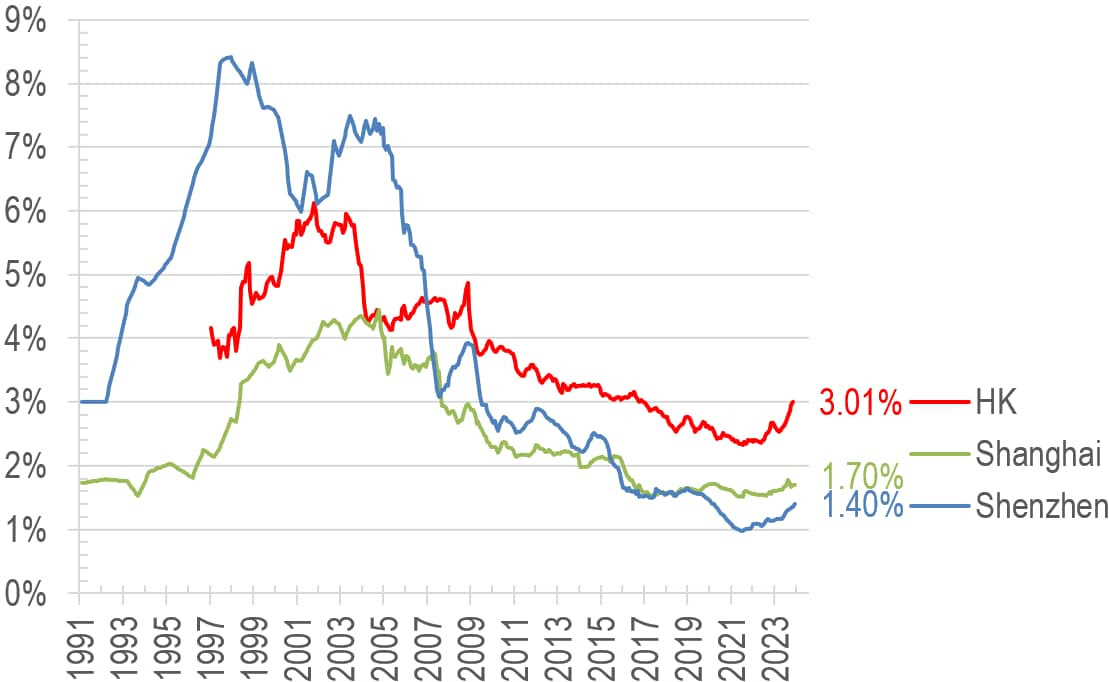
The conclusion of this rate trend divergence is best illustrated in the chart below:  Whenever HK rates hike less than PRC rates (green arrows pointing up, eg 1992, 2006), HK prices tend to rise much faster (red arrows up). The reverse is the case when HK rates rises more above PRC rates - which is where we are now - prices underperform SZ (eg 1996, 2013 to date). With the rate picture increasingly looking like HK rates staying high while China cuts further in the coming year (rightmost green arrow above), HK residential premium over SZ will likely shrink further in the coming two years. 4) Facilitating Southbound flows (good) The HK govt has been tapping into the rise in PRC wealth and talent by attracting them to settle in HK (article 2), but this is not radically different from some other immigration schemes already in place, and perhaps does not have as strong an impact as in earlier years. Similarly, attracting more southbound shoppers is nearing its potential (we already have 49 cities on easy travel arrangements, see article 4), and thus will unlikely result in any quantum leaps with further relaxations. 5) Higher SZ base good for higher HK too (good) As can be seen below, the premium in HK prices remain quite substantial over SZ for comparable luxury estates (Residence Bel Air in HK vs Seaworld Shuangxi Garden in SZ):  Whilst global comparison suggest that our current 120% premium may be too high - eg NYC Midtown is 50% premium over San Fran, and 63% premium over NYC Downtown - perhaps the shrinkage of the HK-SZ premium is largely done. Hopefully SZ price increases will do most of the catch up work rather than even deeper HK price drops... Looking forward, we think a combination of the two remains the most likely scenario; here the Price-to-income ratio trends suggest that SZ prices will improve by some 12% in the coming year or two whilst HK might see a larger 30% correction. For HK, the bulk of the improvement will have to come in price correction rather than income growth:  6) Yields already safer than many global cities (good) A saving grace for HK at least is that its real property yield is already quite 'reasonable' when viewed in the context of real property returns:  Above table is updated to December, showing that high inflationary pressures in places like Tokyo and London is destroying returns on rentals, whilst both SZ and HK sit reasonably happy in positive territory near the top of the pile. Generally high real return markets are more sustainable pricewise than -ve yielding ones. The higher nominal yield in HK (3%) also means that the higher interest rates here in the longer term will make for a healthier market when SZ's paltry 1.4%:
7) final technical look - SZ might do better medium term? On a long term technical perspective, SZ could continue to play catch up, but we await price action to give the next signal (either pierces the green support or breaks out of the blue resistance) before jumping into investment action. The answer might show itself by as early as mid-2024:
Given various headwinds in primarily geopolitics, perhaps investors are best to diversify into commodities and low conflict risk jurisdictions, exactly what we have been doing for the past 2-3 years... ==================Article 1================== Hong Kong vs Shenzhen: a day of food, drinks, sightseeing and leisure compared – how much cheaper can the mainland Chinese city be?The recent jump in people heading from Hong Kong to Shenzhen at the weekend suggests you can enjoy a lot more for much less in the mainland Chinese city... ==================Article 2================== Facilitation measures on two-way flow of high-end talents within the GBAThe Hong Kong Special Administrative Region Government and Mainland authorities have been exploring means to further facilitate the two-way flow of talents within the GBA, including “northbound” flow of non-Chinese Hong Kong residents.... https://www.info.gov.hk/gia/ ==================Article 3================== China cuts 5-year mortgage rate by record margin to aid property sectorThe People's Bank of China lowered the five-year rate to 3.95%, from 4.2%, marking the first reduction since last June... ==================Article 4================== 消息指中央同意擴大自由行來港 有議員料納入更多二三線城市現僅49個城市居民可自由行來港 部份省份無份原文網址: https://www.hk01.com/article/ English Google translate here. |
2024年2月23日星期五
Will HK fall more than SZ? 20240222




2020年8月21日星期五
Talent attraction – is HK’s work visa scheme up to scratch? 20200821
Posted on 20th August, 2020 Stand News :
With the imposition of national security law in Hong Kong since July, emigration and capital flight have suddenly become hot topics (see our articles here and here). This development makes it even more important for the SAR to attract international talent if the city’s economy is to continue to grow.
We will separately discuss how convoluted the immigration construct in HK has become, but in this first article, we will look in detail at how HK’s work visa scheme could be improved. We will use a close equivalent international regime, namely, that of Australia, for comparison and analysis, given it is now even adopted by the UK for its post-Brexit new work visa arrangements.
Australian scheme much more effective than HK version
Introduced in 2012 July, Australia’s “Skilled Independent Visa (Subclass 189)” (popularly known as the ‘189 visa’) tries to lower entry barriers for talent whose skill set is in short supply within the country. The basic concepts involved in this scheme are: to attract migrants in occupations facing labour shortage, who can make significant contribution to the Australian economy at large and regional development at local levels.
Whereas the 189 visa only made up 21.4% of all visas issued by Australia in 2018-19, the scheme has attracted over 293,000 workers (34% of skills streams of immigrants, and 23% of all immigrants) to Australia since introduced in 2012. Hong Kong’s “Quality Migrant Admission Scheme” (QMAS), first came into effect in 2006, has only ushered in 5,418 individual talent (or 0.89% of all skill schemes, and 0.62% of all immigrants) into the SAR to 2019.
Below, we look into the individual categories which may be improved in the HK scheme to make it more effective in attracting global talent than it currently does.
Upgrade 1: more weighting on productive age groups
In the age factor within the QMAS, people younger than pre-university age can get the maximum points (100% of total, dark green shade, Table 1) even though they may lack any knowledge or skill, compared to 189 visa attributing lower weighting to applicants under 25 (light green shade, Table 1). Reducing weighting of the 18-24 age group further could cut potential resource demand by these young entrants (e.g. on education), unless of course the skills in demand are typically available mostly from within this age group?
|
Table 1: Age Factor – HK emphasise the young and the old more
|

The 189 visa favours old age less – with anyone over 40 getting maximum 50% of maximum points, compared to HK where even by age 50, one can still get 50% of maximum points.
The logic of this skew may be one of economic benefit of 25 years of contribution (assuming retiring at 65) outweighing 15 years of retirement welfare (assuming death at 80) for the Australian system, compared to the HK one with 15 years of contribution vs 15 years of retirement drag. Better experience and connections aside, the potentially increased social burden to the host country argues for reduced weighting in the higher age categories in HK.
Upgrade 2: less emphasis on academic qualifications
Whilst both schemes attribute almost identical weighting to qualifications, HK’s QMAS attach far too great an importance to doctoral degrees, which attracts 57% of maximum points compared to bachelor’s 14% (c. 4.1x! see green and pink shades in Table 2); Australia has a more balanced approach, with 50% vs 38% (1.3x), reflecting perhaps a more practical approach to the job market (even though one could expect Australia as a country needing just as many multi-degree boffins as HK, e.g. in defence, or high academia).
|
Table 2: Academic Qualifications Factor – HK obsession with doctorates?
|

HK’s love affair with brand is also on full display – with QMAS giving 30 extra points to applicants if their degrees are awarded by renowned institutions (meaning top 100 in global rankings), boosting maximum points to 100% of category maximum of 70 points (blue shade in Table 2).
One could well argue that a doctorate in gender studies from Harvard (if it offers such a paper) is less practically useful than a mining engineering bachelor from Curtin University in Australia – which, although ranked 230 overall globally and would not be considered by the HK system, actually is ranked number 2 globally in mining engineering!
Besides, QMAS gives no credit to applicants who gained their degrees from HK’s own universities, while the 189 visa awards an extra 13% bonus for local graduates, plus another 13% if they attended a ‘Regional Australia’ institution (orange shade in Table 2). If QMAS preferred local graduates as applicants, they would integrate into their work and life easier than new arrivals, not to mention the extra economic benefit to the city when the same people first paid for studying in a HK university beforehand – a double win sure?
Upgrade 3: reward local experience
In the work experience category, QMAS favours seniority (rightfully so), but gives no credit to work done within HK. On the other hand, the 189 visa allocates 5 extra points for work experience gained within Australia (Table 3), in accordance with the general policy that hires should be done first from local talent before resorting to overseas recruitment.
|
Table 3: Working Experience Factor – HK favours seniority, Australia prefers local experience
|

Upgrade 4: give bonus for Cantonese proficiency
Having been a bilingual international city for decades, HK’s requirement for either Chinese or English proficiency is understandable (Table 4). However, there is no objective measurement for language abilities in QMAS, compared to the 189 visa scheme, where applicants’ English proficiency can be easily quantified by reference to their IELTS and TOEFL scores.
|
Table 4: Language Proficiency Factor – more objective in Australia
|

Furthermore, the Australian scheme gives extra bonus to ‘community language’ ability, which HK should adopt – e.g., by granting bonus points for Cantonese proficiency, so that candidates with ability to integrate into local society are given more preference.
Upgrade 5: remove children and degree bonuses
QMAS applicants were given credit for attributes that seem irrelevant to their competence as an applicant, for example, a maximum of 10 points (or 4.5% total weighting) are given for accompanying unmarried dependent children (5 points each), whereas the 189 visa does not have such a feature (blue shade in Table 5). There does not appear to be any inherent advantage for favouring an applicant with two children compared to another who does not; we think this feature should be removed from QMAS.
|
Table 5: Family Background Factor – youngsters and degree again feature large in HK
|

Another curious feature in HK is the obsession with degrees – where QMAS grants 5 points (or 2.25% total weighting) to a spouse with degree, the 189 visa is far more practical in adding 5-10 points to partners who are either Australian citizens or meet age/English/skill criteria (orange shade in Table 5).
Upgrade 6: Higher passing threshold, less education weighting
The final area we look at relates to how the various categories fit together in the overall scheme. Here we can see some interesting emphasis differences: HK puts more emphasis on experience (24% vs 15% for Aus) but Australia lets age do the vetting (23% vs 13% in HK), and language is more important in Aus (19% vs 9% for HK), while HK has more other factors (13% vs 4%):
|
Table 6: Point allocation by categories – degrees trumps all for HK
|

However, the much lower pass threshold for QMAS is potentially a problem (36% vs 46%), to the point that just collecting academic degrees gets the applicant nearly 90% of the way towards an visa approval.
We will look into in what proportions different types of visas are granted in HK in a separate article, which throws up even more issues that can be improved. At the end of the day, anyone should be welcome in the city as long as they can afford to stay and contribute, too many pigeon holes with too many rules each could not only deter talents, but also reduce the local competitiveness as the city does not let in the best the world has to offer.
The author would like to thank Cheung Ka Wai of The Chinese University of Hong Kong for assisting in data collection, analysis, and drafting of this article.