顯示包含「deglobalisation」標籤的文章。顯示所有文章

2026年10月12日星期一

Sovereign crisis - France blow out right on cue - chartporn 3


The recent French riots is but the tip of the iceberg in what could spiral out of control in the 2nd largest economy in the EU, as we have aluded to for some time now. The next big crisis will be from sovereign bonds, and France is indeed leading the charge (see here). More graphically, the debt pile is now much higher than even the USSR at the time it broke up:

Europe faltering on all fronts

The woes in Europe does not stop at the English Channel - as indicated in the how HSBC may be caught in a rising tax trap (see Article 7), UK is also facing some severe fiscal challenges and tax hikes may be the only solution, which will surely weaken the tax base even further.

And Germany's continuous decline in manufacturing output (Article 1) could further undermine investor confidence when any bad statistic hits the wires next. All major economies are now in a spiralling interest cycle, and any default by a weak payer could trigger the next contagion:

On top of all this, when more central banks next hike policy rates, the momentum could accelerate in long bond yield increases:

  Fed – further 50bp of Fed hikes expected
  RBA – risk of further tightening this year
  ECB - 25bp hike expected by year end
  BoE – a 25bp hike by year end
  BoC - expect to lift 25bp in both December and March

While some banks may be advocating long bonds at this juncture (below chart shows massive long bets on bonds right now), may be due to myopic focus of very short term trading patterns, the mega multi-decade turning point upon us could swiftly sweep all longs into big losses, so beware of who you listen to...

Other factors to exacerbate rate pressures

There are some truly worrying developments all over the place that suggest inflationary pressures will not ease, for example, Supertanker Rates Soaring To Near Record $1 Million A Day, adding cost of oil and bulk commodities being shipped (Article 2), and even in the US, diesel prices are reaching new highs:

Deglobalisation / trade fragmentation add headwinds

As govts lose people's confidence (eg Scottish, Welsh and Northern Irish leaders meet to plan break-up of United Kingdom, Article 3), separatist movements is now clearly on the march, increasing trade and investment friction, further adding to inflationary pressures. The next one to watch will be the Alberta vote to leave Canada:

Meanwhile increasing temptation to add sanctions will further disrupt global supply chains, as Trump signed the Russia and Iran Sanctions Bill (Article 4)...

US should be safer, private sector in better shape, but hyperscalers...

Although the US debt situation is severe (most of 2026 rollover is already on short duration, and likely see some coupon inflation soon, see chart below), the likely blow up first shot will be fired in Europe or Japan, or some other fringe economies.

We continue to see the pandemic to be centred on public sector, as for the first time in the past 70 years, govt debt is by far the biggest elephant in the room:

Also worth staying vigilant is how the new bubble of AI may be pricked given how extended the euphorial rises have become, and of course with it all the hundreds of billions of AI related debt issued of late:

Risk of false flags rising

When govts lose control, the temptation rises to create false flags to divert attention to 'external enemies'; the institution of emergency conditions may also conveniently defer or cancel elections in which current politicians in power could dodge the unavoidable losses facing them. The telltail signs are now becoming quite obvious:

- Poland's prime minister warns of Russian 'accidental' attacks on Ukraine's allies (Article 5);

- Moscow Sends Nuclear Warning to NATO as Tensions Rise in the Baltic (Article 6)

So many things can go wrong, and some of them catastrophically... all we can hope is to be prepared and safeguard our own immediate circle of care. Hope our fears of the bad outcomes are overly pessimistic, it still does not make the case for preparation invalid.

---------------------
Article 1: Who backstops the backstop?
https://bondvigilantes.com/blog/2026/09/who-backstops-the-backstop/

Article 2: Mideast Chaos Sends Supertanker Rates Soaring To Near Record $1 Million A Day
https://www.zerohedge.com/energy/mideast-chaos-sends-supertanker-rates-soaring-800000-day

Article 3: Scottish, Welsh and Northern Irish leaders meet to plan break-up of United Kingdom
https://www.telegraph.co.uk/politics/2026/09/13/irish-scots-and-welsh-leaders-meet-to-plot-break-up-uk/

Article 4: Trump Signs Russia and Iran Sanctions Bill
https://www.theepochtimes.com/us/trump-signs-russia-and-iran-sanctions-bill-6089946

Article 5: Poland's prime minister warns of Russian 'accidental' attacks on Ukraine's allies
https://www.npr.org/2026/09/18/nx-s1-5973265/poland-nato-russia

Article 6: Moscow Sends Nuclear Warning to NATO as Tensions Rise in the Baltic
https://www.themoscowtimes.com/2026/09/30/moscow-sends-nuclear-warning-to-nato-as-tensions-rise-in-the-baltic-a93828

Article 7: 滙控恐要進貢倫敦 再非收息首選
https://www.hkej.com/dailynews/article?id=4535013


2026年9月21日星期一

Sovereign bond - crisis chartporn 2!

 Some reader feedback from our last missive - 'I am not as bearish as you' being a common theme. This triggered us to bring out more charts from our extensive collection on the subject.

We are not here to scare, but try to warn so we are all prepared... The above view may be premised on the belief that Central Banks (CB) are able to save the market, again. But the below factors are suggesting that this time may be very different:

1) govt debt levels are already too dangeriously high

Japan debt aside, take another big OECD stalwart, France - its debt has now exploded to such levels that it is approaching Grexit Debt Crisis levels:

The market is now so nervous about it that the spread over the Bund is higher than Grexit times (see Article 3). Of course the debt pile is not just even France's problem alone, the developed market taken together we are at post WW2 highs already:

The comfort and trust in sovereigns back in the early 1900s were premised on debt levels in the 40-60%s, not the 120+% we are sitting at now...

2) weak and fickle holders are all we have left

We showed how even Japan and China were lightening their treasuries load last instalment, what is more scary is how high the govt bond market is now inhabited by ultra-short term holders such as hedge funds:

They would bolt at the first sight of trouble, meanwhile, more prudent central banks continued to amass gold in their vaults, as shown here:

3) wars and trade wars will exacerbate inflation

The marching war drums are getting louder as more European countries plan for compulsory drafting (Article 2). Perhaps it is because of the unstable debt and wilting political support that the politicians will have no alternative but to divert attention abroad. What better excuse than the Russian bogeyman they have been counting on (but disappointed) for so long?

Wars bring more inflation, but even before the bullets fly, trade wars (what we have highlighted as deglobalisation) are already creating price volatility, as seen in the latest round of US-Canadian trade spat:

- Trump ...to ban imports of some motorcycles, dairy and alcohol (Article 5);

- Canada publishes list of US products subject to counter-tariffs effective September 8, 2026 (Article 6).

Under such dysfunctional global economic, geopolitical situation, how could inflation not rise further?

3) issue competition is huge

This cycle is different from past debt crises in the sense that the most powerful, the most loaded up and cash rich companies in the world (ie the hyperscalers, the Mag7s) are competing with sovereigns for the pockets of investors amounting to hundreds of billions of bonds. One estimate puts the 2026 issuance in the long duration space at close to 70% of the size of Treasury issuance:

No wonder the yields are spiking everywhere, here is 10y TB:

​

4) confidence is already lost, we are in finale

We know the market's confidence in the sovereigns are gone when you see rates rise while economic indicators tank - below the blue arrows and red arrows move in lock step in the good old days... until the market realises that bad economy can no longer be saved by rate cuts, and that whatever the CBs do beckons even more selling (and higher yields):

All the theatrics that the govts can throw at the problem (see Bessent's "I am the house now" claim, Article 1) is not going to work, because people see that rotating long duration into bills is akin to taking poison, as the cycle is now out of control:

Whatever short term reprieve will likely be a short opportunity... a bit like Soros adding his bets everytime the UK asserted that the pound was safe.

Why the private sector is safe this time?

Because this time the crisis is not in the corporate or household sector, for example, the US household sector has improved its liability ratios for most of the past 2 decades:

Of course, we need to beware whether these households are overly long on potentially toxic AI investments...

We know that corporate balance sheets are also in sound shape, and that is why in the next debt crisis, it will not be the Corp-less-govt spread blowing out, like in past crises (blue arrows), but could be a complete opposite (red arrow):

Some govts are in much better shape (eg most of Asian jurisdictions), which allows bond issues there to still garner good demand (eg HK's Silver Bond, at 4.25% guaranteed yield, see Article 4). But we know high inflation could clip these what seem to be generous levels, so we would even avoid better quality bonds, and go straight to real hard assets, anything that the bankrupt issuers (including currencies) cannot print...


Article 1: The Treasury Is Now Supporting Its Own Debt Market

https://www.armstrongeconomics.com/armstrongeconomics101/economics/the-treasury-is-now-supporting-its-own-debt-market/


Article 2: Army to mobilise veterans in preparation for war

https://www.telegraph.co.uk/news/2026/09/07/army-to-mobilise-veterans-war-preparation/


Article 3: France’s debt crisis-in-waiting

https://www.ft.com/content/16081c0e-5471-4c00-8b12-29cac20a69d2?syn-25a6b1a6=1


Article 4: The 11th Silver Bond draws record applications in both number and value

https://www.thestandard.com.hk/finance/article/341899/


Article 5: Trump escalates trade war with Canada, moving to ban imports of some motorcycles, dairy and alcohol

https://www.nbcnews.com/business/economy/trump-escalates-trade-war-canada-moving-ban-import-autos-dairy-alcohol-rcna596666


Article 6: List of products from the United States subject to counter-tariffs effective September 8, 2026

https://www.canada.ca/en/department-finance/news/2026/08/list-of-products-from-the-united-states-subject-to-counter-tariffs-effective-september-8-2026.html

2025年4月3日星期四

Macro - Liberation Day winners & losers 20250403

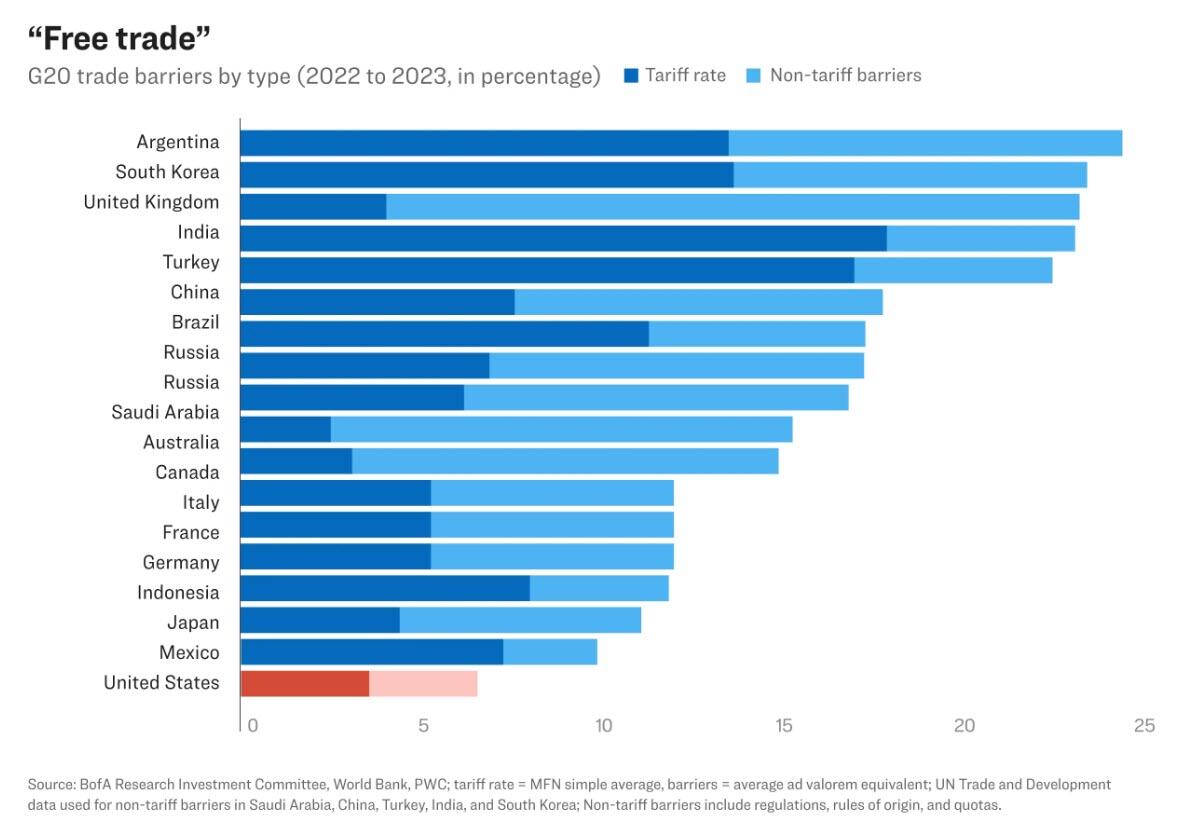
The much awaited 'by country score card' of US tariffs is finally out overnight (see article 1). What is clear is the US's determination to level the playing field, as it has been 'ripped off' by trading partners which have far more punishing trade duties/barriers than US:

The distribution of the tariff rates can be seen from article 1 as well, but here is the global distribution from low tariffs (green) to high (red) - it is obvious that the whole Asian export complex is hit, even US's traditional allies S Korea and Japan:

Most hurt of course are the SEA nations which have received much offshoring and reshoring investment in recent years. But what the currency markets have reflected are positive surprises for Japan and Switzerland (blue circles), while Thailand and S Africa (red circles) may have been more punished than expected:

Whilst not surprising, the US also closed the loop on China's small parcels route to exporting given earlier brief tariff imposition which was quickly reversed. To show how big the Chinese parcel export industry has become, this is an excellent chart:

Yes you got it right, out of top 20 cities that sell on Amazon, only 7 cities are non-Chinese, which take the top 4 spots by a wide margin...

By trade bloc impact assessment

Below we have broken down the impacted nations by trade blocs - OECD (orange), SEA (blue), and N Asia (green):

The key impact columns are 4th from right, indicating which country is hit hardest within that bloc: EU was punished hardest in OECD, while Cambodia/Laos/Vietnam hurt most in SEA, and China/Taiwan both are bruised more than peers.

On a total economic materiality basis (5th column), top 3 hit countries are Cambodia, Vietnam, Taiwan. The latter being the most surprising entry in our study...

Obviously this is just Trump's opening salvo, and as the 'Art of the Deal' requires, give and take will eventually result in a quite different set of results from this announcement. We await the wide ranging negotiations to begin from today... obviously the more flexible the country is in its executive decision making, the quicker they will reduce the impact of these reciprocal tariffs... Our guess is that most SEA nations fall into this category.

​Response above are from these sources:

A) Japan - Seeking exemptions and negotiating with U.S. counterparts.

B) European Union - Postponed counter-tariffs and prefers a negotiation.​

C) Canada and Mexico - Exempt from baseline tariff but concerned about broader impacts.​

D) China - Retaliatory tariffs and suspended export permits for certain U.S. soybean producers.

​​

======================Article 1===================

We now know the full extent of Trump's reciprocal tariffs. They’re huge.

April 3, 2025

“Liberation Day” turned out to be alarming. President Trump floored investors by announcing the largest tax hike on Americans since at least the 1940s.

[...]

The April 2 announcements included two sets of import tariffs. One is a new “universal” tax on imports from everywhere. The average tariff rate on imports at the start of the year was about 2.5%. So the 10% universal tariff on its own would raise the average tariff to 12.5%. That would be the highest since around 1940.

[...]

Americans bought about $3.3 trillion worth of imports in 2024. The tariff rate of about 2.5% yielded a tariff tax bill of about $83 billion. Investing firm Evercore estimates that all the new tariffs combined will push the tax rate on imports to about 29%.

​https://finance.yahoo.com/news/we-now-know-the-full-extent-of-trumps-reciprocal-tariffs-theyre-huge-232020114.html​

======================Article 2===================

Trump signs order that closes duty exemptions for cheap shipments from China

April 3, 2025

[...]

The order says Trump is ending duty-free treatment for the covered goods imported from China and Hong Kong starting at 12:01 a.m. ET (0401 GMT) on May 2, according to a fact sheet provided by the White House.

​https://www.reuters.com/markets/trump-signs-order-that-closes-duty-exemptions-cheap-shipments-china-2025-04-02/​

======================Article 3===================

Morgan Stanley Sees Tough Road for Trump Deals With China, India

[...]

China is the most exposed to these tariffs, followed by India and Vietnam, according to a research note sent to clients on Wednesday. These three countries could also find it more challenging than other economies in the region to sign a pact by April, according to analysts led by Chetan Ahya.

[...]

“President Trump’s focus on fixing the US’ large and persistent trade deficit means that Asia will be exposed,” the analysts wrote, adding that much of the risk to the region’s economies will come not just from the direct hit of the tariffs. “The indirect effects of tariffs matter more – that is, the persistence of trade tensions will weigh on corporate confidence, capex and trade.”

​https://www.msn.com/en-us/money/markets/morgan-stanley-sees-tough-road-for-trump-deals-with-china-india/ar-AA1zqVCf?ocid=EMMX​