顯示包含「hedge」標籤的文章。顯示所有文章

2023年3月17日星期五

Which Alternative to USDC now? 20220314

Following the USDC depegging, triggered by custodian bank bankruptcy, it is opportune to re-examine the quality of stable coins on the market (which we do at least 3 times a year as a matter of course), and the results are summarised in today's missive below...


There are many levels of risks attached to stablecoins, and the table below looks at 3 aspects:

a) how often and how reliable are issuers audited - obviously USDC has the most prestigious auditor in the form of Deloitte, followed by BDO which issues reports on assets for USDT. This is cold comfort however when SVB itself is audited by KPMG, another big-4 firm...

b) how liquid are the asset backing - here USDC does best with almost all collateral in the most liquid category of assets (cash or short term TBs), followed by USDT (only 18% in longer dated TBs), while DAI is mostly in cryptos (but still 64% being USDC backed);

c) who are the custodian banks - here it is very hard to gauge whether bigger banks are better (more liquidity?) or worse (more complex derivatives books?), but since most of the issuers do not disclose this information (the USDC one only came to light following the SVB crisis), there is no easy way to quantify the counterparty risk at all...

For tradfi supporters, USDC still presents the best protection; for crypto maximalists however, DAI could offer a better solution (but needs to rid itself of tradfi backing to be purist - ie use BTC/ETH as asset collaterals rather than USDC/GUSD and the like).


What about hedging with derivatives?

Aside from avoiding volatility by parking in stablecoins, another way might be to buy put options for downside protection. Below we have done a scenario based on today's prices:

Sadly costs are too steep for hedging under normal circumstances - as can be seen in 3rd column above, for at the money hedging, 12-14% of the portfolio needs to be sold to buy the protection...


So we are back to stablecoins then...

As a result, it seems we are stuck with stablecoins for now, and our hope remain that when BTC becomes big and liquid enough to absorb all hedging activities, perhaps we will have a working decentralised and purely crypto based hedge.

Until that day, here is our updated risk metric table - for now USDT and BUSD seem to be better scoring given the high volatility seen in USDC in the past few days:
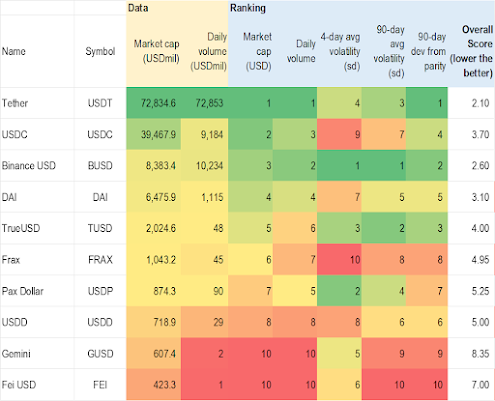
When combined by the qualitative factors discussed in the earlier sections, we will stick with USDC for now...

With the crisis now seemingly over, we are seeing all USDC trading pairs on the larger DEX platforms back to normal behaviour, eg:

Here are not small U$120k trade vs WBTC is attracting only a price impact of 0.24% on one of the several side chain pools. Hail decentralisation!

As we commented earlier also, the coincidence of crypto banks being brought down almost simultaneously is raising questions elsewhere as to whether the takedowns were coordinated - see article 1 below for more. In the end, just like centralised banks fail while decentralised crypto networks continue unfazed, perhaps this will be the norm years in the future?


-----------------------------------------------------article 1------------------------------------------------------------
Binance’s CZ Speculates a Coordinated Effort to Shut Down Crypto-Friendly Banks is in Play

Vignesh Karunanidhi | March 11, 2023


...Unfortunately, the banking realm took a hit with the fall of Silvergate Bank. The issues also escalated with the recent downfall of the Silicon Valley bank.

...Changpeng Zhao, aka CZ, recently put out a tweet highlighting the recent shutdown of cryptocurrency-friendly banks:

Pure speculation. It almost feels like there is a coordinated effort to shutdown crypto friendly banks.

Result?

Banks are shut down.

Blockchains still running.

— CZ 🔶 Binance (@cz_binance) March 11, 2023


CZ says crypto-friendly banks are being shut down

CZ speculates that it feels like there’s a coordinated effort to shut down crypto-friendly banks. The tweet is a follow-up to the recent downfall of two of the cryptocurrency-friendly banks, Silvergate and Silicon Valley Bank. These two banks had a significant relationship with some of the most prominent cryptocurrency giants. However, the relationship has taken a toll as the banks are no longer in play to provide their services to these cryptocurrency businesses.

Perhaps CZ also highlighted the result of this speculative shutdown of cryptocurrency-friendly banks. He mentioned in his tweet that the banks might be shut down, but the blockchains are still up and running.

One Twitter user commented on the tweet, stating that it’s time to stay united and that only CZ can lead the cryptocurrency community out of this darkness.

However, CZ mentioned that there is no necessity for leaders in a decentralized ecosystem, and he also stressed the fact that it works better without a leader.​


​https://watcher.guru/news/binances-cz-speculates-a-coordinated-effort-to-shut-down-crypto-friendly-banks-is-in-play

2022年10月27日星期四

‘We never lost interest’: Asian family offices buy into crypto 20221027

Your author in media : [FT - ‘We never lost interest’: Asian family offices buy into crypto]

William Langley and Chan Ho-him in Hong Kong, 26 Oct 2022


Family offices in Asia are buying into cryptocurrencies, despite months of market turmoil, as weak returns from their traditional portfolios make digital assets attractive.

The interest from investment managers suggests there are still new buyers of cryptocurrencies such as bitcoin and ether, after a boom in digital asset prices during 2020 and 2021 turned to a bust.

Several family offices and wealthy individuals in Hong Kong said this year’s decline in digital asset prices had to be set against the poor performance of local equity and property markets.

After experiencing volatility in the first half of the year, cryptocurrency prices have recently plateaued, prompting speculation about whether they have bottomed out. Investors said the assets remained an appealing hedge against wider market ructions.

“We never lost interest in [crypto],” said Keith Wong, chief executive of Winland Wealth Management, a Hong Kong-based multifamily office. “We see it as diversification and a separate asset class.”

A survey of 30 family offices and wealthy investors in Hong Kong and Singapore, published by KPMG China and crypto group Aspen Digital on Monday, found that 92 per cent of respondents were interested in digital assets, with 58 per cent already invested and 34 per cent planning to do so.

More than 60 per cent of the respondents were family offices or individuals managing assets worth between $10mn and $500mn, said the report.

Bitcoin, the world’s largest cryptocurrency, has dropped about 70 per cent from its peak in November 2021 and has been trading between $18,000 and $25,000 since June. Ether, the next largest coin by market capitalisation, is down about 60 per cent per cent year to date.

However, Hong Kong’s traditional asset classes have also suffered this year, with the city’s equities underperforming US and European stocks. The benchmark Hang Seng index is down more than 30 per cent this year, hit by geopolitical tensions and repeated Covid-19 lockdowns in mainland China.

The city’s housing market has slumped to its lowest level since the 2008 financial crisis following years of coronavirus restrictions and successive interest rate rises.

“All [my] friends with family offices are saying they have shifted . . . into other things like having an art portfolio . . . and cryptocurrencies as well,” said a wealthy investor in Hong Kong, adding that the property sector had been “really stagnant”.

The focus on family offices comes as crypto companies in Hong Kong are lobbying regulators on licensing requirements that will come into effect in March. The industry fears the rules will preclude access to retail investors.

“For the average high-net-worth individual . . . whatever people recommended in gold, you can chop it in half and allocate half of your precious metal to crypto, because that’s an easy way to hedge,” said Eric Wong, managing director of Bricks and Mortar Management, a Hong Kong-based multifamily office.

Hong Kong-based Raffles Family Office has set up a joint venture with crypto company Huobi Tech to service the “unmet” needs of ultra-wealthy families seeking to invest in digital assets. C Capital, the asset manager founded by Hong Kong tycoon Adrian Cheng, plans to raise about $200mn to invest in blockchain assets over the next 18 months.

Digital assets face a generational divide, advisers said, with crypto companies keen to tap into “old money” from individuals who are more resistant to the new asset class.

“For example . . . the other day I was sitting with a family . . . the parents know nothing about crypto and the kids are asking about it,” said Winland Wealth’s Wong.

In the long run, this intergenerational dynamic will bring more crypto buyers “from the elderly side of the population pyramid”, said Bricks and Mortar’s Wong.


https://www.ft.com/content/5646ce04-ff09-4230-a35b-e46529545a4f

General Disclaimer - where quoted in media reports, your correspondent does not exercise control on editorial policy and therefore what appears in the publication may not coincide, or even rarely, contradict your correspondent's views...