顯示包含「debt default」標籤的文章。顯示所有文章

2023年3月17日星期五

Which Alternative to USDC now? 20220314

Following the USDC depegging, triggered by custodian bank bankruptcy, it is opportune to re-examine the quality of stable coins on the market (which we do at least 3 times a year as a matter of course), and the results are summarised in today's missive below...


There are many levels of risks attached to stablecoins, and the table below looks at 3 aspects:

a) how often and how reliable are issuers audited - obviously USDC has the most prestigious auditor in the form of Deloitte, followed by BDO which issues reports on assets for USDT. This is cold comfort however when SVB itself is audited by KPMG, another big-4 firm...

b) how liquid are the asset backing - here USDC does best with almost all collateral in the most liquid category of assets (cash or short term TBs), followed by USDT (only 18% in longer dated TBs), while DAI is mostly in cryptos (but still 64% being USDC backed);

c) who are the custodian banks - here it is very hard to gauge whether bigger banks are better (more liquidity?) or worse (more complex derivatives books?), but since most of the issuers do not disclose this information (the USDC one only came to light following the SVB crisis), there is no easy way to quantify the counterparty risk at all...

For tradfi supporters, USDC still presents the best protection; for crypto maximalists however, DAI could offer a better solution (but needs to rid itself of tradfi backing to be purist - ie use BTC/ETH as asset collaterals rather than USDC/GUSD and the like).


What about hedging with derivatives?

Aside from avoiding volatility by parking in stablecoins, another way might be to buy put options for downside protection. Below we have done a scenario based on today's prices:

Sadly costs are too steep for hedging under normal circumstances - as can be seen in 3rd column above, for at the money hedging, 12-14% of the portfolio needs to be sold to buy the protection...


So we are back to stablecoins then...

As a result, it seems we are stuck with stablecoins for now, and our hope remain that when BTC becomes big and liquid enough to absorb all hedging activities, perhaps we will have a working decentralised and purely crypto based hedge.

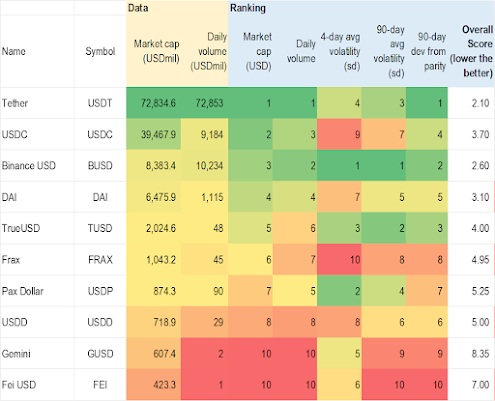
Until that day, here is our updated risk metric table - for now USDT and BUSD seem to be better scoring given the high volatility seen in USDC in the past few days:

When combined by the qualitative factors discussed in the earlier sections, we will stick with USDC for now...

With the crisis now seemingly over, we are seeing all USDC trading pairs on the larger DEX platforms back to normal behaviour, eg:

Here are not small U$120k trade vs WBTC is attracting only a price impact of 0.24% on one of the several side chain pools. Hail decentralisation!

As we commented earlier also, the coincidence of crypto banks being brought down almost simultaneously is raising questions elsewhere as to whether the takedowns were coordinated - see article 1 below for more. In the end, just like centralised banks fail while decentralised crypto networks continue unfazed, perhaps this will be the norm years in the future?


-----------------------------------------------------article 1------------------------------------------------------------
Binance’s CZ Speculates a Coordinated Effort to Shut Down Crypto-Friendly Banks is in Play

Vignesh Karunanidhi | March 11, 2023


...Unfortunately, the banking realm took a hit with the fall of Silvergate Bank. The issues also escalated with the recent downfall of the Silicon Valley bank.

...Changpeng Zhao, aka CZ, recently put out a tweet highlighting the recent shutdown of cryptocurrency-friendly banks:

Pure speculation. It almost feels like there is a coordinated effort to shutdown crypto friendly banks.

Result?

Banks are shut down.

Blockchains still running.

— CZ 🔶 Binance (@cz_binance) March 11, 2023


CZ says crypto-friendly banks are being shut down

CZ speculates that it feels like there’s a coordinated effort to shut down crypto-friendly banks. The tweet is a follow-up to the recent downfall of two of the cryptocurrency-friendly banks, Silvergate and Silicon Valley Bank. These two banks had a significant relationship with some of the most prominent cryptocurrency giants. However, the relationship has taken a toll as the banks are no longer in play to provide their services to these cryptocurrency businesses.

Perhaps CZ also highlighted the result of this speculative shutdown of cryptocurrency-friendly banks. He mentioned in his tweet that the banks might be shut down, but the blockchains are still up and running.

One Twitter user commented on the tweet, stating that it’s time to stay united and that only CZ can lead the cryptocurrency community out of this darkness.

However, CZ mentioned that there is no necessity for leaders in a decentralized ecosystem, and he also stressed the fact that it works better without a leader.​


​https://watcher.guru/news/binances-cz-speculates-a-coordinated-effort-to-shut-down-crypto-friendly-banks-is-in-play

2023年3月16日星期四

USDC depegging crisis - More a Debt/Banking/Liquidity Crisis than a Crypto one 20230313

Given the importance of the subject matter and its ability to impact everyone's financial arrangements in the coming years, we are putting the below internal client communication out in the public domain, hoping to contribute to clarify what actually happened in the liquidity crisis initially couched as a crypto crisis.

----------------------------

The depegging of the USDC stablecoin over the weekend was a big event, as it could have shake the confidence in what is deemed the safest of all the stablecoins. There was quite a roller coaster ride in both USDC and DAI (which holds some USDC as its reserve backing), which now seem to be all good again after govt guarantees were rushed out late Sunday:

USDC touched as low as 0.88 early Saturday

Crypto banks - the Sudden Wipe Out Syndrome?

Whilst it is easy to characterise the incident as another 'nail in the coffin' of cryptos, a look under the hood reveals that this is a banking/liquidity problem - deposit taker (or SVB) going bust and not the stablecoin operator, who has barely jumped ship from another bankrupt bank (i.e. Silvergate Bank) some 10 days ago (see details here)!

What seems odd though is that these close banking allies of the crypto ecosystem seem to be going under eerily close together - Signature Bank also got taken over by the govt (article 1) citing liquidity issues also.

With these entities now killed off in short succession, some in crypto space might question could this be not random occurrences just when govts are starting to launch their own CBDCs (central bank digital currencies)? Without these on/off ramp channels, how could the crypto space continue to grow?

The 4 Hoursemen of debt apocalypse?

Irrespective of what possible coincidences/agenda against the crypto industry may be speculated, what we see in the bigger picture is that we are in the early phase of a bond default crisis that has been decades in the making:

a) ever lower record low interest rates has created bias for buying and holding 'risk free' govt bonds (sometimes mandatory, eg pension funds) that have now become toxic, especially long dated ones, thanks to the 4 massive negatives (you may call them the 4 horsemen of bond demise) that will keep bonds risky:

1) record govt debts are driving risk premium up and will keep worsening as rates increase;

2) geopolitical separation will drive deglobalisation for years to come (so no more cheap goods, which will get dearer for years to come),

3) lockdowns and net zero carbon agenda will drive higher energy costs for years to come, rippling into other costs throughout all supply chains; and

4) the war in Ukraine and likely WW3 will worsen both risk premium and supply chain disruptions

b) stuck in old theories, central banks keep hiking rates chasing inflation as it spirals out of control, creating banking/liquidity crises like the one we are seeing now - ie bank/pension balance sheets crash as bond prices collapse - resulting in solvency/liquidity concerns which lead to bank runs.

To understand how bond illiquidity and pervasive govt prescription on risk management has resulted in the mess we are now in, look at Bill Ackman's short diagnosis (article 3) or Dan Lacalle's longer missive (article 2), and finally how mobile banking + instant social media could create flash bank runs at the drop of a hat (article 4).

Seek protection in Anything But Bond/cash?

So we know this debt bust will be inevitable, how can we protect ourselves? There are several levels to position:

1) stay in the best quality and most liquid market, avoid the weaklings (eg most EU bonds/currencies, even JPY /JGBs which will suffer more in rate hike race) vs US - both cash and short dated bills;

2) park money in real assets (property/stocks/ precious metals/ even crypto) - when bond market, many times the size of equities trigger capital flights, the flood will likely be overwhelming, just buy in safe places (eg away from conflicts) or sectors that will not suffer from the cost of capital spike (eg tech);

3) more esoteric but more mobile/ alternative / off-grid assets such as paintings, antiques, etc, here is one chart that illustrates how the trend is very much underway already:

Void in crypto on/off ramping - will be filled soon?

With the pro-crypto banks now decimated, will there be a void now that prevents crypto purchases using fiat, and vice versa? That concern certainly seems valid for now, but could the clampdown be creating opportunities elsewhere, eg by a Middle East state (Dubai), China (very good strategic move if they dared, via the CNY!), that basically allow what may be an irrepressible phenomenon to grow, especially when people generally distrust the potentially tyrannical official imitation (see all the links giving reasons why CBDC will be shunned here) of the same?

Perhaps the Nigerian disastrous CBDC launch is one example:

Nigerians’ Rejection of Their CBDC Is a Cautionary Tale for Other Countries
Digital-Currency Plan Falters as Nigerians Defiant on Crypto

Just like gold's longevity in the age of fiat currencies, crypto will probably become the new digital version of gold in the CBDC dominated future...

-----------------------------------------------------article 1------------------------------------------------------------

Regulators close crypto-focused Signature Bank, citing systemic risk

 MAR 12 20236:24 PM EDT 

U.S. regulators on Sunday shut down New York-based Signature Bank , a big lender in the crypto industry, in a bid to prevent the spreading banking crisis.

“We are also announcing a similar systemic risk exception for Signature Bank, New York, New York, which was closed today by its state chartering authority,” Treasury, Federal Reserve, and FDIC said in a joint statement Sunday evening.

The banking regulators said depositors at Signature Bank will have full access to their deposits, a similar move to ensure depositors at the failed Silicon Valley Bank will get their money back.

...

Signature is one of the main banks to the cryptocurrency industry, the biggest one next to Silvergate, which announced its impending liquidation last week. 

...To stem the damage and stave off a bigger crisis, the Fed and Treasury created an emergency program to backstop deposits at both Signature Bank and Silicon Valley Bank using the Fed’s emergency lending authority.

The FDIC’s deposit insurance fund will be used to cover depositors, many of whom were uninsured due to the $250,000 guarantee on deposits.

https://www.cnbc.com/2023/03/12/regulators-close-new-yorks-signature-bank-citing-systemic-risk.html

-----------------------------------------------------article 2------------------------------------------------------------

Silicon Valley Bank Followed Exactly What Regulation Recommended

12 March, 2023 | Daniel Lacalle

<below are summary points only>

 - The Silicon Valley Bank Collapse Is a Direct Consequence of Loose Monetary Policy

- The demise of the Silicon Valley Bank (SVB) is a classic bank run driven by a liquidity event, but the important lesson for everyone is that the enormity of the unrealized losses and financial hole in the bank’s accounts would have not existed if it were not for ultra-loose monetary policy

 -  the bank’s liquidity event could not have happened without the regulatory and monetary policy incentives to accumulate sovereign debt and mortgage-backed securities.

 - The bank’s assets ...More than 40% were long-dated Treasuries and mortgage-backed securities (MBS). The rest were seemingly world-conquering new tech and venture capital investments.

 - Most of those “low risk” bonds and securities were held to maturity. They were following the mainstream rulebook: Low-risk assets to balance the risk in venture capital investments. 

 - The entire asset base of SVB was one single bet: Low rates and quantitative easing for longer. ...these were the lowest risk assets according to all regulations and, according to the Fed and all mainstream economists, inflation was purely “transitory”, a base-effect anecdote. What could go wrong?

 - Inflation was not transitory and easy money was not endless.

 - Rate hikes happened. And they caught the bank suffering massive losses everywhere. Goodbye bonds and MBS price. Goodbye tech “new paradigm” valuations. And hello panic. A good old bank run, despite the strong recovery of the SVB shares in January. Mark-to-market unrealized losses of $15 billion were almost 100% of the market capitalization of the bank. Wipe out.

- SVB showed how quickly the capital of a bank can dissolve in front of our eyes.

- SVB did exactly what those that blamed the 2008 crisis on “de-regulation” recommended. SVB was a boring and conservative bank that invested the rising deposits in sovereign bonds and mortgage-backed securities and believed that inflation was transitory as everyone except us, the crazy minority, repeated.

 - SVB did nothing but follow regulation and monetary policy incentives and Keynesian economists’ recommendations point by point. SVB was the epitome of mainstream economic thinking. And mainstream killed the tech star.

 - Many will now blame greed, capitalism and lack of regulation but guess what? More regulation would have done nothing because regulation and policy incentivize adding these “low risk” assets. Furthermore, regulation and monetary policy are directly responsible for the tech bubble.

- SVB invested in the entire bubble of everything: Sovereign bonds, MBS and tech. Did they do it because they were stupid or reckless? No. They did it because they perceived that there was exceptionally low to no risk in those assets. No bank accumulates risk in an asset they believe has considerable risk. The only way in which a bank accumulates risk is if they perceive that there is none. Why do they perceive it? Because the government, regulators, central bank, and the experts tell them so. Who will be next?

 - Many will blame everything except the perverse incentives and bubbles created by monetary policy and regulation and will demand rate cuts and quantitative easing to solve the problem. It will only worsen. You do not solve the consequences of a bubble with more bubbles.

https://www.dlacalle.com/en/silicon-valley-bank-followed-exactly-what-regulation-recommended/

-----------------------------------------------------article 3------------------------------------------------------------

Bill Ackman @BillAckman

...Absent @jpmorgan @citi or @BankofAmerica acquiring SVB before the open on Monday, a prospect I believe to be unlikely, or the gov’t guaranteeing all of SVB’s deposits, the giant sucking sound you will hear will be the withdrawal of substantially all uninsured deposits from all but the ‘systemically important banks’ (SIBs). These funds will be transferred to the SIBs, US Treasury (UST) money market funds and short-term UST. There is already pressure to transfer cash to short-term UST and UST money market accounts due to the substantially higher yields available on risk-free UST vs. bank deposits. These withdrawals will drain liquidity from community, regional and other banks and begin the destruction of these important institutions. The increased demand for short-term UST will drive short rates lower complicating the @federalreserve’s efforts to raise rates to slow the economy. Already thousands of the fastest growing, most innovative venture-backed companies in the U.S. will begin to fail to make payroll next week. Had the gov’t stepped in on Friday to guarantee SVB’s deposits (in exchange for penny warrants which would have wiped out the substantial majority of its equity value) this could have been avoided and SVB’s 40-year franchise value could have been preserved and transferred to a new owner in exchange for an equity injection. 

...The gov’t’s approach has guaranteed that more risk will be concentrated in the SIBs at the expense of other banks, which itself creates more systemic risk. For those who make the case that depositors be damned as it would create moral hazard to save them, consider the feasibility of a world where each depositor must do their own credit assessment of the bank they choose to bank with. I am a pretty sophisticated financial analyst and I find most banks to be a black box despite the 1,000s of pages of @SECGov filings available on each bank. SVB’s senior management made a basic mistake. They invested short-term deposits in longer-term, fixed-rate assets. Thereafter short-term rates went up and a bank run ensued. Senior management screwed up and they should lose their jobs. ...

10:38 pm · 11 Mar 2023

-----------------------------------------------------article 4------------------------------------------------------------

Lots of really bad takes about SVB. Let’s try and correct

...

The important question is why so many demanded their money back at once. And I’m not referring to the last two days. I’m asking about the days/weeks leading up to this last two days forcing SVB to sell securities and realize a $1.8B loss, necessitating a capital raise. Why were depositors withdrawing in big enough amounts before Thursday/Friday?

First, welcome to the world of mobile banking. Gone are the frictions of standing in line with tellers instructed to count money slowly. (Media images of lines Friday were largely gawkers)

How did $42 billion get withdrawn Friday alone without thousands in line? Answer, your phone! This is not the Bailey Savings and Loan anymore.

This should scare the hell of bankers and regulators worldwide. The entire $17 trillion deposit base is now on a hair trigger expecting instant liquidity.

Add in social media and millions get a message, like Peter Thiel telling Founders companies to pull out, or Senator Warren gloating that SI went under, and pick up their phone open a Chase account and Venmo-ed their life savings into it in 10 minutes. Instant liquidity (not solvency) crisis with everyone still in bed.

Banking will never be the same.

...

What needs to be done? Two things.

The FDIC needs to raise the deposit insurance ceiling to unlimited as they did this in 2008. Besides $250k is a made up number anyway. So make up a bigger number.

Banks need to get their deposit base to stop figuring out how to buy a 4.5% money market fund. They need to raise the interest rates they pay 3.00% - 3.50%, from 0.50%, immediately. Yes, this will kill bank profitability so expect Bank Execs to balk at doing this.

This way the public gets the message that you money is safe, no matter the bank, or the amount, and the rate paid on your money is at least competitive with other alternatives. So, do nothing.

Otherwise, if we are all waiting for the Fed to START a meeting at 11:30 Monday, hundreds of billions of deposits will have moved by phone and it will be far worse.

https://twitter.com/biancoresearch/status/1634885127179325440

2022年9月20日星期二

Reiterate UK sell – prospects dimming fast 20220920

Since our 13th May bearish call on UK property, things have not improved on any front, and in this report we update some important macro factors that have either added or worsened the property headwinds the UK is facing. We urge investors to speed up their disposals before it is too late to do so.

Several of the key factors impacting the outlook of UK, and in a sense Europe at large, continue to play out and the current lull (helped by both summer warmth and a temporary correction in energy prices) may reverse unexpectedly when winter arrives. Here are what could happen:

  1. Energy starvation undermines livelihoods, triggers civil unrests?

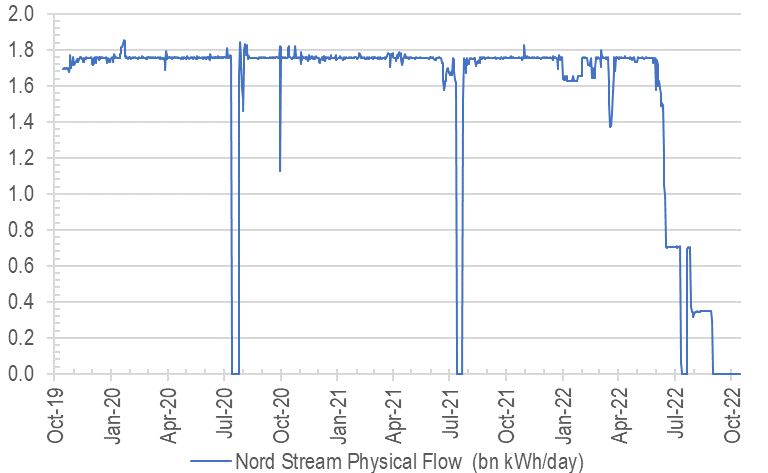
The unfortunate situation Europeans find themselves in can best be described as  a combination of: a) political grandstanding in Ukraine where sanctions beget retaliations (energy & food shortage) from its biggest supplier (Chart 1), while b) the zealous embrace of fundamentalist ‘green’ energy policies without having backup plans worsens the hardship that can potentially explode on to the scene.

Chart 1: Nordstream gas turned off – is it lights out for Europe? Source: Nord Stream AG

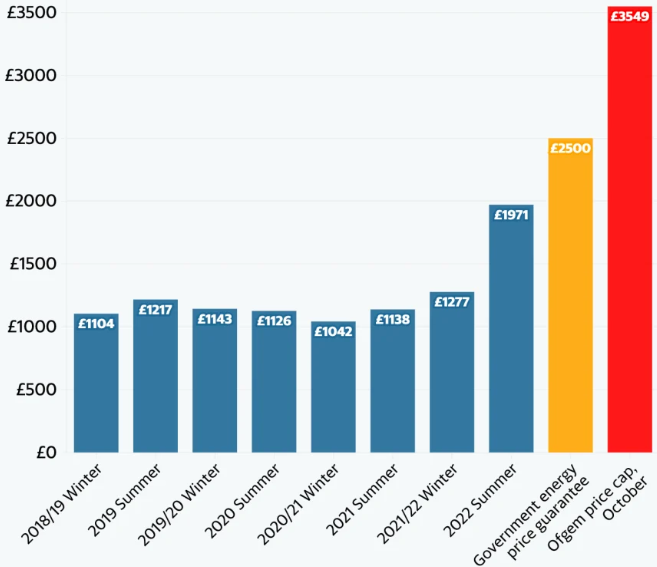
Focusing just in the UK, our subject market, where 40% of electricity is generated from natural gas in 2021, the energy bills for households and businesses are going vertical (Chart 2). An outcome that would have been avoided if the UK did not gleefully hitch the joy ride that expansionist/hawkish US / Nato policies brought about when diplomatic solutions have been in place since 2014 (ie the Minsk Agreement brokered by France and Germany).

Chart 2: UK gas prices tripled vs a year ago

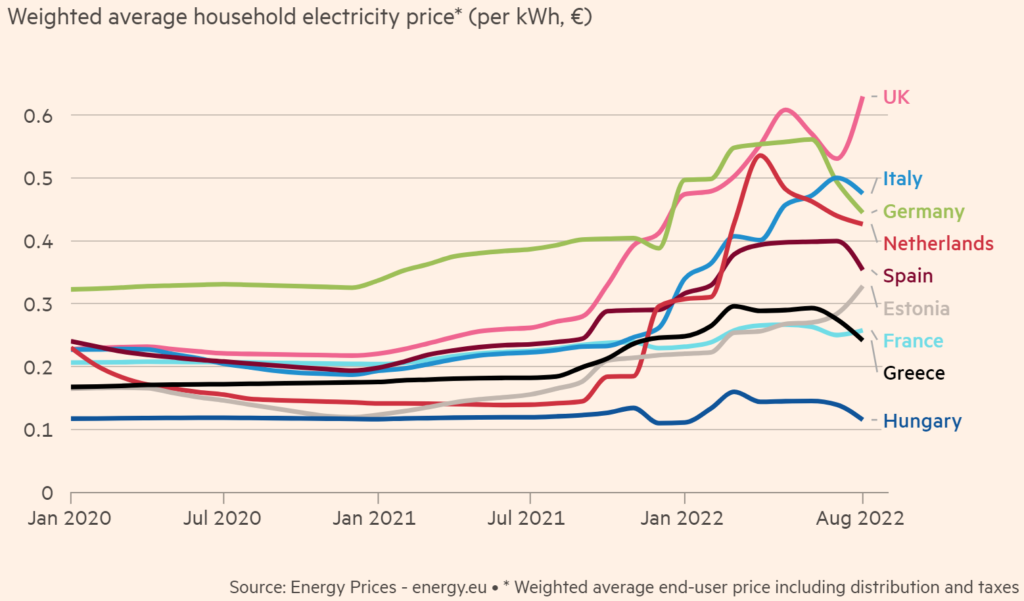
Chart 3: UK electricity price highest in Europe

Now European countries not only have to suffer manufacturing stoppages due to energy shortage, but also issue even more debt to relieve household energy hardships at a time when cost of funds are exploding (more below), all while spend unnecessarily on a costly arms race in an unnecessary war which benefits mostly foreign (ie US) energy and munitions producers. This is as close to a perfect storm as it gets, coming on the heels of devastating lockdowns that has destroyed the SME sector in the past three years and ushered in record high inflations (also expanded later, Chart 3) even before the war began…

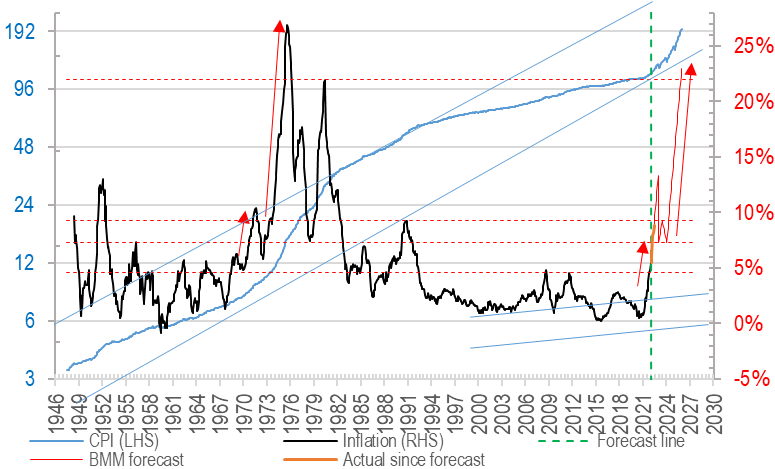
Chart 4: UK inflation: tracking the the crazy 70s inflationary cycle?

2) Interest rates bursting out of CB control

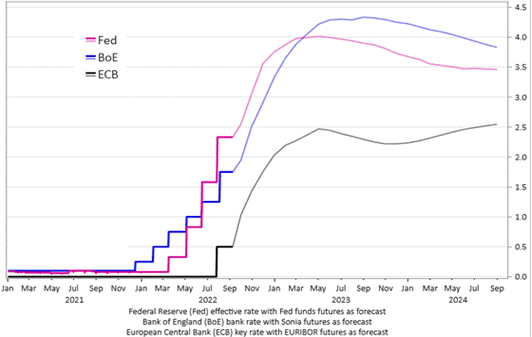
As the Fed aggressively pursues neutralising rates after years of QE, the rest of the world is dragged along with it, with many EM countries flirting (if not already in) double digit interest rates territory. In the UK alone, it is widely expected now some 250bps of hike is on the cards by Q3 2023 (Chart 5), we fear that might appear mild if the sovereign debt crisis worsens.

This will force a repayment crisis for any home owner on high LTVs who will already be seeing their disposable income drop due to high inflation.

Chart 5: Central bank rates in the west projected to hike
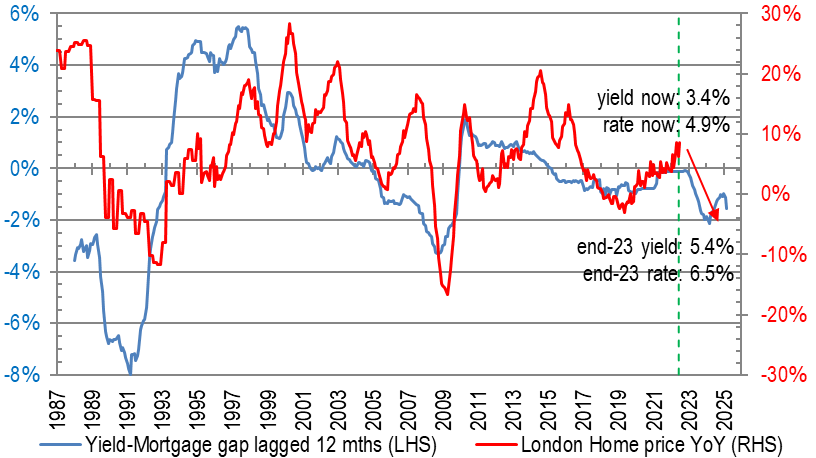
Chart 6: rental yield lagging mortgage – negative for prices

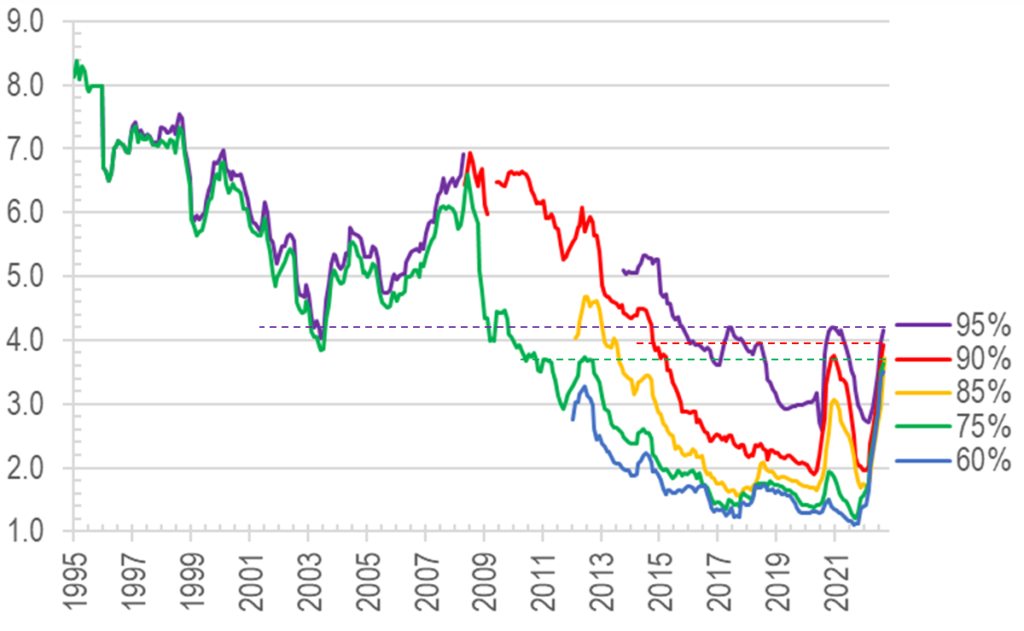
As a result, property yields will have to rise either through big rental hikes (eg in Chart 6 above, c.60% if prices were to stay flat) or some meaningful price corrections heading into 2025. This hike in funding costs will hit even owner occupiers (who may be less concerned with yields discussed just now), as their repayment instalments have only just taken off, and could see multi-decade highs ahead, here is a taste of the rapid ascent and what it looks like:

Chart 7: UK mortgage rates by LTV levels - variously at new highs since 2002-2015

3) Economic shrinkage unavoidable? Unrest/war wildcards on top…

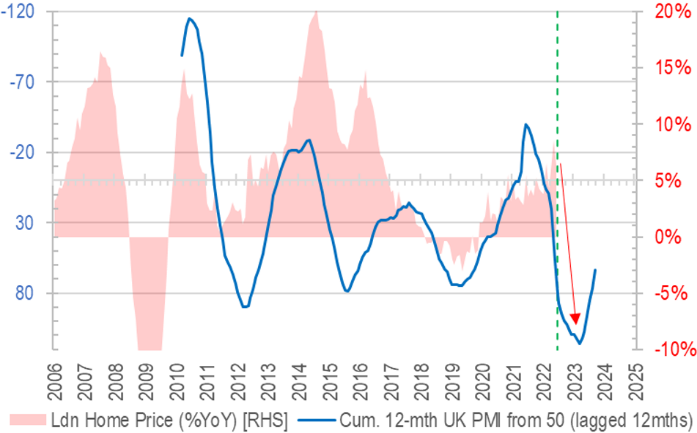
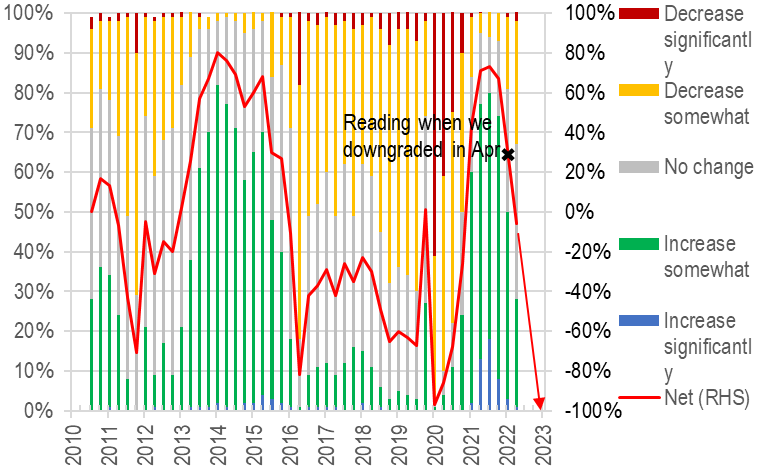
Given the set up of these very unpalatable cocktail, it is unsurprising that our sentiment momentum tracker is suggesting price drops into H2 2023 (Chart 8) and finance directors are getting more bearish (see Chart 9 – again, we expected weaknesses ahead back in May, but this may persist for a few more months to come), which can spell trouble for investments and consumption ahead.

Chart 8: Fast dropping PMI bodes ill for home prices
Chart 9: CFO survey – weak sentiments weakening further

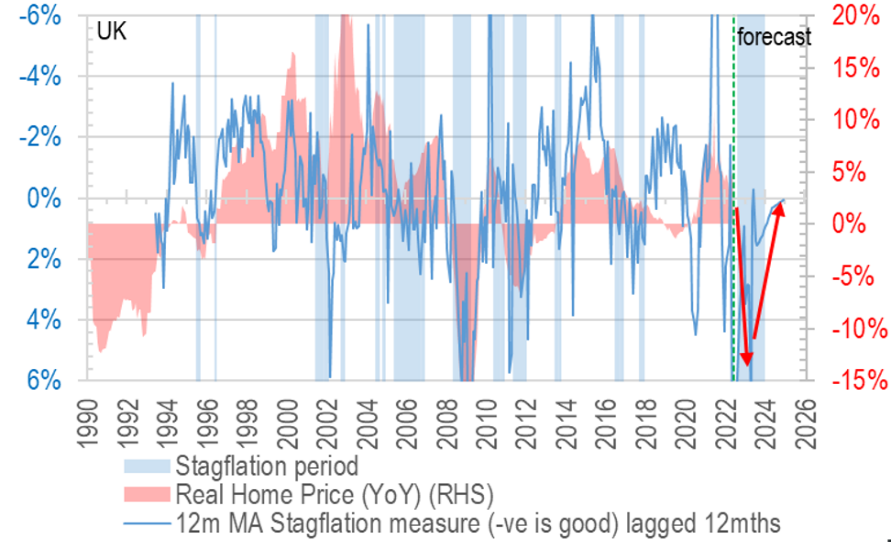
To put all of these indicators on one consolidated view, it is helpful having our ‘stagflation chart’, which encapsulates both the expected weak (if not negative) household income growth and rising unemployment, we see a lot of downside risk indeed:

Chart 10: Stagflation flags point to real home price to fall in 2023-24

4) The weaker the GBP, the more imported inflation – a vicious cycle?

On top of the lacklustre macro picture overall, the currency headwinds are not to be overlooked either – as UK suffers the multiple disadvantages of wrong geopolitics and woke/green misadventures, less investment will head for the British shores, or if there were fleeing EU money, they may bypass the British Isles this time and head straight for the USA instead.

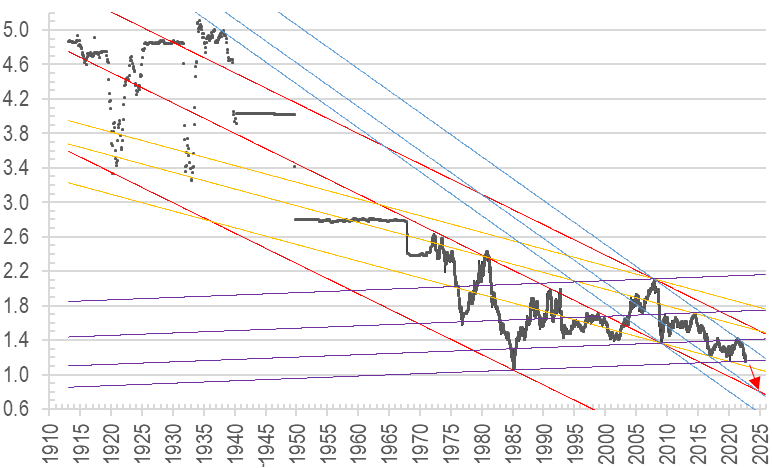
What this means is that, especially for foreign investors (which is everyone buying UK property from HK), more currency losses are possible on top of price drops in local currency terms. In fact latest falls in GBP has broken a long term support level that hs held since the 1980s:

Chart 11: GBP could fall another 25% by 2025 after piercing long term support

With this major technical breach, we could be looking at the pound reaching 80 cents on the dollar within the next two years, or another 25% devaluation. A familiar Christmas carol paints a serene scene like this:

In the bleak mid-winter
Frosty wind made moan;
Earth stood hard as iron,
Water like a stone;
Snow had fallen, snow on snow,
Snow on snow,
In the bleak mid-winter
Long ago.

Let’s hope this scenario does not come true this winter…and the politicians will have the wisdom to reverse so many bad policies that could result in just such a bleak mid winter indeed.

2022年5月13日星期五

UK property – time to sell? [Article 1 of 2] 20220513


UK property – time to sell?

UK has been a good market for many HK investors, especially those who bought after the lows of GFC. Your writer has done even better by focusing on fringe markets which continued rising even when the prime central London sector crashed since its peak in 2014 – some popular development projects there having fallen by as much as 50% since:

Chart 1: prime central London underperformed by 14% since 2014 peak vs Greater London…


But with a plethora of negative factors now taking centre stage politically, economically, climatically, and on valuation grounds, we think the prospect of future rises, let alone outperformance, of the UK property market, is now much dimmed. Below is an extract of a longer piece we sent to clients, some key reasons for our cautious views are as follows:

1) Energy / food / hyperinflation => drop in real income, rise in civil unrest

2) Debt explosion + Rate surge undermining returns

3) Taxes must rise to service the rising rates, unsustainable welfare, and military spending

4) International wars cause capital flights (to US/Asia) and disrupt business

5) Chasing out the rich – the selling has just begun? e.g. Superman Li. The Saudis, Russians, and Chinese may not return if the seizure of private assets continue

6) Regulations Overload is becoming unbearable – for property investors

7) Positive immigration inflows may reverse after Brexit

Below we will look at all these factors in more detail.

1) Massive energy/food inflation drains disposable income, may trigger civil unrest?

The UK/EU construct, being heavily manufacturing and trade dependent, cannot afford to lose reliable and cheap energy imports, which was badly hit by supply shortages following covid lockdowns. This is now worsened as geopolitical tensions explode.

Just about every essential commodity, manufactured good, and service (eg imported labour) is now at critically low levels, stoking massive price hikes sometimes in triple digits. For example: reserves of arabica coffee, the higher-quality bean loved by espresso aficionados, have fallen to their lowest level in 22 years… prices on the ICE futures exchange rallied as high as 2.55 in Q1, up 140 per cent from 2020 lows:

Chart 2: Coffee inventory at multi-decade lows, and could worsen further as fertiliser/transport costs continue spiking

There has been widespread coverage of the energy shortage and price spikes so we will not go into detail here, one example being ominous The Telegraph warning on 18 Nov 2021 – well before even the Ukraine conflict broke out:

We are back to warnings of power rationing and industrial stoppage, a looming disaster for the European Commission and the British government alike

[Gas] Inventories are currently 52pc in Austria, 61pc in Holland, 69pc in Germany at a time of year when they should be near 100pc

Chart 3: UK less affected by Russian imports, but still can’t escape rallying global prices


UK is not as safe as the chart above suggests, as cross-Channel prices move in near lockstep, and the fact that the government allowed storage sites to close means the country may be nakedly exposed with just days of stock.

Further, the Hinkley Point C nuclear power station will not come on stream for another five years at best, and have banned, since 2019, fracking to extract easy oil resources.

Edging private sector to invest in fossil fuels is now more difficult than ever: ten years ago, the "cost of capital" for developing oil and gas was similar to renewable – at between 8% and 10%. Now, the threshold of projected return that can financially justify a new oil project >20% for long-cycle developments, vs renewables falling to 3%-5%, according to Goldman Sachs.

Chart 4: Cost of capital: very costly to start fossil fuels projects due to politics and ‘green imperative’ mentality

Why so high? Simple. Few want to lend to fossil fuel producers as stakeholder capitalism, ESG mandates, and identity politics infest corporate boards.

2) Debt explosion + Rate surge undermining returns

The West has sleep walked into a vicious cycle of:
(a) high welfare =>
(b) higher debt =>
(c) higher taxes when can’t borrow =>
(d) cut interest rates to -VE when can’t raise tax =>
(e) to buy political support, increase welfare (ie back (a))

This trick was easy to pull off from the early 80s when interest rates were as high as 15%, but now with EU at negative rates compounded by massive inflations every way you look, the game is OVER.

A slight increase in rates – when EM countries are now well equipped, after having gone through their own versions of debt crises (eg Asian Financial Crisis) – will cause the West into a painful reverse trade that threatens to rapidly unwind the past 40 years’ profligacy.

In the case of the UK, public debt has gone from 20% of GDP to 100% over 30 years (Chart 5), but all while interest payment fell from 10% of revenue to 3%. All of these are coming to a head now with collapse in confidence in public debt, triggered by govt mandated economic lockdowns, zealous push for green agenda, and now international wars:

Chart 5: UK public debt as post-war highs


Chart 6: Thanks to rate manipulation

The optimistic forecasts of OBR are probably based on low rates, low inflations, and strong growths after coming out of the lockdowns, but all of these assumptions are severely challenged, which could mean a debt explosion from the highest level since the 1960s to much higher levels than forecast below:

Chart 7: UK debt forecast likely too optimistic

Coupled to this the economy destroying zero-carbon ideology feverishly pursued by most of bureaucrats and politicians, the UK could see as much as 60ppts more in debt load in the next 30 years:

Chart 8: Climate change scenarios: public net debt impact by 2050-51

As international interest rates head higher, the ability of the slow growing OECD (mostly EU) to hold down their risk free rates will evaporate, as capital leaves seeking better returns elsewhere – all of this will lead to much higher finance costs for property very soon. The strong inflation backdrop (Chart 9) is also probably grossly under-estimated by the market, where low to mid single digit forecasts are still the norm, when we are already potentially looking at as high as 20%s levels (especially the 70s oil shock pattern repeats):

Chart 9: with war added to the mix of energy + food crisis, we fear UK inflation could reach double digits soon


Chart 10: Fed projected to hike 300+bps in next 1.5 years

If The Fed’s hike trajectory (300bps in 12 months) is anything to go by, given a weaker GBP (which means more imported inflation) plus higher energy uncertainties compared to continental USA, 400bps+ rate increases are a high probably outcome to us:

Chart 11: yield gap analysis suggests possible price falls 

As a result, even modestly assuming 300bps mortgage rate hike (Chart 11), the low property yields of today will feel a lot of pressure to catch up. Expanding yields mean higher rental growths are needed (69% in above scenario) just to keep prices from falling!

3) Taxes must rise to serve the rising rates, unsustainable welfare, and military spending

Part of the problem of high inflation and high interest rates is the erosion of profits at the corporate level and take-home pays at the individual level. It is no wonder that the government’s own forecast project the highest tax-to-GDP level since WW2 (Chart 12), adding insult to injury after the first two drags on people’s income:

Chart 12: tax take as % of GDP up 8ppts from 80s lows


Chart 13: 2019/20 to 26/27 tax increase by factor

All of this is in addition to the economic rebound nearing its peak, when corporate expansion intensions are starting to reverse:

Chart 14: CFO expansion survey – growth may have peaked

As rates rise, and inflation and tax bite, people’s take-home pay will likely drop, leaving them less money to invest in property, and we expect the record high P/E ratio (home price to earnings) to also turn south (Chart 15), perhaps having first made a dash for new highs by as late as Q3 2022:

Chart 15: Home price to income ratio also may peak by Q3 22

Looking at the complex picture in one condensed chart, we factor in income growth and interest rises against real home prices (ie after inflation) below, we present two possible scenarios:

1)      optimistic outcome where home prices stay unchanged (blue solid line, Chart 16) - the combined effect of inflation and income growth will make home prices a lot more affordable by 2026 (red sold line);

Chart 16: yield gap analysis suggests possible price falls 

2)      but what if the cycle we see in the red line repeats itself, and the red dotted line plays out by 2024 at the 700 reading on the real home valuation index? Such an outcome would require a home price drop of 37%, as represented by the blue dotted line.

The only possibility for home price drops not to happen is if income rises more than inflation (unlikely) and rate hikes are much less forceful than we forecast (also not high chance)…

Although our forecast contains a lot of forward assumptions, what we know for sure also is that the market has been too blasé about how the govts and central banks will be able to keep everything on a steady straight line (very typical mandarin thinking).

In the next instalment
Our discussion will continue in a second piece shortly, in which we will go back to more descriptive mode and go through some of the more real life examples of how and why owning and investing in property in the UK is now much more an uphill struggle compared to the ease it used to be barely 10 years ago... This aspect will very much weigh on the global collective sentiment towards this asset class going forward.


The author would like to thank Benson Kong Yu Chin of The Hong Kong Polytechnic University for assisting in data collection, analysis, and drafting of this article.