顯示包含「2022」標籤的文章。顯示所有文章

2022年11月15日星期二

香港樓市已死?20221115

最近,香港樓價已進入下降周期之說似乎漸成共識,特別是中原指數自2019年起三頂不破而轉頭向下,上周更跌至新低後(見【圖一】中綠線)。至今該指數已由高位累跌12%:

圖一:以不同貨幣計價的樓價指數


但對身處世界各地的投資者來說,回報的計算總是會以本國熟悉的貨幣為計價單位,因此只有當環球大多數投資者以本身角度去量度都同時觀察到樓價下降時,香港樓價進入跌市之判斷才能成為「客觀的共識」。

為確定香港樓價下跌是否真的已成共識(【圖一】似乎暗示時機未到),筆者由以下主要貨幣著手:

一)非美元地區(以美匯指數計價,代表其成份籃子內國家之集體共識;以下簡稱“美指籃子”)

二)歐盟區(以歐元計價);

三)英國(以英鎊計價);和

四)全球的黄金投資者(以金價計價)


港樓對海外投資者而言仍處牛市

從發達經濟體(即美匯指數中六大國貨幣,見【圖三】)角度來看,以港元(【圖二】中藍線)計價之樓價下跌勢頭並未被以美匯指數計價的樓價趨勢(紅線)確認:

圖二:以非美元計價的樓價仍呈上漲趨勢

事實上,以美指籃子計算的價格仍處上升通道,不論是從長期趨勢(綠色虛線)抑或中期走勢(紅色虛線),甚至是更短線的角度(藍色虛線)都可觀察到!這表明,對於經合組織的一般投資者而言,香港房地產仍是一項上升中的資產。

圖三:美匯指數由六種貨幣構成


港樓對歐羅區投資者更顯強勢

對歐元區投資者而言,港樓的上漲勢頭似乎比以美匯指數及港幣計價更加強勁,而過去數月歐元的急跌使以歐元計算的香港樓價在【圖四】中紅色虛線通道內加速上漲: 

圖四:歐羅區投資者可能正目睹香港樓價加速上行


英國投資者亦見升勢?

同樣,雖然自1981年以來,因美元及英鎊如影隨形而兩個貨幣計價之樓價指數難捨難分,但是自2015年起之英鎊貶值潮導致以其計價之指數開始拋離港元指數,而近期英鎊的急跌,更造就了英國投資者「感覺」香港樓價正在加速上漲的現象!

圖五:英國投資者可能覺得香港樓價正強勁反彈中

自約翰遜執政起的英鎊弱勢(拙劣的脫歐安排及瘋狂的疫下封城政策?)造就了香港資產在疲軟英鎊環境下不斷走強的現象。


黃金是唯一拋離香港房產的貨幣?

對信奉黃金價值的投資者而言,似乎奇蹟出現!以黃金計價的香港樓價,1997年的高峰仍然是未被超越的最高點,意味著從黃金這種貴金屬的角度來看,港樓仍處於一個長線熊市:

圖六:黃金強於港幣,但小幅突破正在發生?

儘管香港樓價指數已經衝破了短線運行通道頂部(【圖六】紅色虛線),但若明年戰爭風險擴大,則黃金可能會重奪主導地位,而以黃金計價的香港樓價亦會逆轉向下。時間會證明一切。


強勢貨幣進口通縮,在萬物騰貴下並非壞事!

在過去40多年的低通脹期内,每當美元疲軟時與美元掛鉤的香港資產通常會走強,如80年代中及2000年早期(見【圖七】)美元弱勢時樓價升勢強勁,反之亦然(主要在90年代後期):

圖七:美元疲軟對房價有利,反之亦然;這次會否一樣?

然而,當下是否會重複類似70至80年代初的強美元環境,令流動性回流美國而產生通貨緊縮?這又與時下超高通脹環境如何互動?今輪美元走強是否是降低「生活成本危機」風險的一個契機?

這是一個非常有趣的議題,在香港短暫的貨幣歷史中肯定是從未見過的…上述研究表明,雖然筆者看跌港幣計價的樓價,但在全球貨幣角度來看,樓市進入熊市之判斷似乎仍言之過早。


筆者特別鳴謝香港大學會計及金融系李旻軒同學協助收集及整理本文相關數據及圖表

2022年10月31日星期一

Is bear market confirmed for HK? 20221031

The observation that HK housing is in a downcycle has become consensus of late, after the CCL reaches a new low last week from the triple top dating as far back as 2019 (see green line in Chart 1). Cumulatively the index is now down 12% from the Aug 2021 high:

Chart 1: Home prices denominated in various currencies

But across the world, investors will always think about returns in their own currencies, and therefore, an 'objective consensus' of a true bear market in any asset price is only formed when the bulk of observers around the world see the same down trend that the base currency investors also sees.

So in order to find out whether the HK home prices are truly in a bear market by consensus (Chart 1 does not seem to suggest that is the case), let's take a look at the index as denominated in a few main jurisdictions:

a) the collective non-USD community (as proxied by DXY);

b) the EU community (as proxied by Euro);

c) the Brits (as proxied by GBP); and

d) gold bugs (as proxied by the price of gold).

HK still in bull market to world at large

From the point of view of the developed world population (as the USD index is represented by six liquid currencies, see Chart 3), however, the drop in HKD (blue line in Chart 2) terms is not corroborated by the price as measured by DXY the USD index:

Chart 2: Home price in non-USD terms still trending up

In fact, the non-USD price index is still very much heading up, from the longer term view (green dotted lines) to medium term view (red dotted lines), to even the shorter term time horizon (blue dotted lines)! What this suggests is that for the average OECD investor, HK property is still a rising asset.


Chart 3: make up of the DXY - 6 currencies

Home prices even more bullish for Europeans

For the average person based in Euro, the upward momentum seems even stronger compared to DXY, and HK prices, thanks to the collapse in Euros in the last few months, seem to be accelerating upwards within the red channel:

Chart 4: Euro investors may see HK prices accelerating upwards

Brits also feel the upturn?

Similarly, with the recent precipitous drop in the value of the Pound, the HK home price index will appear to the average Blighty investor to be positively surging even, after HK first started pulling away from a very correlated pairing between the HKD and GBP denominated indices which pretty much shadowed each other since our data started in 1981:

Chart 5: HK prices look strong to the British Pound investor

The much weaker pound post Boris's premiership (botched Brexit plus zealous lockdowns?) ensures that the weak pound has provided a strong platform for HK assets to appear to go from strength to strength.

Gold the only currency beating HK property?

For those who believe in gold, there is good news - In Gold terms, the 1997 peak remains the unsurprised top for HK home prices, meaning that we may still be in a bear market when measured from the perspective of the precious metal:

Chart 6: Gold strong vs HK, but mini breakout underway?

Even though the price index has broken above a near term trading channel, as indicated by the red arrow in Chart 6, if war does flare up more next year, we think gold might reassert its dominance and the break up could reverse. Time will tell.

Strong currency imports deflation, which is not a bad thing now!

In normal disinflationary times such as most of the past 40+ years, being pegged to the USD is good for HK assets during times of weak USD, as Chart 7 illustrates - weakening or weak USD is generally accompanied by bouts of strong home price increases, and the reverse held true (mostly in the mid/late 90s):

Chart 7: weak USD good for home prices, and vice versa - will it be different this time?

However, could we be in a period similar to the early 70s or early 80s, when strong USD will suck liquidity away from HK and produce deflation? How does this contrast the current super high inflationary environment? Is the strong USD a blessing as it reduces the 'cost of living' crisis that would otherwise hit these shores?

A very interesting dynamic, not seen before in our brief monetary history for sure... The above study shows that, whilst we remain somewhat bearish on the outlook of the HK market, more needs to happen in the global currency markets before it is a true foregone conclusion...


The author would like to thank Lee Man Hin Carson from The University of Hong Kong majoring in Accounting and Finance for assisting in data collection, analysis, and drafting of this article.

2022年10月20日星期四

【施政報告】王震宇 寬免買樓辣稅難吸大量海外專才 20221020


【Now財經台】《施政報告》提出向外來人才退還買樓額外印花稅,不過,未有提及其他樓市「減辣」措施,地產建設商會表示失望。


《施政報告》提出,推出一系列措施更積極搶企業及搶人才。合資格人士在香港住滿7年並成為永久居民後,可申請為仍持有的物業退還已繳付的買家印花稅(BSD)及新住宅印花稅(NRSD)。


以1個樓價1000萬元的住宅物業為例,原本非本地居民須繳交樓價15%的BSD,以及15%的從價印花稅(AVD),涉及300萬元稅款。不過,即日起簽署的買賣協議,當他們成為香港永久居民,只需承擔跟港人一樣,按「第二標準稅率」計算的3.75%印花稅,之前多繳的部分,即約262萬元可申請退回。


地產建設商會對《施政報告》沒有進一步為樓市「減辣」感到失望。


地產建設商會執委會主席梁志堅說:「(政策)幫不到樓市,有些失望。即使有人願意買樓也好,如果要滿7年才退還,即是做了與沒有做沒有太大分別,買樓住照樣要(支付)是完全沒有意思。」


有分析認為,措施不會突然吸引一批人士來港,亦不會影響樓市。


Bricks & Mortar Management主席王震宇說:「很多時過了4、5年後,才會決定考慮成為永久居民,你問很多外籍人士都會這樣回答。這個(政策)只會令到他們來港工作少了1個負面因素而已。」


王震宇認為,除按揭壓力測試,所有妨礙自由市場的樓市「辣招」都應該撤銷。


訪問來源:NowTV【施政報告】

NowTV Chanel 331

特此鳴謝

NowTV 記者:Sarene Ho

攝影及剪接:NowTV Production Team

請前往作者YouTube頻道觀看更多視頻: 王震宇宇論 Yulun

2022年10月19日星期三

【樓市指南針】施政報告房屋範疇 20221019

 2022年10月13日
【Now財經台】

直播訪問內容:


1. 政府指,為了招攬人才合資格外來人士,在港置業居港七年並成為香港永久性居民後,可就已購入並仍然持有的首個住宅物業申請退還買家印花稅及新住宅印花稅。此政策吸引力如何?

2. 有業內人士指;有關調整稱不上「撤辣」,對其他推行十多年的「辣招」未有鬆綁亦感到失望。你會如何解讀政府維持「辣招」的舉措?

3. 當中有何利弊?是否真的很擔心「撤辣」令樓市升溫?

4. 包括你在內,不少分析已認定樓市處於下行周期。現時「辣招」維持亦未見有其他刺激樓市的政策;你對今年餘下時間及明年樓市前景有何最新看法?整體樓市買賣會否進一步萎縮?

5. 相比中小型住宅,豪宅前景是否更暗淡?

6. 施政報告公布前,元朗有新盤開價見到首批單位折實呎價重返2018年的水平;又提供「漸進式按揭」計劃。你會如何評估發展商短中期的賣樓壓力?推盤及定價策略會有何變化?


訪問來源:

NowTV【樓市指南針】- NowTV Chanel 333 Trading Hour

特此鳴謝

NowTV 記者:Karmen Lee

攝影及剪接:NowTV Ingest & Production Team

請前往作者YouTube頻道觀看更多視頻: 王震宇宇論 Yulun

2022 HK policy address speech - Pro property and pro industrial 20221019

Key points of the policy speech are as follows:

a) all out attracting talent to HK - a must do given the loss of 140k population in the past 2-3 years, this is contained in divider a) below;

b) more drive for family office hub as well as other small measures of business support see divider b);

c) housing bad policy continues - i) plundering private market share with every rising PRH/HOS supply, resulting in every higher private home prices and ever more public housing slaves - what a missed opportunity! ii) displacing brownfields into new built industrial - likely insufficient vs demand; iii) private supply low, but development process shortening. see divider c);

d) major speeding up of infrastructure build out - mostly roads and rails, very positive and lots of opportunities opening up for the smart property investor see divider d).

In summary - talent will not come unless we lift the lockdowns, but otherwise by and large a pro property speech with lots of bright spots, but sadly will not help affordability of housing, which is unsurprising given how entrenched the public-housing vested interest groups is!

below are extracts of the speech, emphasis are mine, with odd comments thrown in:

-----------------------------------------------------a) Talent------------------------------------------------------------

Attract Enterprises, Investment and Talents to Enhance Competitiveness

26. …new institutional setups and implement an array of new initiatives targeted at attracting enterprises, investment and talents:

establish the Office for Attracting Strategic Enterprises (OASES), led by the Financial Secretary, for attracting strategic enterprises …offering them special facilitation measures and one-stop services;

establish the Talents Service Unit, led by the Chief Secretary…formulating strategies to recruit talents;

set up Dedicated Teams for Attracting Businesses and Talents …reach out to target enterprises and talents and persuade them to pursue development in Hong Kong;

set aside $30 billion from the Future Fund to establish the Co-Investment Fund for attracting enterprises to set up operations in Hong Kong and investing in their business;

launch the Top Talent Pass Scheme;

enhance existing talent admission schemes; and

upon becoming permanent residents, apply for a refund of the extra stamp duty paid for purchasing residential property in Hong Kong.

27. The OASES will:

1. draw up a list of target enterprises …to reach out to and carry out negotiations with the enterprises;

2. measures covering aspects such as land, tax and financing that are applicable exclusively to target enterprises, and …tailor-made plans to facilitate the setting up in Hong Kong; and

3. provide the employees …one-stop facilitation services in areas such as visa application and education arrangement for their children.

Trawl for Talents

29. Over the past two years, the local workforce shrank by about 140 000. … We will:

1. launch the Top Talent Pass Scheme for a period of two years. Eligible talents will include individuals whose annual salary reached HK$2.5 million or above in the past year, and individuals graduated from the world's top 100 universities with at least three years of work experience over the past five years. …two-year pass …not subject to any quota. Individuals who graduated from the world's top 100 universities in the past five years and have yet to fulfil the work experience requirement will also be eligible, subject to an annual quota of 10 000;

2. streamline the General Employment Policy (GEP) and the Admission Scheme for Mainland Talents and Professionals (ASMTP), vacancies under the 13 professions in the Talent List with annual salary of HK$2 million or above, employers are not required to provide proof to substantiate their difficulties in local recruitment;

3. suspend the annual quota under the Quality Migrant Admission Scheme (QMAS) for a period of two years;

4. relax the Immigration Arrangements for Non-local Graduates (IANG) by extending the limit of stay from one year to two years …expand to cover the GBA campus of a Hong Kong university on a pilot basis for a period of two years.

5. enhance the Technology Talent Admission Scheme (TechTAS) by lifting the requirement for technology firms to employ additional local employees;

6. extend the limit of stay of employment visas … will be valid for a maximum period of three years; and

7. refund the extra stamp duty …become a permanent resident …can apply for a refund of the Buyer's Stamp Duty and the New Residential Stamp Duty paid for the first residential property purchased which they still own, while the Ad Valorem Stamp Duty at Scale 2 rates is still payable such that the overall stamp duty charged will be on par with that charged on first-time home buyers who are ordinary permanent residents.

30. waive the requirement of applying for an employment visa for more visitors participating in short-term activities in Hong Kong. …will expanding to more categories.

---------------------------------------------------b) Business Freebies--------------------------------------------

International Financial Centre

37. …strengthen asset and risk management – …to offer tax concession for eligible family offices. The target is attracting no less than 200 family offices to establish or expand their operations in Hong Kong by end-2025.

45. support the convention and exhibition (C&E) industry …new $1.4 billion scheme …to subsidise more than 200 exhibitions to be staged in Hong Kong over three years.

46. To provide further support for SMEs, we will:

extend concessions of government fees and charges –reduce 75% of water and sewage charges for non-domestic accounts for eight months from 1 December 2022 to 31 July 2023, subject to a monthly ceiling of $20,000 and $12,500 respectively per household. …provide 75% rental or fee concessions …tenants of government premises and eligible short-term tenancies and waivers under the Lands Department for six months from 1 January 2023 to 30 June 2023.

----------------------------------------c) Housing Madness Continues-----------------------------------------

63. The Steering Committee on Land and Housing Supply and the Task Force on Public Housing Projects …submitted …reports. set the following key strategies and targets:

1. introduce the new Light Public Housing (LPH), with about 30 000 units to be built in the coming five years; [ed: only bureaucrats know how to create more complex structures over already bewildering complicated infrastructure]

2. increase public housing production by about 50% in the coming five years (from 2023-24 to 2027-28);

3. cap the waiting time for PRH immediately. …6 years and shorten it to about 4.5 years in four years' time (i.e. in 2026-27);

4. saleable area of all subsidised sale flats completed from 2026-27 onward will be no less than 26 square metres [ed: public housing becoming ever more luxurious and ever larger – no longer a safety net];

Private Housing Supply

66. …the demand for private housing in the next 10 years will be 129 000 units. …providing no less than 72 000 residential units in the next five years. [ed: private ownership is now an after thought in the bureaucratic housing steam roller]

69. …plan to make available land in Yuen Long and Hung Shui Kiu for development of multi-storey industrial buildings from next year, with lease conditions requiring a certain portion of floor area to be set aside for leasing to the affected brownfield operators below market rent.[ed: supply will be much less than displaced brown field site GFA by far, good for industrial property]

70. Tseung Kwan O (TKO) Area …provide 50 000 residential units with the first population intake in 2030 at the earliest. [ed: not a pleasant district – ultra high density dormitory town]

71. To substantially compress the time required for land production, we will:

1. streamline statutory procedures – …bill to amend the Town Planning Ordinance, the Land Resumption Ordinance, the Foreshore and Sea-bed (Reclamations) Ordinance, the Roads (Works, Use and Compensation) Ordinance and the Railways Ordinance, as well as amendment to the Schedules to the EIA Ordinance …the time required …reduced from at least 6 years to 4 years, …large-scale projects from 13 years to 7 years, of which the time for the EIA process will be compressed to within 18 to 24 months;

2. …charging land premium at standard rates for redevelopment of industrial buildings. …extend this approach, [from] only industrial buildings and in-situ land exchange applications in NDAs, to cover agricultural land in the New Territories located outside NDAs to compress relevant workflow; [ed: will speed up industrial revitalisation speed]

3. …lowering the compulsory sale application thresholds for private buildings aged 50 or above but below 70 from 80% to 70% of ownership, and further to 60% for those aged 70 or above. For industrial buildings in non-industrial zoning, the threshold will be lowered to 70% of ownership for those aged 30 years or above; [ed: great for industrial, bad for minority private ownership rights]

----------------------------------------------------d) Infra Galore-----------------------------------------------------

Drive Development by Transport Infrastructure

76. The six major transport infrastructure projects are:

1. Northern Metropolis Highway – It will facilitate east-west connectivity in the New Territories North between Tin Shui Wai in the west and Kwu Tung North in the east via San Tin;

2. Shatin Bypass – connecting Tai Po and Kowloon West …relieve traffic pressure on Tolo Highway;

3. TKO-Yau Tong Tunnel – …third road tunnel at TKO [for] TKO Area 137;

4. Hong Kong-Shenzhen Western Rail Link – Hung Shui Kiu with Qianhai [ed: long shelved but now back on track];

5. Central Rail Link – …12th railway line will connect Kam Tin in Yuen Long with Kowloon Tong via Kwai Chung, alleviating pressure on the carrying capacity of the Tuen Ma Line; and

6. TKO Line Southern Extension –TKO Line southwards to TKO Area 137,.

77. …Kwu Tung Station of the Northern Link will be commissioned in 2027, …the Tung Chung Line Extension, Oyster Bay Station and Tuen Mun South Extension commencing next year.

78. …projects under planning, including Route 11, Tsing Yi-Lantau Link and Tuen Mun Bypass, as well as improvements to Lion Rock Tunnel. 

2022年10月6日星期四

再論英國樓市 仍見驚濤駭浪 20221006

本文亦於2022年10月6日在【信報】刊登:再論英國樓市 仍見驚濤駭浪

自筆者於5月13日看淡英國樓價以來,基本因素不但不見好轉,更是急轉直下。本文趁更新前篇幾項數據之便,再度呼籲投資者在市況允許之際盡快離場。

當前,影響英國乃至整個歐洲前景的幾個關鍵宏觀因素仍在惡化,但一時的平靜(受惠於夏季溫暖天氣和能源價格暫時調整)隨時會在寒冬降臨時意外地逆轉。以下分析屆時可能發生的情況:

 一)能源緊缺:破壞生計,引發内亂?

當前歐洲所處的窘況可以概括為

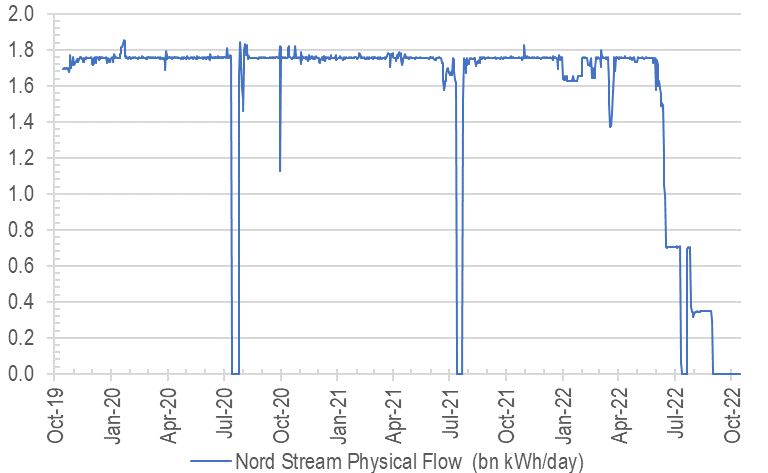
1. 因爲政治性的搖旗吶喊,致使歐洲各國在烏克蘭議題上未經思考便全身投入經濟制裁,結果惹來對方報復,令自己陷入能源和食品短缺危機(見【圖一】俄羅斯斷氣過程);\

2. 在不顧有否足夠後備資源的情況下推出類近原教旨主義性質的「綠色」能源政策,加劇能源短缺危機的殺傷力。

圖一:北溪天然氣管道斷氣,歐洲死火?

資料來源:北溪天然氣管道

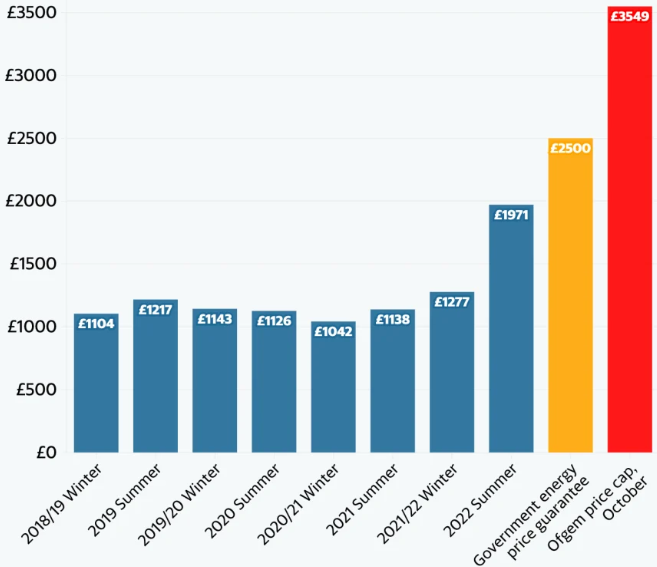
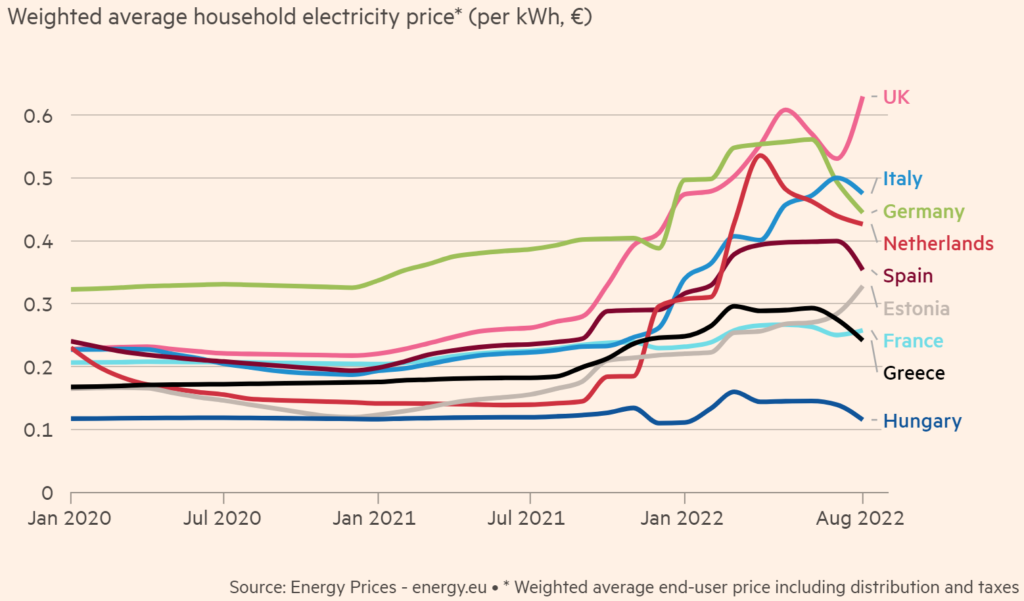
再看英國現況:在2021年,其四成的電力來自天然氣發電,家庭和企業的能源成本亦因此垂直上升【圖二、三】。如果英國沒有一廂情願地栽入美國好戰鷹派政客的雷雷戰鼓,特別是當自2014年來已經有外交劃船下協議的和約(即法國和德國斡旋而簽訂的明斯克協議),當下能源/食物危機是完全可以避免的。

圖二:英國天然氣價格急升兩倍

圖三:英國能源成本全歐最高(家庭平均能源支出€/kwh)

現今歐洲國家不僅要承受因能源短缺所帶來的工業停產,還要在利率爆炸式抽升的情況下,發行更多國債來救濟國民於能源困境(詳見下文)兼從事一場因不必要的戰爭而要進行的代價高昂之軍備競賽——而在這一蚌鶴相爭形勢下唯一得利的就是外國(如美國)的能源和軍火生產商!在過去三年因封關而摧毀了的中小企產能及中產階級財富已經導致創紀錄的高通脹(見【圖四】),現在戰爭的陰影更會將危機重重的歐洲政經形勢推向完美風暴的中心。

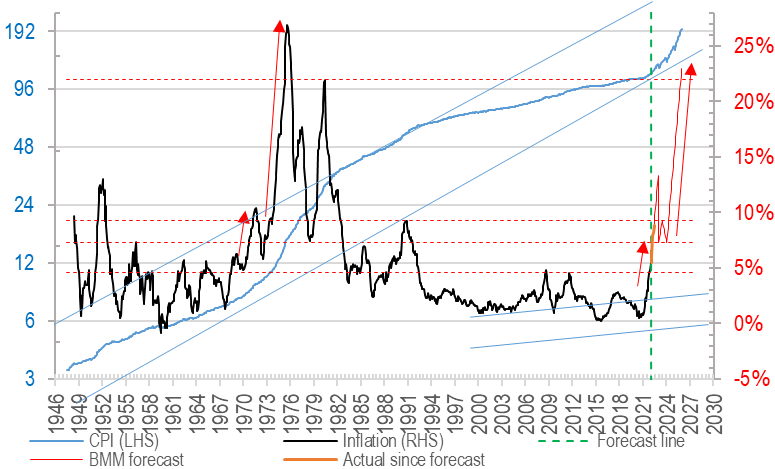
圖四:英國將重演70年代的惡性通脹潮?

二)利率脫韁 央行失控

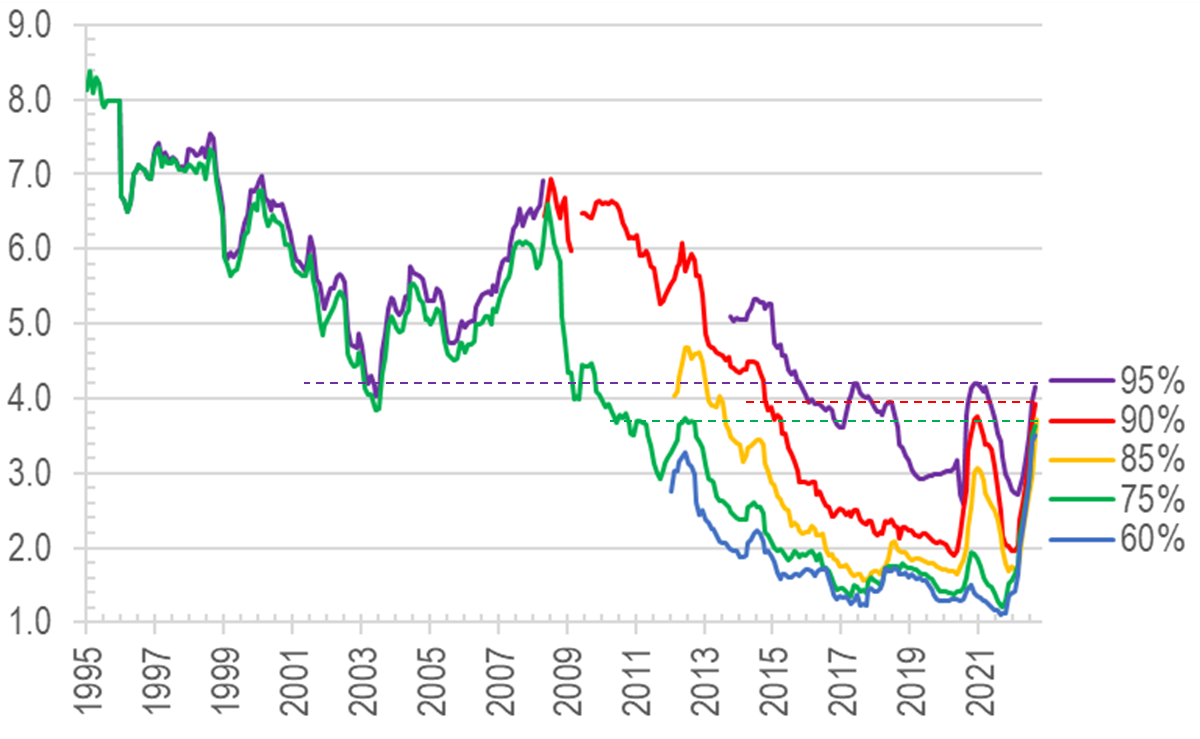
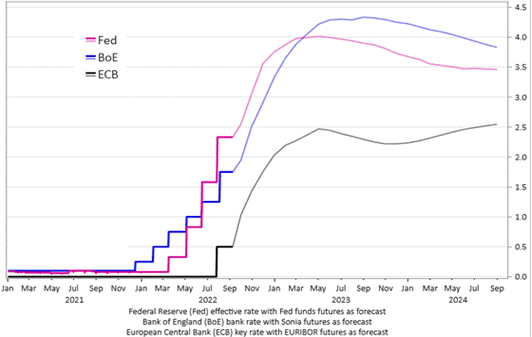
隨著美聯儲在多年的超低息兼量化寬鬆政策後撥亂反正,積極追加利率至合理水平,其他經濟體亦將步其後塵,拼命追趕:許多新興市場甚至已經步入雙位數利率水平。僅在英國,市場普遍預測,至2023年第三季將再加息250個基點【圖五】;唯筆者擔心如果主權債務危機惡化,利率升幅將會大大高於央行預料。

在新的高息環境下,所有高借貸(即按揭成數)的業主將面臨還貸危機,特別是當其可支配收入已被高通脹蠶食殆盡…

圖五:三大央行利率預計將持續飆升

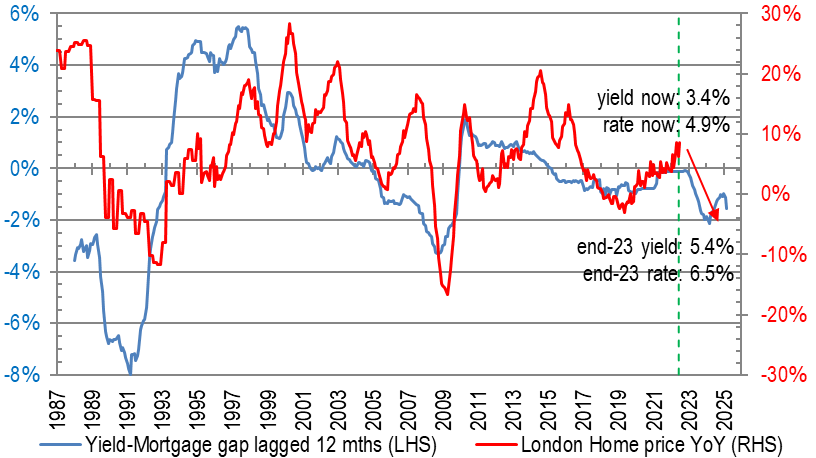
圖六:回報率跑輸利率——不利樓價

有鑑於此,物業回報率必須跟隨利率上調:除非大幅加租(以【圖六】為例,如果價格保持平穩,租金需勁增60%之多),否則在2025年之前樓價唯有大幅下調。高息率當然不會放過自住業主(儘管彼等不會太計較回報率的高低),因為借貸息率才剛剛起步,向數十年來的新高邁進,如下圖所示:

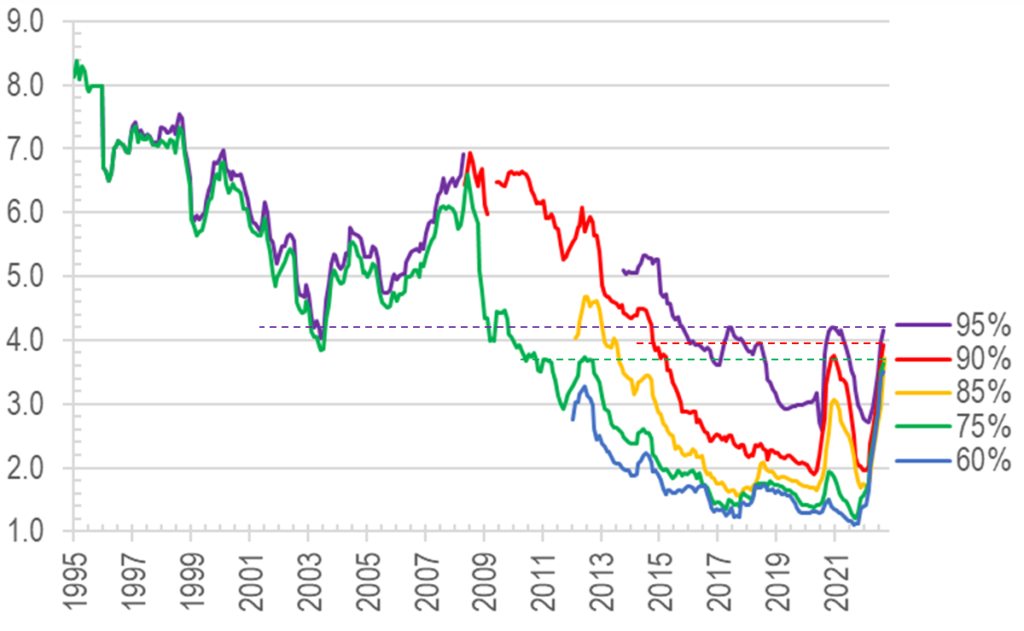
圖七:以成數分類之英國按揭利率:已升達遠至2002年之新高

三)經濟萎縮難免,騷亂戰爭可期…

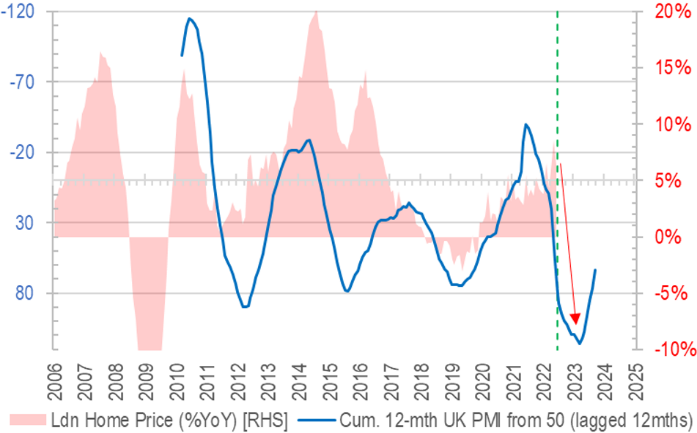
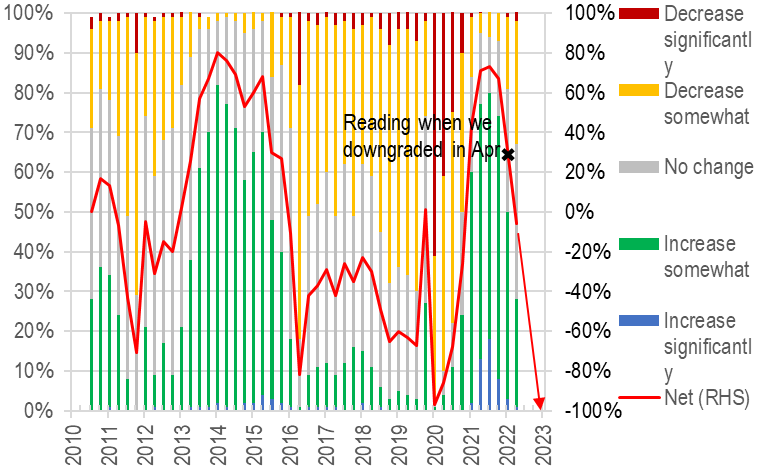
鑑於以上極度不利的整體環境,難怪信心指標正急速下滑,預示樓價將在2023年中前下跌(【圖八】);財務總監信心指標亦同步下跌(見【圖九】,驗證筆者5月之預期,並可能持續多數月),可見未來的投資及消費支出展望會極度嚴峻。

圖八:快速下跌的PMI指數暗示樓價有難

圖九:CFO擴張意向:一蹶不振
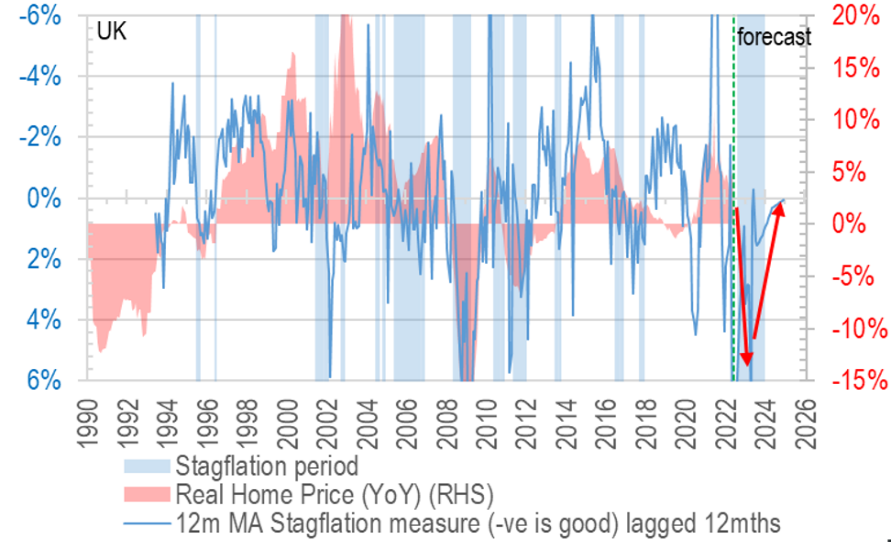
將以上各項因素歸一於單個圖畫,筆者的「滯脹指標」圖表相當有用;該圖包含家庭收入增長和失業率變化等函數,結果對樓價走勢的影響不言而喻:

圖十:滯脹指標預示實質樓價將在2023-24年下跌

四)對外英鎊越弱,輸入通脹越高

除了總體低迷的宏觀形勢之外,貨幣的劣勢也不容忽視——在錯誤的地緣政治博弈、瘋狂的綠色能源政策、和過度政治正確的意識形態夾擊下,英國的投資吸引力正在急速減少。就算有逃離歐盟的資金,亦可能會繞過英倫而直奔美國。

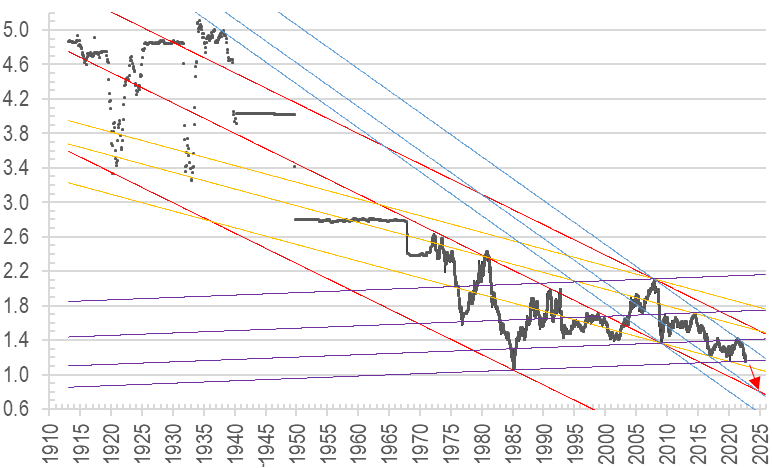
對海外投資者(包括買英國樓的港人)而言,業主不僅要承擔樓價下跌的風險,還要蒙受英鎊貶值的痛苦。而事實上,英鎊最新的匯率已經跌穿了80年代的長綫支持軌再創新低:

圖十一:在下穿長綫支持軌後,英鎊可於2025年時再跌25%
在插穿此重要技術位後英鎊在未來兩年大有機會跌至0.8美元水平,即再貶值25%。如此慘淡場景令人記起一首聖誕歌的歌詞:
In the bleak mid-winter
Frosty wind made moan;
Earth stood hard as iron,
Water like a stone;
Snow had fallen, snow on snow,
Snow on snow,
In the bleak mid-winter
Long ago.

但願上述情況不會在今年冬天發生……而當政者能懸崖勒馬,扭轉眾多劣政,否則一個慘淡的冬天似乎無可避免。

本文早前出版的英文版本可在細閱。

筆者特別鳴謝香港大學經濟及金融系陳海嵐同學協助收集及整理本文相關數據及圖表

2022年9月20日星期二

Reiterate UK sell – prospects dimming fast 20220920

Since our 13th May bearish call on UK property, things have not improved on any front, and in this report we update some important macro factors that have either added or worsened the property headwinds the UK is facing. We urge investors to speed up their disposals before it is too late to do so.

Several of the key factors impacting the outlook of UK, and in a sense Europe at large, continue to play out and the current lull (helped by both summer warmth and a temporary correction in energy prices) may reverse unexpectedly when winter arrives. Here are what could happen:

  1. Energy starvation undermines livelihoods, triggers civil unrests?

The unfortunate situation Europeans find themselves in can best be described as  a combination of: a) political grandstanding in Ukraine where sanctions beget retaliations (energy & food shortage) from its biggest supplier (Chart 1), while b) the zealous embrace of fundamentalist ‘green’ energy policies without having backup plans worsens the hardship that can potentially explode on to the scene.

Chart 1: Nordstream gas turned off – is it lights out for Europe? Source: Nord Stream AG

Focusing just in the UK, our subject market, where 40% of electricity is generated from natural gas in 2021, the energy bills for households and businesses are going vertical (Chart 2). An outcome that would have been avoided if the UK did not gleefully hitch the joy ride that expansionist/hawkish US / Nato policies brought about when diplomatic solutions have been in place since 2014 (ie the Minsk Agreement brokered by France and Germany).

Chart 2: UK gas prices tripled vs a year ago

Chart 3: UK electricity price highest in Europe

Now European countries not only have to suffer manufacturing stoppages due to energy shortage, but also issue even more debt to relieve household energy hardships at a time when cost of funds are exploding (more below), all while spend unnecessarily on a costly arms race in an unnecessary war which benefits mostly foreign (ie US) energy and munitions producers. This is as close to a perfect storm as it gets, coming on the heels of devastating lockdowns that has destroyed the SME sector in the past three years and ushered in record high inflations (also expanded later, Chart 3) even before the war began…

Chart 4: UK inflation: tracking the the crazy 70s inflationary cycle?

2) Interest rates bursting out of CB control

As the Fed aggressively pursues neutralising rates after years of QE, the rest of the world is dragged along with it, with many EM countries flirting (if not already in) double digit interest rates territory. In the UK alone, it is widely expected now some 250bps of hike is on the cards by Q3 2023 (Chart 5), we fear that might appear mild if the sovereign debt crisis worsens.

This will force a repayment crisis for any home owner on high LTVs who will already be seeing their disposable income drop due to high inflation.

Chart 5: Central bank rates in the west projected to hike
Chart 6: rental yield lagging mortgage – negative for prices

As a result, property yields will have to rise either through big rental hikes (eg in Chart 6 above, c.60% if prices were to stay flat) or some meaningful price corrections heading into 2025. This hike in funding costs will hit even owner occupiers (who may be less concerned with yields discussed just now), as their repayment instalments have only just taken off, and could see multi-decade highs ahead, here is a taste of the rapid ascent and what it looks like:

Chart 7: UK mortgage rates by LTV levels - variously at new highs since 2002-2015

3) Economic shrinkage unavoidable? Unrest/war wildcards on top…

Given the set up of these very unpalatable cocktail, it is unsurprising that our sentiment momentum tracker is suggesting price drops into H2 2023 (Chart 8) and finance directors are getting more bearish (see Chart 9 – again, we expected weaknesses ahead back in May, but this may persist for a few more months to come), which can spell trouble for investments and consumption ahead.

Chart 8: Fast dropping PMI bodes ill for home prices
Chart 9: CFO survey – weak sentiments weakening further

To put all of these indicators on one consolidated view, it is helpful having our ‘stagflation chart’, which encapsulates both the expected weak (if not negative) household income growth and rising unemployment, we see a lot of downside risk indeed:

Chart 10: Stagflation flags point to real home price to fall in 2023-24

4) The weaker the GBP, the more imported inflation – a vicious cycle?

On top of the lacklustre macro picture overall, the currency headwinds are not to be overlooked either – as UK suffers the multiple disadvantages of wrong geopolitics and woke/green misadventures, less investment will head for the British shores, or if there were fleeing EU money, they may bypass the British Isles this time and head straight for the USA instead.

What this means is that, especially for foreign investors (which is everyone buying UK property from HK), more currency losses are possible on top of price drops in local currency terms. In fact latest falls in GBP has broken a long term support level that hs held since the 1980s:

Chart 11: GBP could fall another 25% by 2025 after piercing long term support

With this major technical breach, we could be looking at the pound reaching 80 cents on the dollar within the next two years, or another 25% devaluation. A familiar Christmas carol paints a serene scene like this:

In the bleak mid-winter
Frosty wind made moan;
Earth stood hard as iron,
Water like a stone;
Snow had fallen, snow on snow,
Snow on snow,
In the bleak mid-winter
Long ago.

Let’s hope this scenario does not come true this winter…and the politicians will have the wisdom to reverse so many bad policies that could result in just such a bleak mid winter indeed.