顯示包含「restaurant」標籤的文章。顯示所有文章

2024年3月22日星期五

Barbarians at the gates – will mainland eateries flood HK’s F&B scene? 20240322


One of the hottest topics in dinner conversations of late has been Hongkongers shopping or even spending weekends in Shenzhen, even major media channels are reporting the phenomenon (eg. in SCMP and NYT). The scale of the outbound outpouring is not restricted to just Guangdong of course, given how locked down HK has been during 2020-2023, and how strong the HKD has risen against other currencies of late.

This thirst for new and affordable cuisines and services should not have escaped the attention of any ambitious PRC brands – in fact the southbound march has begun in earnest already (as seen in this Singtao piece). We have found some examples of recent PRC brands opening here:

Figure 1: MuWu BBQ

Figure 2: HeFu Noodle


Figure 3: Tai Er Pickled Veg Fish


Figure 4: Tan Yu 


So how big are the potential inroads these Mainland brands can make in HK? We start by looking at a Top 100 PRC Restaurants for 2023, which covers some 219,000 outlets nationally to assess likely impact of shop openings in HK. The top 30 names from the list is shown here alongside their scores and franchise sizes:

Table 1: Top 100 PRC food & beverage brands and their cuisines


Charting food preferences in China

By analysing the breakdown of the top F&B chains into their cuisine and types of foodstuffs, we are able to peer into the modern taste of the Chinese urban population at large.

First, by cuisine, Sichuan cooking has the highest number of chains operating across China (16 of them, followed by beverage brands at 13, see blue bars below):

Chart 1: Top 100 PRC brands/outlets by cuisine 

Sichuan cooking is also the 3rd highest cuisine by number of outlets (orange marks above), closely following beverages at #1 and American at #2.

Together, almost 30% of Top 100 PRC F&B outlets offer Sichuan and Guangdong cuisines. Most surprisingly however, of the 23 cuisines charted above, Shandong and Jiangsu ranked #23 and #19 respectively despite their reputation as part of the ‘eight major cuisines of China’!

Made to order & fast food dominate food types

When it comes to type of foods, it is unsurprising to see people wanting their individual tastes catered for, resulting in cook-to-order (also known as 小菜) chains ranking first by brands (1st blue bar below). We think this more labour intensive way of catering should be dominated mostly by smaller chains in the list, not to mention millions more even smaller eateries not in the top-100 list.

The next biggest entries are all easy to cater, volume business type foodstuffs, such as hotpot, beverages, fastfood, burger, pizza, and the like:

Chart 2: Top 100 PRC brands/outlets by food type – mostly fastfood varieties 

Also unsurprising is how these fastfood outlets – handshake beverage, Chinese fast food, fried chicken, Chinese braised meat (or 滷味) – given the economies of scale due to fast turnover and large volumes came high in the ranking of number of outlets (orange marks above).

Why is Guangdong cuisine so underrepresented?

Despite the freshness, high creativity, and widespread availability around the world, it was surprising for us to note that Guangdong cooking was probably the most underrepresented cuisine in the top-100 list:

Chart 3: Brand % vs outlets % - high penetration from fastfood vs low presence from Guangdong 

In fact, as is clear from the chart above, Guangdong cuisine is the furthest away from trend in relative proportion of branches as well as outlets. This unexpected pattern might be explained by the need to have fresh ingredients many of which from warm climate, and proliferation of seafood dishes which call for proximity to the ocean, and possibility of the more skilled preparations required (eg more frying rather than braising) which limits the availability of proficient cooks being available to staff the kitchens…

Drinks and mass fast food items dominate market shares

In the food type domain, the same factors are at work in deciding which type is abundantly supplied (fastfood category food, see blue labels below) compared to those serving cook to order food (red label) where complexities in diners’ orders results in a smaller number of brands operating but is compensated by higher number of outlets (in fact the highest category by food type):

Chart 4: Brand % vs outlet % - Food Items 


How do Shenzhen and Shanghai measure vs national average?

We next look at how brands enter top cities (we chose Shanghai and Shenzhen) to gauge how each city has its own appetite, as well as if opportunities exist for under served cuisines in these cities.

It is interesting to note that in Shanghai, the over populated brands (red names below) appear to be dominated by listed companies from HK and benefited from easy access to capital market for their expansion plans. On the other hand, the underpenetrated brands tend to be regional brands which may have a lower mind share or ‘prestige’, thus explaining their under penetration in Shanghai (ie population implied outlet numbers are much higher than actual outlets, eg. Shuyi and CHAGEE):

Chart 5: SH - population implied outlets vs actual outlets

The pattern is even more interesting in Shenzhen – the one phenomenon that stands out here is how the city is highly penetrated by local brands and cuisines – Hakka and Guangzhou already point to the geographical proximity of their cuisines, while ZhenGongFu and Muwu are both locally grown brands:

Chart 6: SZ – population implied outlet numbers vs actual


HK to see a torrent of new entrants yet

Set aside the fact that HK may be at equilibrium in its number of F&B outlets, the large number of PRC hopefuls to establish a bridge head here, or simply to use HK as a marketing medium given its international status, should suggest that a large number of the top F&B brands in China will continue to come this way.

So how do we estimate the likely inflows? With Hong Kong and Shanghai both being gateway cities, it may well be a good proxy to use the Shanghai F&B population as a proxy of likely concentration of eateries present there already but not yet entered HK yet. Below is the result of our projections:

Chart 7: SH population implied outlets vs actual numbers in HK

Funnily, the Shanghai concentrations suggest that Café De Coral is over populated in HK, and could be in need of some trimming in numbers. However in its place there are dozens of just the top-100 brands that will want to open up here, as shown by the whole bank of orange marks on the left. All of them, given their own concentration in Shanghai already, should mean hundreds of new arrivals in HK in the months and years ahead – the thinner arrow above suggests each brand with >10 outlets, and those behind the fatter arrow suggests single digit openings.

Applying the SH mix to HK, here is a league table of top brands that need to open shop here:

Chart 8: HK brand potential – most likely entrants and leavers charted 
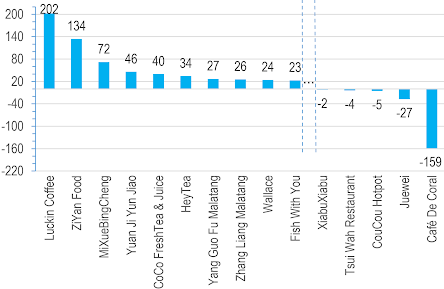
The results are an incredible number of new beverage outlets to come, at roughly 300 stores from the above chart! Factors outside the above quantitative analysis however must be factored in when making predictions, for example, how heavily penetrated are local HK coffee shops already – you can hardly not bump into specialty barista cafes anywhere you go these days, have they already filled the gap of the Luckins of the world? What about the local traditional herbal tea brands that may reduce demand for mass PRC milk tea offerings like HeyTea?

On the flip side of likely inflows, we may have an oversupply of brands in HK such as Juewei which specialises in duck necks (?!), and local champions like Café de Coral may also see leakage of its traditional customer base as the HK product mix enriches with new entrants…

Retail demand from new entrants – not material

So how will this new onslaught of new brand openings in HK bring in terms of new retail floor space demand? Our modelling suggests some 0.55m square feet of new entrants from the top 100 brands, which when benchmarked against HK’s retail stock at 130m square feet, is but a rounding error – or a mere 0.45% boost. It is exciting nevertheless as a consumer to see new offerings which increases shopper choices and introduces new ways of eating/drinking which can only enhance HK’s reputation as a ‘paradise of food’ even further…


The author would like to thank Yeung Ching Wa Oscar from City University of Hong Kong majoring in Finance for assisting in data collection and analysis of this article.

2022年12月16日星期五

Dash to lift lockdowns... at last! 20221216

After vacillating and hiding for far too long behind the rest of the world, the tide of protests finally prompted Chinese authorities to swiftly take down most of its lockdown measures - almost like a domino fall, and it is still in motion by the day.

Good news at last for HK properties as the PRC money and talent starved SAR will finally be able to play its conduit role without which it can hardly be called an international 'anything' centre...

So briefly here are some of the big changes that have been implemented or hinted to be put into effect:

HK relaxations:

  1. LeaveHomeSafe (the identity tracing app) scrapped from 14th Dec - residual restrictions of vax status scan still required to enter dining venues (article 3);
  2. Quarantine-free travel between China and HK from early January - see article 2;
  3. We expect the embarrassing climb down by officials means the vax pass may also be abandoned in Jan, signalling a full return to normal after 3 years of prison like living.

China's “Ten New Measures”:

The measures (details in article 1) came down like a tone of bricks and swiftly swept through China like wild fire from 13 Dec onwards. The impact is jaw dropping in its magnitude and extensiveness, one day after the announcements:

  1. Search volume for air tickets increase by 438% ;
  2. Search volume for air tickets during Chinese New Year increase by more than 5 times;
  3. Search volume for train tickets increase by 276%;
  4. Search volume for train tickets during Chinese New Year increase by nearly 7 times;
  5. Search volume for hotels increase by 7 times
  6. vs a week before, scenic spot ticket sales rose by 59% to 300%

Back to HK, we expect the reopening to finally put a bottom beneath the rental levels of ALL property types, with prices benefitting as well. Take retail for example: 


Assuming PRC visitor numbers return to pre-unrest/pre-lockdown days in the 2017-18 area (blue arrow), we could safely project F&B value to go up 24% from here (or combined 12% to mid-23 (lower red arrow) and then another 13% to end-24 (upper red arrow)), or if we ignore the events of the past four years and assume the pre crisis trend (red dotted line) will continue, an even larger 51% rise from here (red dotted arrow).

Extending the analysis to retail rents:
It is not difficult to see retail rent will rise some 10% conservatively from here in the next year and half (red arrow), and if a return to trend unfolds, even 23% rise from here over the same period (dotted red arrow). All this is before we factor in the high inflation that is now the norm, which tends to push up rents even when the economy slows...

Now is a good time to lock in your rental agreements (if not already late), before aggressive hikes becomes a norm in the new year?


-----------------------------------------------------article 1------------------------------------------------------------

The “Ten New Measures” have just been released, and the search volume for air tickets has increased by 438% in an instant, and the search volume for hotels on New Year’s Day has increased by 7 times! Searches for air tickets soar to three-year high on the eve of Chinese New Year

December 07, 2022

On December 7, the National Joint Prevention and Control Mechanism issued the “Notice on Further Optimizing and Implementing Prevention and Control Measures for the New Coronary Pneumonia Epidemic”. The notice proposed a total of 10 specific items, including scientifically and accurately dividing risk areas, further optimizing nucleic acid testing, optimizing and adjusting isolation methods, etc....

Optimizing the implementation of the new ten rules for epidemic prevention and control is here! focus

  1. Temporary blockade in various forms shall not be adopted;
  2. No more inspections of nucleic acid test negative certificates and health codes for cross-regional migrants, and no landing inspections; except for nursing homes, welfare homes, medical institutions, childcare institutions, primary and secondary schools and other special places, no nucleic acid test negatives are required proof, without checking the health code;
  3. Asymptomatic infected persons and mild cases who are eligible for home isolation are generally home isolated;
  4. High-risk areas with no new infections for 5 consecutive days should be unblocked in time;
  5. The online and offline purchase of antipyretic, cough, antiviral, cold and other over-the-counter drugs shall not be restricted;
  6. Accelerate the vaccination of the elderly against the new crown virus;
  7. Promote the implementation of hierarchical and classified management;
  8. Non-high-risk areas shall not restrict the movement of people;
  9. It is strictly forbidden to block fire exits, unit doors, and community doors in various ways;
  10. Schools without the epidemic should carry out normal offline teaching activities.

above text from Google Translate, Chinese version: 

-----------------------------------------------------article 2------------------------------------------------------------

Hong Kong to send ‘thousands of officers’ to checkpoints along mainland Chinese border ahead of shift towards freer travel

Cannix Yau and Clifford Lo | 16 Dec, 2022

...
[quoting key points of the article only]

Sources previously told the Post that the city was set to fully reopen its borders with the mainland and resume the high-speed train service to Guangdong from early next month.

The expected reopening follows the government’s decision to roll back anti-epidemic restrictions, such as easing entry rules for arrivals and no longer relying on the “Leave Home Safe” risk-exposure app, despite a significant increase recently in Hong Kong’s virus caseloads.

Thursday marked the highest number of daily cases since March 18, with health officials reporting 17,080 infections, 831 of which were imported, and 19 additional deaths.

The city’s overall tally stands at 2,307,397 cases and 11,075 related fatalities.

As part of eased restrictions on the mainland, authorities there have introduced measures to facilitate the cross-border flow of people and goods from Hong Kong, including increasing the daily quota for the number of residents allowed to cross from 2,000 to 2,500 on Thursday.

From Monday, mainland authorities have also allowed cross-border truck drivers to collect and deliver goods directly to destinations there without using the designated checkpoints.
...

A third government source said authorities would conduct refresher training for officers, inspect equipment and test computer systems, as well as carry out disinfection of facilities before reopening the checkpoints.
...

A source familiar with the plan to fully reopen the border said Beijing was keen to restore travel by earl He added that the reopening had been planned for a long time but was postponed several times as a result of different circumstances.

...

Hong Kong Railway Employees Union chairman Tam Kin-chiu said the move was subject to government approval but rail staff had already received rosters for both days.


-----------------------------------------------------article 3------------------------------------------------------------

Covid-19: Hong Kong axes app QR scanning to enter venues and lifts some restrictions on arrivals
by HILLARY LEUNG | 13-Dec-2022

While the use of the LeaveHomeSafe app for entering businesses has been scrapped, members of the public must still show their Vaccine Pass. Separately, arrivals will no longer be issued an amber code.

Hong Kong will no longer require members of the public to scan their Covid-19 LeaveHomeSafe app to access restaurants and other businesses starting from Wednesday, though vaccine proof will still be needed.

Arrivals will also not be issued an amber code in their LeaveHomeSafe app, meaning that people will be able to visit restaurants and other businesses during their first three days of landing in Hong Kong. Vaccine proof, several rounds of testing, and a health declaration will still be mandatory to enter the city.

Making the announcement at a press conference on Tuesday, Chief Executive John Lee said the adjustments were based on data and risk assessment.

“The risk of imported cases to Hong Kong is even lower than the risk of getting infected in the community,” Lee said. “Cancelling the amber code [arrangements] will not increase the risk of getting infected locally.”

He added that under the new rules, the LeaveHomeSafe app will only issue two different codes – red for those infected with Covid-19, and blue for those not infected.

The use of the Vaccine Pass, however, will still be required to enter businesses.

...

Residents are still required to wear face masks, including outdoors, and a gathering limit remains in force for groups larger than 12.

Arrivals to the city are also subject to two PCR tests and daily rapid tests for their first five days in the city.

He added that the resumption of “normal travel” with the mainland was “close to [his] heart.”

“I’ll do everything that can facilitate it, but we also must be aware that the decision must similarly be made on the actual situation… but I think that all people want to have as few restrictions as possible,” Lee said.

Hong Kong has seen 2.26 million cases of the virus since the onset of the pandemic, and 10,984 deaths according to the government’s Covid dashboard on Tuesday.