顯示包含「tax」標籤的文章。顯示所有文章

2023年11月28日星期二

HK Petrol Supply should be treated the same as Electricity/Gas 20231128

There is one thing that Hong Kong reigns supreme on global league tables – besides its high academic IB scores or long life expectancy – the city is the world’s most expensive place to buy petrol:

Figure 1: not the right reason to be named world #1?

So just how expensive is the cost of petrol to the citizens living here, and is there something that should be done about this exorbitant cost? Below we delve into the wonderful world of high land costs, oligopolies, and misdirected net zero policies to unravel this unfair set up that is likely hampering business and living costs for all Hongkongers.


Disadvantaging business vs competitors

Naturally when comparing competitiveness with other jurisdictions, we turn to fellow small open economies such as Singapore and Switzerland, while also benchmarking two larger countries for added context. In this exercise we have chosen Japan (for Asia comparison) and USA (for global context):

Chart 1: absolute petrol prices – HK is head and shoulders above rest of world…

Chart 2: we pay almost 3x as much as the average US driver

According to Bloomberg/globalpetrolprices.com data, it is eyewatering how expensive Hong Kong’s petrol cost (U$3.09/litre in Oct 23) is compared to Singapore which comes in at U$2/litre, while Japan sits almost 40% lower than Singapore still at $1.21/litre. But US really rules the roost, where costs are another 12% lower at only U$1.07/litre (Chart 1). To put everything in the context of relative premium to US prices, Singapore is already at a high 92% premium, but Hong Kong for reasons we will look into below, doubles that, coming at a whopping 189% premium (Chart 2) – what is disconcerting is how the HK premium has been very steadily ranging from 150-200% since much of the past 10 years!


Petrol overpriced against premium office rent AND per capita GDP

Is this expensive fuel cost a function of Hong Kong’s high productivity or expensive land costs? Sadly not. When plotted against Grade A office rents of various top financial centres, HK really stands out in how costly its petrol is – to return to the regression norm, the price of petrol needs to plunge some 25% as a minimum:

Chart 3: HK’s high petrol costs not justified even factoring in its expensive office rents (as a cost proxy for businesses)

Maybe Hong Kong’s expensive real estate is a reflection of its underlying economic productivity? So we plotted the petrol costs against per capita GDP also – here the trend shows much tighter clustering around the regression line:

Chart 4: petrol costs unjustifiably high in context of our economic output

Except Hong Kong that is… Being a true outlier, our petrol prices needs to be cut an even bigger magnitude of 45% to be near the global trend line!


A double whammy of govt & big oil plundering?

To properly analyse the phenomenon of high prices, we first look at whether Hong Kong is buying more expensive international oils:

Chart 5: Import price seems to be relatively stable compared to average Brent price (and rightfully so)

It seems the spread of imported petrol over Brent price has been quite stable even though the premium does vary from teens to high 30%s in the period we looked at above. As a result, Brent oil price can be a useful approximation to the cost of gasoline for imports into Hong Kong (in the absence of dedicated granular data series thereon).

Breaking out the retail prices into its key components, we can see once more how much the consumer is being disadvantaged compared to other countries – whilst the American driver pays only 42% of hiss pump cost to the oil company and government (the rest being cost of the underlying oil), Hong Kong drivers fork out 81% in the pump price to government and oil company (Chart 7), a truly exorbitant magnitude indeed:

Chart 6: Breakdown of pump price – HK is shockingly high on tax and fees

Chart 7: The same components in % terms – HK consumers pay dearly above underlying costs

Here HK in absolute terms are even more jaw dropping – but what surprises us most is how large the profit element is that the oil company makes, after the government already takes the biggest tax chunk out of all comparable markets already (Chart 6).

But has it always been like this, or is it something that happened recently? Looking at the past 18 years, the government levy has not moved (despite being one of the highest in the world all that time!), but it is the major spike in oil company profits that has hiked costs to the consumer:

Chart 8: Pump price – the biggest rise were in oil company margins over the past 2 decades

If we indexed the oil company margins against HK property prices it actually came in lower than home prices in the same comparison period, but something funny happened in 2018-9 period to the cost of petrol station land costs (blue line), which rose much much more (perhaps due to a combination of new entrants and the government suspension of new station tenders):

Chart 9: Comparing price of petrol filling stations; margins, and home prices

But in any case, the significant surge in recent years in oil company margins (now well above inflation index) bodes ill for consumer affordability.

Not only was the arbitrary cessation of petrol station roll out harmful to competition, as the number of cars will not stop rising as the economy and population grows in the longer term, the wishful thinking that everything can go from carbon based fuel to electric from now on (which was the basis of ending new petrol station tendering) is both unrealistic and counter-productive:

Chart 10: how likely can HK go from 85% carbon fuel to zero in 20 years? 

The outright plunge by global bureaucrats towards their utopian of zero carbon targets by 2030s will create endless suffering to the people over whom they govern – a glance at the blue areas above shows how overwhelmingly dominant the global economy and people’s livelihoods are powered today by carbon sourced energy.

To impose a planned economy style hard target over the citizenry and deprive them of essential energy (red arrow) will surely return civilisation back to the stone ages – in other words, the impossibility to come up with a substitute energy capacity in such a short span of time (represented by the vertical orange arrow) means the global population, if all following this mad course of action, will be deprived of 85% of their current energy needs…

In view of the above, the HK govt should rapidly reverse its policy and start issuing new petrol station sites without delay – or consumers will continue to suffer.


A new model for petrol station licencing?

Back to the question of affordable fuel for the end user – the traditional way the HK government tenders out station sites has been on a land sale mentality – that is, with a view to selling the site areas to fetch the highest land revenue for the government and not with a purpose of creating a sustainable after market for the masses.

However, if we view petrol as an essential part of people’s daily needs, much like telephone and electricity then why should we not tender petrol stations on a different formula? Whereas the telephone exchanges and electric substations are pretty much given away for free, we submit that petrol stations should also be tendered out based on minimising future fuel costs.

The objective of controlling electricity costs is achieved by the Scheme of Control framework, which is based on return on capital invested. What we should do on petrol stations perhaps, is to have the oil companies bid for each station where the winner of the site is the one that promises the lowest price margins over the prevailing oil price at the time? Not only is this simple formula easy to monitor from an ongoing basis, it introduces a mechanism to drive down long term fuel costs and every economic sector of the society will benefit, rather than just the government’s one off land sale income. Which would you rather trust to keep the spoils from reduced oil company profits – the government or the people? The answer should be beyond dispute…


The author would like to thank Chan Hei Lui Kiandra from The University of Science and Technology majoring in Quantitative Finance for assisting in data collection and analysis of this article.

2023年7月26日星期三

Don’t fall for the fallacy – HK needs a NARROWER tax base

In view of recent reports of HK fiscal deficits, the pundits are yet again out in force, staging the tired chorus (including the organisation never engaged in any profitable enterprise, the IMF) of how HK’s tax take is too volatile and we should reform to ‘broaden the tax base’ and so on and so forth, to the point that even the HKSAR govt has been hypnotised into starting its own initiative looking into this most unsuitable direction to take for an open economy which survives on being a ‘super connector’ (this is the HKSAR’s own term!) of people, goods, capital, and ideas:

Figure 1: resist the temptation Chief Executive Lee, stay narrow and stay competitive

To illustrate the point more explicitly, we have compiled the total number of levies in the key subcategories of taxation for a number of jurisdictions (HK vs Singapore and Switzerland as small open regions, and Australia and UK as traditional OECD large economies). What is clear from the exercise is that the fewer taxes levied in an economy, the higher the economic growth, and vice versa:


We further collected all the government revenue information of the same jurisdictions and put them in the same general groupings but shown in proportion of total revenues.

It is worth quickly explaining what the tax groupings are:

a)     direct taxation on people’s economic activities – ie tax on income, profits & capital gains;

b)     indirect taxes, in the following activity groupings:

  1.  taxes levied on labour market activities (eg payroll taxes, royalties);
  2.  taxes on property transactions (mostly stamp duty and rates);
  3.  taxes on consumption (ie GST, VAT, plus vehicle and insurance taxes);
  4. traditional social engineering levies (the so called sin taxes on gambling, alcohol, tobacco);
  5. new social engineering levies (all the woke and communistic charges that became so popular in recent years, such as climate change tax, carbon credits); and
  6. border related tariffs/duties (besides traditional tariffs we also include airport taxes – essentially a charge on foreign people crossing borders).

We argue below how careful design of tax regimes can serve as important factors in promoting the competitiveness and economic vibrancy of an economy, and how the proportions need to be adjusted as policy priorities that all governments should pay attention to.

Open free economies tax less on income

What jumps out from the charts below are that Hong Kong and Singapore rely on significant land sale revenues (dark red in Charts 1 and 2) as their fiscal income, which helps when both are amongst the most expensive property markets in the world!

Further, HK’s simple and low tax regime as an advantage is also clear – 4 of the tax categories had nil, or near zero incomes, making it low friction for commerce, and less cumbersome administration of the same taxes as would be the case in other countries. Singapore is less simple but still has one near-zero intake category (thankfully the ‘new social engineering’ group).


Finally, both city economies have much lower direct tax takes – with HK at 49% and Singapore an even lower 42% (dark blue area) – thus rewarding work and enterprise more than their bigger competitors:

Chart 1: HK govt income – low on direct taxation

Chart 2: Singapore GST helps reduce other tax burden

In the other extreme, UK’s takes more out of income (66% of tax revenue is from income/profit taxes) than all the jurisdictions in our study; of what is left in the tax payer’s pocket, the UK takes a larger slice through consumption taxes (19.8% of tax take vs Australia’s 11.1%, light green in Chart 4) than the other countries. Besides higher tax on income and consumption, the UK also has the most number of headings under which it taxes its people, making it even more unpalatable for the average wage earning tax payer:

Chart 3: Percentage of Tax Revenue Breakdown in Australia

Chart 4: Percentage of Tax Revenue Breakdown in UK


Isn’t it ironic therefore that the proponents of ‘broader tax base’ are heeding the preachings coming from largely high tax jurisdictions?

Can HK cancel income/profit tax and levy sales tax instead?

The USA did not have income tax until the 16th Amendment was passed in 1913, before that Article 1, Section 9, Clause 4 of the US constitution forbade direct taxation explicitly. The fact that this provision was inserted in Article 1 of the constitution is significant evidence that the founding fathers did not intend the state to infringe on the freedom of the people to generate and keep their own wealth.

HK’s situation is perhaps also conducive to a move away from income taxes – by virtual of its vast trade and re-export flows, immense tariff or sales tax intake could be achieved without burdening either its wage earning population, or profit making enterprises.

The other advantage of a move from income tax to sales tax is the more stable income stream compared to volatile sources such as land sales and even income/profits taxes.

Theoretically speaking, private consumption expenditure, when taxed at a mere 10% tax rate on 80% of total consumption can already generate HK$188billion of revenue (Table 2):

Table 2: Theoretical sales tax collectable for various tax rate scenarios


Table 3: Sales tax at 14% on 80% of consumption more than covers all income tax and corporation tax takes

In other words, Hong Kong can collect enough sales tax with a rate of 13.5% on 80% of private consumption expenditure to cover all the income and corporation taxes foregone if we were to make such a transition tomorrow.

Revisiting study: less income tax leak = more economic growth

In our earlier research looking at tax composition amongst US states, it was clear that more sales tax than income tax allows people keep more of their wealth, and is better for ecnomic growth, and similarly giving individuals equal or better treatment than company also engenders prosperity (the study can be seen here – English: web, blog, linkedin, facebook; Chinese: web, blog, linkedin, facebook).

Adopting the same analysis in the prior study, we now add our five candidate tax regimes to the study, by plotting them on the same two measurements:

1.    sales tax less income tax (x axis) – higher value means consumption rather than savings are being taxed, thus encouraging investment for longer term;

2.    income tax less corporation tax (y axix) – a low reading indicates either there is a booming corporate sector or individuals get to keep more of their salaries.

Below chart shows that with current tax compositions, HK and Singapore (near the red states) are better positioned than Switzerland/Australia/UK which are situated in the more oppressive quadrant (amongst the purple states) of the original distribution:

Chart 5: lower income tax for HK/SGP suggests better economic prospects


Then if we replace all HK income/corporation taxes with sales taxes as outlined above, HK’s position improves massively – becoming the jurisdiction furthest right in the study universe (right hand red diamond, Chart 6) and leaving Singapore well and truly in the dust:

Chart 6: by replacing income/corporation tax with sales tax, HK beats all US states on tax attractiveness


The above scenario places Hong Kong very much near (if not at) the top of the (Sales Tax – Income Tax) axis amongst the 130+ countries in the world collecting sales taxes. By abolishing the income and corporation taxes, Hong Kong’s global competitiveness and attractiveness for almost all global companies and high income talents, not to mention vast amounts of tax refugees in developed countries where simply being rich is a sin, and having income anywhere outside the country’s borders is a reason to be taxed.


Given the significant benefit of not just economic attractiveness, but also a massive reduction in administrative burdens that the whole tax collection bureaucracy brings with the income/corporation tax regimes, improvements in citizen’s privacy standards (no need to declare what, how, and when you earn your incomes), Hong Kong can truly become a beacon of freedom and commerce. Chief Executive Lee and Financial Secretary Chan should ignore the cacophony of calls from vested interest groups calling for ‘boradening tax base’ including accountants, regulators, and academics, whose livelihood only improves if we have complex and oppressive tax systems, for it is they who get work / compensations when we go down that road. HK deserves better.


The author would like to thank Tia Yik Ethan from The University of Hong Kong majoring in Finance for assisting in data collection, analysis, and drafting of this article.


2023年4月11日星期二

Follow Up on Tax-Friendly States in US 20230411

near perfect match to our previous study on home price vs tax...


we noted Florida, Tennesse, Nevada and Texas being the most attractive states, while New York, Massachusetts, Maryland and Virginia were the least favourable places to live + invest - data from US Census Bureau has proven the same conclusion 

follow the money is always a good guide in investing, and in this case, money in the pockets of the people, not in the claws of the bureaucrats/politicians!


reference to original post below:

Which US states are tax friendly… and cheap?

https://yulun2012.blogspot.com/2022/09/which-us-states-are-tax-friendly-and.html


https://www.databymy.com/post/where-are-people-moving-to-in-the-us-what-is-the-best-state-to-move-to


2022年11月22日星期二

UK Property - No running from tax hikes... 20221122

Since our 13th May, 20th May & 20th September bearish analysis of the UK property market, things have not improved on any front. Now, the Autumn Statement 22 just delivered by the Chancellor either added or worsened headwinds the UK is facing: as we have feared, higher taxes will now follow the double whammy of higher finance cost and higher inflation... 

Some significant tax hikes are summarised here:

Higher rate payers now hit sooner

  • 1/4 million more people in Britain would pay the top rate tax as a result;
  • Higher earners start paying top rate of tax earlier - threshold lowered to £125,140 from £150,000:

Dividend tax allowance halvings

  • allowance will be halved from £2,000 to £1,000 and then halved again to £500 in 2024 - will hit entrepreneurs and small businesses most

Capital Gains Tax exemption cut

  • annual exemption will halve from £12,300 to £6,000 from April 2024, then drop to £3,000 from April 2025
  • People will hold off from selling, or quick spike in sales before implementation of the new threshold

Other key changes:

  • 6-year freeze on the personal allowance = millions pay more tax;
  • The Inheritance Tax nil rate band have been frozen at £325,000 until 2028 = pay more if values increase;
  • The Residence nil rate band have been frozen at £175,000 until 2028 = pay more if values increase;
  • Energy firms hit with Windfall Tax of 35%, up from the 25% already levied = no cash left to invest in supply to alleviate high energy costs;

In the meantime, the pace of inflation keeps accelerating - the Oct reading is now a new high of 11.1% YoY:

all while our expected peak of price-earnings-ratio may have now arrived too - suggesting underperformance in home prices vs income (probably anaemic given the worst economic outlook on record - see article 2 for details):

On top of all these, the life of landlords will continue to deteriorate as residual rights to their own property get progressively pried out of their hands, see article 1 below.

As a result of these alarming datapoints, and our expectation of further GBP weakness, the reason to keep holding properties there is diminishing by the day... Sell if you have not already started. The winter is only beginning...


---------------------------article 1 - below are our extracts-----------------------------------------------

A FAIRER PRIVATE RENTED SECTOR?

21 Oct 2022 by ALEXANDER CLARKE

On 11 October 2022, the Government confirmed it would commit to a manifesto pledge and honour the White Paper ‘A Fairer Private Rented Sector’. This means a ban on no-fault evictions for private renters and essentially scrapping Section 21 of the Housing Act 1988, amongst other new measures.

No more no-fault evictions?

  • As part of this proposed change, a landlord would no longer have the right to end the tenancy for no reason and it would be necessary to give reasons (i.e. rent arrears, breach of tenancy) and pursue a possession order under Section 8 of the Housing Act 1988.
Decent homes standard

  • As part of the White Paper, the Decent Homes Standard, which already applies to social housing, will be extended to the private sector.

Other proposals

Other measures in the White Paper include:
  1. Introducing a new single Ombudsman to whom all private landlords must be answerable. 
  2. A new Property Portal to help landlords to understand, and comply with, their responsibilities, as well as giving councils and tenants the information they need to tackle rogue landlords.
  3. Stronger enforcement powers for local authorities
  4. Only allowing increases to rent once per year, end the use of rent review clauses, and improve tenants’ ability to challenge excessive rent increases through the First Tier Tribunal.
When?

The proposals will require legislation before they come into force and it was expected that Government would introduce a ‘Renters Reform Bill’, encompassing the above proposals, in 2023.

-----------------------------------------article 2-below are our extracts-------------------------------

UK faces longest recession since records began, Bank of England says

Karen Gilchrist NOV 3 2022

KEY POINTS
  • The Bank of England said Thursday that the U.K. is facing its longest recession since records began.
  • The central bank described the outlook for Britain’s economy as “very challenging,” noting that unemployment would likely double during the country’s two-year slump.
  • The BOE raised interest rates by an historic 75 basis points Thursday, its largest hike in 33 years.

2020年12月17日星期四

US - High tax states driving businesses away

As we have shown in our article “ Lower US State Tax Drives Population Inflows, Home Price Rises”, high taxes drive businesses towards low tax neighbours - below are some recent datapoints that echoe our analytical conclusion:

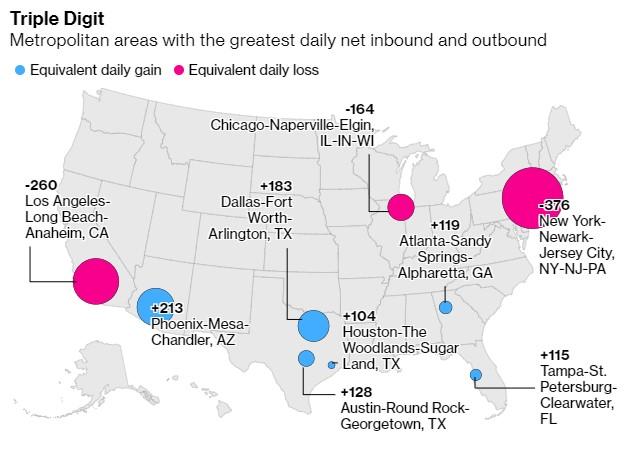
1) People Pouring Out Of US Cities Like LA And New York Even Before COVID Started
- New York lost 376 residents per day to domestic migration since 2019:

https://cms.zerohedge.com/s3/files/inline-images/covidny.jpg?itok=-tIiBKOY 

-Almost 60,000 people moved to New York while 200,000 people left in 2019


2) Carl Icahn moves hedge fund from NYC to Miami:
–for warmer weather and fewer taxes


3) Goldman Sachs eying Florida move for key division
- Florida offers tax advantages
-
The securities and trading industry paid >18%, or more than $15 billion, of collected state taxes, and 6% of NYC taxes collected.


4) Deutsche Bank raises prospect of moving half its New York staff

-Deutsche Bank could move as many as half its 4,600 Manhattan staff to lower-cost area for cost saving
-Manhattan was losing finance centre jobs to cheaper cities such as Tampa and Dallas


Very sad to see great cities like NYC falling apart like this, but from investment point of view, there is no time for pity - sell NY/LA and buy TX/FL!