2020年2月12日星期三

東方日報專訪 20200212

載於2020年2月12日東方日報 (此報導雖不完全反映筆者觀點,但部分內容值得參考):

兩大專家齊嗌樓市高危

新冠肺炎疫情持續擴散,令自去年中已「見頂」回落的香港樓市更「雪上加霜」。兩大樓市專家Portwood Capital董事總經理卓百德(Peter Churchouse)及Bricks and Mortar主席兼總裁王震宇接受本報訪問,前者預期今年全年樓價最多跌13%,但認為「危中有機」,後者卻擔心美國短債債息失控,隨時成為本港樓市的「計時炸彈」。

卓百德估住宅跌價13%

卓百德指出,新冠肺炎的影響對樓市絕對是負面,此單一因素或拖累中國和全球經濟,直言目前情況並非常規的經濟分析工具可以預測,只能透過經驗、歷史等來入手。回顧九七年亞洲金融風暴,香港經濟經歷了六年通縮,樓價累計下挫了60%,○三年應是通縮的尾聲,但卻爆發了非典型肺炎(俗稱「沙士」),情況與如今有點相像。

回顧○三年上半年,本港住宅樓價累跌約9%,但疫情完結後樓價逐步回升,全年計樓價反而上升約5%。卓氏認為,目前樓價再要跌多少,需視乎要多久才可成功研發治療藥物,又或像當年「沙士」一樣,疫情隨着季節轉變而逐漸消失。

預期聯儲續推QE

他不看好疫情會在短期內解決,故調低了今年的樓價預測,由疫情前估計全年只跌7至8%,降至全年料跌12至13%。

儘管如此,卓氏認為,在疫情爆發前其實不乏好消息,尤其去年底起全球有多達35間央行減息或採取寬鬆貨幣政策,低息環境今年料持續,而美國聯儲局今年料不會加息,甚至有機會減息一次,並會繼續推出類似量化寬鬆(QE)的措施來增加流動性。

至於香港住宅供應長期低於政府預測,對樓價有支持作用,且港府自去年十月放寬按揭保險上限後,按揭申請大幅增加,顯示住宅需求一直強勁,而激烈的示威活動近日已相對平靜。

王震宇憂美債累港樓

據Bricks and Mortar主席兼總裁王震宇從宏觀角度分析,認為經濟上美國強、其他國家弱,為港樓埋下了下跌的危機。他首先撕破市場對美國聯儲局會再量化寬鬆(QE)的憧憬,直言「QE意思是買長債,聯儲局職責是控制長息」,但該局自去年九月起主力買入短期國債,令資產負債表再度擴張,亦暗示短債債息有失控之嫌。
他又指,近期新冠肺炎死亡率與流感相近,也較「沙士」兩、三成死亡率低,料影響非長久,情況不會十分惡劣。惟他認為,利率的影響卻不容小覷。


買股回報勝置業

王氏坦言,近年美國經濟太強,令加息去遏通脹的壓力漸增,相對歐洲多國和新興市場經濟卻在走下坡,「近年歐洲好多國家發債都冇人買,只是央行買,但央行錢從何來?都係同德國借,所以如果一間央行出事,成個歐洲金融系統會變得好大鑊」。因此,資金回流美國是正常事,惟他擔心聯儲局最終控制不了短債債息,同時香港本地資金亦會抽緊,港息隨時會高於美息,即使香港過去沒有跟足美國加息步伐,屆時香港加息或在所難免。

他又指,香港樓價對利率最敏感,呼籲未來一兩年買樓「避得就避」。他更身體力行,於去年底率先沽出所持擎天半島單位,認為買樓不如買地產股和內房股,其回報和升值潛力都較港樓佳。

2020年2月5日星期三

Why is HK full of white elephant monuments, and what can we do about them?

Posted on 4th Feb, 2020 Stand News :

The landslide loss of seats by the so called ‘royalist’ district councillors in November’s District Council Elections was followed by queries over whether they have faithfully served the community over the years while in power. One of the areas most criticised by the incoming councillors, and indeed the electors at large, has been how too many white elephant monuments have been erected during their rule, which seemed to publicise the names of these outgoing councillors and their pals in the government, with the same monuments serving dubious if non-existent benefit to the district at large. Some of the more well known (or mocked) monuments are listed below.

Table 1: Select “famous” white elephant projects around HK


Such ubiquity of ‘white elephants’ may be traced to the fact that since 2008, the 18 district councils combined started receiving an annual budget of HK$300m for the purpose of ‘district minor works’. Come 2013, the then Chief Executive CY Leung, boosted the handout to an even more generous HK$100m for EACH of 18 district councils!

With many of the district councils too lazy to consult the public and too confident in their own professional judgment and town planning expertise, the temptation became irresistible to splurge on image enhancing projects which had little bearing on improving local residents’ livelihoods and facilities.

Eye sores at the most prominent street corners
To take two busiest districts in HK as examples, otiose ‘vanity landmarks’ come in the form of the Goldfish Sculpture in Mong Kok (Figure 1) and the Golden Dragon Sculpture in Wan Chai (Figure 2). These two monstrosities not only occupy the primest locations in the city’s busiest thoroughfares, they were brought to you the tax payer at huge expenditure – both to build and to maintain. How these inutile objects may lift the spirits of the local residents is anybody’s guess.

Figure 1: the Goldfish Sculpture condemned by graffiti as ‘white elephant’ at the time photo was taken


Fig.2: the Golden Dragon Sculpture of utmost imperiousness


What must puzzle most tax payers must be the question over why these contraptions, made out of plane cement and paint would cost millions to build? Compared to the extravagant HK$3m cost to erect the gaudy Golden Dragon Sculpture, would the Tai Chi bronze sculpture (Figure 3) in Exchange Square which was authored by the famous Taiwanese sculptor Ming JU, be a far more pleasing and inspring artifact? What is more, a bronze sculpture from the same Tai Chi series was sold at a 2009 auction for a mere HK$5 million. If the people of Wan Chai had the choice, would they have opted for the aggressive looking dragon or the graceful Tai Chi master?

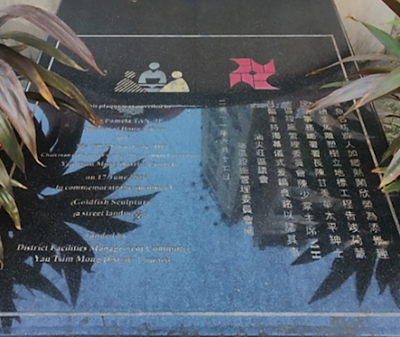
The self important intention of erecting such monuments becomes amply clear when one looks at the inscriptions below the sculptures – the text is but an orgy of adulations and praises for those ‘celebrities’ involved in erecting the monument (Figure 4). No mention of course of what good the article would do the people who live nearby…

Figure 3: Ming JU’s Tai Chi man work in Exchange Square


Figure 4: Mong Kok’s Goldfish Sculpture seems more a memorial to advertise dignitaries’ names than to promote the characteristics of the district


Ivory tower administrator makes no green fingers 
With the ever expanding concrete jungle around us, people are increasingly being alienated from nature, which is not an ideal environment for health and mental wellness. When tree cover is progressively eliminated from urban space, even from sites sizable enough and conducive to being covered by trees, the only possible explanation must be bureaucratic obsession for convenience and ease of control.

Take the open space where the Goldfish Sculpture is situated, a thoughtfully planned cluster of mature ficus or camphor trees will have the miraculous effect of turning the current ugly and hostile collection of concrete boxes (Figure 5a) into an urban oasis (Figure 5b).

In terms of costs, planting mature trees roughly two storeys tall only costs HK$50,000-100,000 per tree. In other words, fully covering the 10,000 square-feet Goldfish site needs just a dozen or so trees, with an estimated total bill of less than HK$2m.

Figure 5a: Goldfish site in Nullah Road now – barren, plain, and dull


Figure 5b: After tree planting – whirling shades and calming greenery


The result cannot be further from the sorry situation people have to put up with every day – the island is now a bountiful area of shades where pedestrians can rest and take their minds off dreadful high density concrete structures bearing down on them.

Turning to Wan Chai’s Golden Dragon site next: with a site area of some 5,000 square feet, even six to seven mature trees will achieve similar greening effect as in Mong Kok above. The total cost for planting will also half to around HK$1m, with the same significantly enhanced therapeutic effect (Figure 6b) that the ghastly golden contraption (Figure 6a) can never match!

Figure 6a: Golden Dragon Sculpture – leaves you baked, drenched, and deafened


Figure 6b: With green cover – bird songs and insect chirps abound?


Retake our city - plant trees, and take out the white elephants 
The above tree-for-elephant philosophy of decorating urban open spaces may seem absolutely logical to the end users who are the local residents. Alas this is not the way mandarins/councilors in habiting air-conditioned offices think. As a result, we have gotten used to being deprived of what is rightfully ours, as they opt for the easy option of concrete pouring and mechanized lazy maintenance. This is why the city is overwhelmed with white elephant constructions which have no benefit to the residents whatsoever.

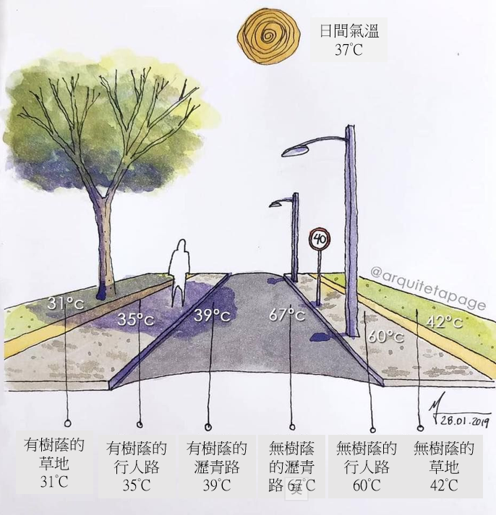
From an environmental science perspective, trees provide the best possible shelter for pedestrians and public space users alike, lowering the surface temperature in a hot climate city such as Hong Kong. In fact, the ability of tree shade to mitigate the ‘heat island effect’ is a shockingly high – not only is the shaded ground temperature several degrees lower than air temperature, the difference is even larger against concrete/bitumen road surfaces by close to a multiple (Figure 7).

Figure 7: Tree shades can reduce temperature by as much as 36℃ on a sunny day


The above sustainable and yet economic urban management strategies are so common sense that it is unimaginable that they are not widely adopted all around HK already. In contrast, what we get are the expensive, tawdry, unsightly piles of waste costing millions of our money. We surmise that the flawed design of the urban management bureaucracy may be the main cause for HK’s white elephant phenomenon, this is explored below.

Cowboys leading experts + wrong mandates for the specialists = disaster
We suffer from overly centralized urban planning and management – this should be a function led from the user level, not from some remote administrator – the misallocation of expert resources is also a crucial factor contributing to the current plight we find ourselves in.

For example, there are 1.7m trees that may fall under the duty and care of some 137 certified arborists employed by various government departments (Table 2). However, there are vast discrepancies between the work load of these arborists:- the Highways Department, which oversees 600,000 trees (the highest amongst the departments), employs only 8 arborists; who would each be in charge of 80,000 trees on average. So if any of these specialists work the full 365 days a year, each still has 214 trees to check on every day!

Meanwhile, the 15 arborists in the Housing Department have a mere 18 trees per day to work on – the workload difference is a factor of 12 times!

Table 2: Tree responsibility by department – no apparent logic?

With such a haphazard allocation of resources and responsibilities on how HK’s greenery is maintained and enhanced, it is not surprising that all we see are trees being cut down or dying (from a multitude of causes: malnutrition, diseases, to overzealous felling in the name of safety), instead of plans, actions, or debates about how the green coverage can be enlarged or enhanced.

The establishment of the Greening, Landscape and Tree Management Section could have been the opportunity to address this structural deficiency, but this initiative also ended with a whimper. The crooked infrastructure continues to turn our arborist experts from potential tree conservation champions into tools of administrative execution.

Perhaps the only way urban greening can become an effective movement is by empowering a centralized arborist function, may be under the aegis of the AFCD, and with its own budget and mandate to greenify the city. Another way to add to this momentum would be to delegate local urban planning authority to the district councils so they have the power to drive the beautification of their own districts in fashions that local residents demand, with the help of this new centralized arborist team.

White elephants will continue to appear unless we address the structural issues of urban management, and it is high time major reforms were implemented to return power to the people and their gardeners.

The author wishes to thank Mr Kelvin Wong Siu Fung of the School of Communication, Hong Kong Baptist University for assisting in drafting this article, collecting data and compiling charts.

2020年1月31日星期五

Wuhan pneumonia in context – why we need not overreact 20200131

There seems a universal (well at least in HK) panic about the Wuhan pneumonia outbreak, with at least 95% of the people we see in the streets wearing masks – a spectacle – and many organisations completely shutting down (including the govt) for fear of contagion…

This is despite to date only 10 people in HK have been confirmed cases. The status at the time of writing looks like this:

Figure 1: current outbreak statistics


If you look at the numbers, however, the situation is perhaps much less frightening than the media (and officials) have whipped up:

1) Death rate similar/weaker than normal flu? As table below shows, the death rate of diagnosed cases in the epicentre, Wuhan, may be high at 5.7%, but by the time you look at the province at large, it drops to 3.5%, and overall China-wide, the ratio becomes a low 2.2%. HK’s death rate is a lucky big Zero:

Table 1: WARS statistics


Compared to other headline flu pandemics reported (see FR1 below), where death rate range around 0.03-0.08% of population, the current rate of death, even in Wuhan, is a tiny fraction (see right column in Table 1, at 0.0012%) – ie there needs a 100-300x increase in deaths from current Hubei levels (0.00027%) to match past pandemics alone – ie. 16k – 49k in casualties in total. Luckily, the Hubei death toll is a low 162 as of today; 

2) The death rate have been dropping – usually the early deaths tend to be more heavily reported/collected as a statistic compared to the actual infected population, while the catching up by the latter leads to a more normalised, actual rate in time (red line below). Public awareness may also put a stop to accelerated growth in death rates, which the blue line below could well be suggesting, falling from 3% to early 2% in the past few days. A consistent departure from the red trajectory will mean we can largely return to normal activities:

Chart 1: death rate tends towards the disease’s true virility in time


3)      Vigilance is ultra-high this time – compared to SARS (when prevention only scaled up after several weeks of casualties), people are armed to the teeth within days, thanks to the magnifying effect of social media and international measures (which are unprecedented – chartered flights to retrieve nationals from China, for example). As a result, the spreading of the disease will likely be much less rapid. Here is a map showing which country to be in with any epidemic outbreak. Not surprisingly, OECD countries come top:

Figure 2: which countries are best prepared for an outbreak?


4)      Possible longer drag than SARS – One feature that does not talked about is the timing of the current outbreak – instead of a March incident like in SARS, we are in January, that means the period of time before it becomes too warm for virus to spread diseases will be longer than during the SARS episode, which ended in June 2003 as temperature rose.

This time round, the outbreak will potentially be lengthened by two months. Hopefully the growth in case numbers (red line in Chart 2 below) will see a tailing off much faster this time compared to SARS (blue line) on increased vigilance.

Chart 2: Case growth rate may decay like the SARS outbreak


5)      Virility tracking will give the answer – the viciousness of the current outbreak has yet to be proven, but if the trends discussed thus far hold, the situation stands good chance stabilising at current levels.

In the next few weeks we should have our answer, but if anyone even remembers the not too distant 2009 avian flu outbreak, which is so far 1000x higher than WARS in death rates (red dotted line, Chart 3), people seem much more ready, if not more than necessarily prepared this time round.

Chart 3: log chart comparing current death rates to past pandemics


------------------------

Reference – further reading 1 (FR1)

Flu causes more death than you may think!

Every flu season, a lot of people die from this disease, mainly from complications such as pneumonia

More than 200,000 people are hospitalized each year in the United States for the flu illness and its complications and between 3,000 and 49,000 people die each year from the flu. The number of flu deaths every year varies. That is 1.5%-25% of hospitalised flu victims die each year!

According to the World Health Organization (WHO), about 3 to 5 million cases of severe flu illness and about 250 000 to 500 000 flu season deaths worldwide occur due to the influenza virus. That is anywhere between 5% to 17% of deaths.

Really big pandemics in context

The world has seen five pandemics during the last century, which took a large number of lives. Here are the figures of deaths that occurred in the United States and Worldwide during those years.

1. 1889 Russian Flu Pandemic – about 1 million flu deaths (0.07% global population)

2. “Spanish flu” A of 1918-19 caused the highest number of influenza-related deaths: approximately 500,000 deaths occurred in the U.S. and 20 million worldwide. That figure is more than the total number of deaths caused by the World War one — 16 million. As a matter of fact, during that year, the flu had killed more people than any other illness in recorded history. (1.1% global population)

3. “Asian flu” A of 1957-58 caused 70,000 deaths in the United States and about one million to two million deaths worldwide (0.07% global population)

4. “Hong-Kong flu” A of 1968-69 resulted in 34,000 deaths in the United States and an estimated one million to three million people died worldwide. (0.08% global population)

5. 2009 H1N1 Flu Pandemic – about 18,300 deaths in the United States and up to 203,000 deaths worldwide (0.003% global population)

So amongst the most feared pandemics in history, only the Spanish flu was of truly frightful scale when 1.1% of population perished.


Reference – further reading 2 (FR2)
Trends in Recorded Influenza Mortality: United States, 1900–2004, by Peter Doshi

In results section author concluded: “An overall and substantial decline in influenza-classed mortality was observed during the 20th century, from an average seasonal rate of 10.2 deaths per 100 000 population in the 1940s to 0.56 per 100 000 by the 1990s. The 1918–1919 pandemic stands out as an exceptional outlier.”

2020年1月29日星期三

權貴樹碑連連 社區白象處處

載於2020年1月29日信報, 完整版如下:

區議會選舉剛在去年11月完成,一洗過去建制派盤踞的格局;隨之引來的熱議,莫過於前任議員多年來到底為選民及當地社區有何建樹。其中一個最惹人詬病之處,乃是各區區議員是否於過往數年以樹碑立傳、揚名立萬為目的,不建立真正便民設施,卻大量建造各樣光怪陸離且毫不中用的形象地標【表1】。

表一:較「著名」形象工程一覽
地區
民間謔稱
造價(萬)
竣工日期
網民評價
灣仔
金龍像
300
2003年
一身俗氣金色外皮
旺角
金魚像
34
2011年
難令人聯想旺角金魚市集盛況
筲箕灣
東區文化廣場
9000
2019年
佔地頗大,卻欠缺基本設施
鰂魚涌
不能避雨亭
21
2015年5月
無助市民避雨兼佔用路面空間
深井
四不像燒鵝
120
2013年,已拆
造型似鵝非鵝,無實際作用
觀塘
海濱音樂噴泉
5000
未知
噴泉阻礙遊人於草坪上休憩
葵芳
安全島
85
2018年4月,已拆
貌似墳墓,設計混亂如同「建築廢料」
屯門
石躉
20
2019年8月,已拆
既似龜殼,也似「古墓」、「山墳」,用途不明

究其原委,不難發現,自2008年起,全港十八區區議會每年都總共獲得由政府撥出的三億元,作為地區小型工程的預算;到2013年,時任特首梁振英更將預算大幅提升至每區一億元!在缺乏本地諮詢,兼且專業規劃知識欠奉的生態下,最終撥款淪為當屆區議員鞏固形象的本錢,卻對當地民生或區域形象毫無正面作用。

筆者隨手拿來兩個人流旺盛,地點居中的例子:旺角金魚像【圖一】和灣仔「蟠龍匯瑞」金龍像【圖二】。這兩頭小白象不但霸佔市區黃金地段,且耗費龐大;對市民不但毫無實際用途,更難對心靈有任何鼓舞或激勵作用!

圖一:旺角金魚像早於筆者攝影之前,已被有心人狠批

圖二:灣仔金龍像霸氣十足,拒人千里

以上白象工程,用料只是普通的水泥和顏料,為何工程費用會動輒過百萬?灣仔那條名為「蟠龍匯
瑞」的「彫塑」竟耗資300萬元!相比之下,置於交易廣場、出自雕塑大師朱銘手下的太極人作品【圖三】,不但引人入勝,洗滌心靈,就算是其兩米長同系銅雕作品在2009年拍賣也只達500餘萬元,試問閣下在有選擇情況下,會選霸氣金龍,還是優雅太極?

再仔細一看白象下題字,滿目所見盡是官官互賀、自得其喜的痞態【圖四】,哪有為民造福,改善社區的半點意思?

圖三: 朱銘 太極系列雕塑一例
圖四:究竟建造金魚像是為了突顯該區特點,還是純粹方便碑上的社會權貴刷政績?

貪便圖利,綠蔭無緣!

隨著城市發展,石屎森林不斷增高加濶,市民與自然日漸疏離,不但對身體無益,亦令人精神受壓。然而就算在較具規模的公共空間,樹木都逐漸被清洗淘汰,這若不是官僚為求方便,對綠化敷衍塞責,實在想不出其他原因!

以旺角金魚工程所在為例,只要在空地種植數棵成熟樹木,就已經可以將視之生惡的水泥佈景【圖五a】變成翠碧綠洲【圖五b】。就算兩層樓高的成熟大樹,成本亦只需5至10萬一棵,故此,全面覆蓋水渠街休憩空間若一萬方呎,相信也只要十數棵,總成本200萬以下已可埋單。
圖五a:水渠街和金魚像現狀 — 光禿一片,枯燥乏味
圖五b:水渠街和金魚像 — 綠化後一片生氣,綠影婆娑

再看灣仔,空地面積較小,約5千呎而已,同樣以兩層樓高的成熟大樹為例,6至7棵已可成事,總成本亦可減半:100萬的經濟效益,必定比金龍像長遠兼受歡迎!【圖六a及六b】
圖六a:金龍像現狀 — 日曬雨淋,身震耳聾

圖六b: 金龍像綠化後鳥語花香,蟲鳴蝶舞?


重新植樹鬧市 再度還民自然

以上由樹林取代大白象之倡議,其實順理成章,自然不過,奈何長處冷氣間之官僚,及以福利掛帥,置民生不顧之前任區議會,卻從未有此思維。以至經年累月之下,形象工程遍地開花,嘍嘍蟻民卻只見自己鄰里左右之綠化空間買少見少!由科學角度解釋,除了樹蔭能於炎炎夏日供市民避暑乘涼,更能大大減輕城市熱島效應,其效果之大,連筆者也大出意外——炎熱天時,樹蔭下地面溫度不但較氣溫低數度,相對日漸泛濫的石屎/瀝青地面更相差以倍數計,見【圖七】。

圖七:城市樹蔭能降低地面溫度達36度之巨!
這般既經濟又惠民的政策,政府不但遲遲洞察不到,反而不斷建造動輒數以百萬元計、華而不實的廢物。當今行政結構設計錯誤(過度中央集權)應是此現象之罪魁禍首。

外行管內行 內行不在旁
除了上述之行政權力集中的結構問題之外,樹木管理工作的分工更是雜亂無章,人力分配與工作需求嚴重錯配!舉例說:政府各部門總共有137位註冊樹藝師,理論上「照顧」全港約170萬棵已知管轄範圍內的樹木。

然而,各部門的樹藝師人數懸殊,旗下最多樹木的路政署中,八位樹藝師要為遍佈全港的60多萬樹木負責,每位平均處理近8萬棵樹,即在一年365日無休的情況下,都要每天擔當214棵之眾;反過來,最「悠遊」的房屋署各專家,只須每日看守18棵而已,即是兩者工作量相差12倍!

表二:全港樹目管轄情況一覽
部門
護養樹木數目(萬棵)
樹藝師(名)
每名樹藝師需管理的樹木數目(棵)
漁農自然護理署
3.80
28
1,357
渠務署
2.48
1
24,800
路政署
63.30
8
79,125
房屋署
10.08
15
6,720
康樂及文化事務署
51.50
70
7,357
水務署
15.71
0
-
地政總署
難以點算*
13
-
建築署
20.00
1
200,000
整體
166.87
136
1,227
*由於地政總署管轄上述土地樹木眾多,故難以點算。
來源:2018年立法會文件

難怪旺角/灣仔這些最渴求綠化的路邊公共空間,只見樹木因營養不良、病死、或為行人安全而犧牲,卻不聞有計劃、有愛心的本區園丁去施肥淋水,更遑論爭取樹木應有的生存條件,及擴大各區綠化比例。

曾幾何時,政府似乎感覺到問題的重要性,並成立樹木辦,可惜最後無疾而終,而各樹木專才亦由本應是樹木保育的推動者身份,成為各官僚手中隨意殺樹滅林的劊子手。如要有效推動市區綠化,實應將所有樹藝師和一切樹木的種植及維護工作者全數撥歸漁農署管轄,但由區議會或其他地區單位負責綠化方針,包括財政資源的分配。只有以由下而上的方式去美化當區環境,才能充分釋放居民的積極性並制訂出靈活多樣卻又合乎居民利益的環境政策。

筆者特別鳴謝香港浸會大學傳理系學生黃兆楓協助草擬本文,及收集和整理相關數據圖表。


2019年12月23日星期一

蘋果日報專訪 20191223

載於2019年12月23日蘋果日報(此報導雖不完全反映筆者觀點,但部分內容值得參考):
兩名星級分析師同唱淡 樓市明年悲觀 料再跌價一成
政局未改善 移民潮累樓價

【地產專題】「最壞時刻尚未來臨﹗」過去半年港抗爭持續,加上中美角力等因素,資金加快外流,削弱本港經濟。本報找來兩位星級分析師蔡金強及王震宇、業內人士汪敦敬及以《易經》推算樓市的學者李天生,預測明年樓市;惟均是一面倒悲觀,預期樓價明年跌幅將達雙位數。蔡金強及王震宇認同,這個調整周期較以往發生的金融危機更漫長。

樓市的表現向來與經濟增長並駕齊驅,經濟如果下行,樓市亦只好跟着走。曾是花旗銀行房地產分析員、現為奧陸資本總裁的蔡金強認為,本港經濟受到社會運動、中美貿易戰及反全球化三大因素影響,樓市前景極度悲觀,目前樓價已由今年6月時的高位下跌約一成,相信明年會再跌一成,「香港樓價現在是由喜馬拉雅山頂滑落,調整20%至25%是最基本的,但工商舖會更大鑊,尤其街舖跌幅或達三至四成」。

警告調整周期漫長

蔡金強又指,這個調整期只屬第一階段,意味沒有最壞,只有更壞。

瑞銀房地產前分析員、現為Brick & Mortar Management主席王震宇亦指出,中美對立加上全球違約潮出現,都會拖垮香港的經濟表現,「內地數家銀行及不少公司出現違約,全球亦有多宗違約事件,這些都會使資金流緊絀,令市場出現信心危機。」

王震宇又特別提到息口問題:「目前銀行存款息口已逐步上升,樓按息率更在暗地裏上調,多間銀行對樓按的優惠減少,其實變相加息,若往後香港經濟惡化,銀行的定價審慎度必會加強,息差會逐步擴闊。儘管聯儲局想阻止息口上漲,香港私人銀行的息率也會上揚。」他預期,市場將陸續出現劈價成交,認為樓價跌勢才剛開始,估計明年1月樓價便會出現雙位數跌幅。

樓市陷寒冬,是否意味地產股都無運行?蔡金強卻不認同,他指本地發展商利潤豐厚,即使樓價下跌10%,淨利潤至少仍有10%。此外,本地發展商大多是家族式持有,財力雄厚,若股價跌至低水平,他們可以進行回購支持股價。他又認為,除了港地產股,若手持資金不知何去何從,可考慮買黃金保值或投資中美日三地的股票,主要是上述國家底子厚、市場大,以及受反全球化影響較低。

王震宇亦同意,當下買地產股好過買樓,他指,發展商借貸比例屬單位數,資產負債表低於持有資產的價值,買地產股保本能力較強。不過他認為香港資產價格始終高昂,反觀海外資產仍值博,即使頭寸不足也可考慮買海外REIT,甚或手持美元,但千萬不要投資美債。

香港一直是亞洲排名最高的金融中心,國際地位僅次於紐約和倫敦,可惜一個《逃犯條例》令香港的法治及自由面臨挑戰,外資對港漸失信心,蔡金強認同今次社會運動的影響是67暴動後最深遠的,不少內地人已把私人銀行資金逐步調往新加坡,儘管部份戶口的運作仍然由香港負責,但實際已由新加坡託管。

須防中港兩地同化

他預期,未來隨澳門在金融領域上的突破,或多或少會分擔了香港的功能,新加坡在全球金融指數的排名一直緊隨香港,定必成為投資者首要考慮的地點,加上深圳及上海的步步進逼,香港的優勢遲早被取代。不過他相信,香港的國際金融中心地位仍可維持5至10年,主因人民幣仍未能自由兌換,香港作為美元的「基地」,在中央的眼中確有其價值。

王震宇則認為,如果香港賴以成功的要素是因為其與中國內地的分別,而不是中港兩地同化,那麽這個獨特性可能對香港未來發展還有一定的好處,前景亦不用那麽悲觀。

政局未改善 移民潮累樓價

香港過去曾經出現多次移民潮,如1984年中英簽署聯合聲明、1989年六四天安門事件及1997年回歸前等,皆觸發港人紛紛移居外地,樓市隨即陷大調整。這次「反送中」運動令香港前途問題晦暗不定,港人信心危機再現,對香港樓市的「殺傷力」又有多少?

中英兩國自1980年開始就香港前途問題談判,投資者出現信心危機,觸發81年股災及港元大貶值。翻查差估署資料,本港私人住宅樓價指數由1981年的24.4,急挫至1984年的17.2,跌幅達三成,市場上有數據更指期間樓價曾急跌70%;其後的1985年至1986年間,港人移民人數急增,據一份1988年提及移民潮的行會文件顯示,1987年申請移民宗數達到4.6萬人,較1985年勁增1.7倍。

或9萬家庭移民

王震宇坦言,這次港人的信心危機是自1984年中英聯合聲明簽署後最大,將是影響未來樓價重大因素。他表示,1985年至1997年間十多年,夾雜六四事件,香港高峯期約有6至7萬個家庭移民,相當於人口約1%,今次社會運動風波若持續,估計會再有8至9萬個家庭移民外地,若局勢遲遲沒有改善,移民人數增幅可能會加快,這種人才流失對香港而言絕非好事,不但未能支持樓價,反過來令跌勢一發不可收拾。