顯示包含「bureaucracy」標籤的文章。顯示所有文章

2025年5月13日星期二

Argentina: time to invest after 100 years of socialism/fascism?

After writing extensively during our due diligence trip during Easter to this once richest country on earth, the fundamental economic numbers do point to massive turnaround from very depressed levels, but the one big question that could deter actual commitment to this as an investment target remains: Can President Milei's reforms last?

To understand whether the Milei phenomenon will last, we must look at the global geopolitical pattern at large: we are now in a gigantic anti-establishment wave that will characterise economic cycles for many years to come; and thus Milei may not be a flash in the pan phenomenon of some 'whacko academic madman' hitting a random high. Let us explain this thesis in a bit more detail:

The end of a multi-decade bureaucratic expansionary cycle?
The post-WW2 years have started a period of perhaps well intended, but centrist and interventionist governance wave, typified by deficit spending and ever bigger governments that made these charts look so absolutely lopsided:


The cancerous growth in the public sector led to, for example, too much Gerontocracy (left chart, in USA) enabling permanent politicians to make fortunes trading on insider legislative info, while the governments they are supposed to supervise and scrutinise go into perpetual deficit spending (right chart, not just USA, but in all developed world). The main side effect of this is the explosive increase in tax burden - big governments need big tax incomes to finance - while killing the middle class (note how little regulation there was before WW2):

There are many such charts that demonstrate such post-WW2 cancerous growth of the administrative state, but we will stop at the above three. 

No wonder so many democracies now look like autocracies (see our many UK comments for details), with the state and its establishment allies increasingly targeting real representatives the people voted in as 'deplorables', 'extreme right wing', and 'populists'. That cycle seems to have reversed: now people are voting en masse against the socialist establishment, and bringing back to power, one after another, politicians who vow to fight for the common man,  and not globalist causes:
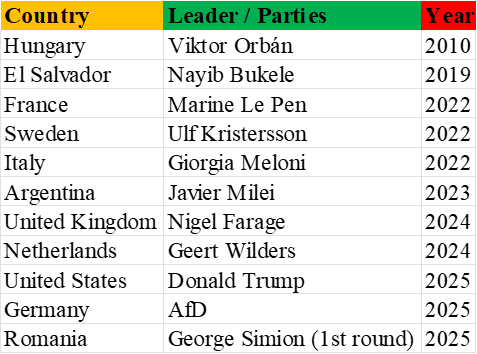
Note how this movement has turned from a trickle from 2019 into a tsunami by 2025. The momentum of the counter establishment movement was gaining so much speed that the powers that be had to persecute Trump with endless lawfare, put Le Pen in jail to prevent her returning to power in 2007, and disqualify Călin Georgescu so his anti-EU policies will never see the day of light... It has now reached such farcical extent that Germany's spy agency labelled AfD 'extremist entity' to ban the now most popular political force:

This wave of anti-establishment sentiment is reaching a new height in May in the UK, where local elections returned a landslide win by Nigel Farage's Reform party, decimating all other opposition in the process.

Milei - the more daring (or genuine) of the rebels

It is against this context that we view President Milei as a phenomenon that will not vanish overnight, because he is a fresh outsider with policies far more radical than many of the more jaded politicians named in the table above - most of whom having been in politics for far too long, and have become disillusioned by the bureaucratic drag that they know will undermine their policies.

Milei is different - he seems unmotivated by money and position, and he is a more fervent believer of anarcho-capitalism than just about all the rebels listed above (see analysis here for a good summary of his beliefs). What's more, he does not mince his words:


Another example (see link here) of his no holds barred style makes him so transparent to the voters as to where he stands, unlike all politicians out there:

This is why his public spending cut drives (see this video for dramatic effect), although ambitious, could indeed work?

Will Milei succeed?

The biggest question on the minds of investors will be: does Milei have the ability to pull off his reform agenda, not being the leader of a majority party in the parliament? Here is our quick take on his various policy agenda thus far:

One year in, we are delighted to see so many ticks or half ticks in this long list of dramatic social/economic/political reforms in the sick man of America a.k.a. Argentina. So impressed is the current reformist US to have such an ally that the Trump administration seems willing to help Milei with Argentina's debt restructuring efforts (link).

His latest big surgery is to return the Peso to market driven fair values, and is apparently succeeding - below, the black market rate premium (blue area below) has collapsed from 160% pre-Milei to near parity now:

The only previous episode when we had a similar drop was during the term of President Mauricio Macri (2015) when he lifted capital controls. The premium returned after President Alberto Fernández was elected and reinstated strict currency controls (which gave rise to property hoarding as a hedge of hyperinflation that resulted). 

If we were to bet on a new future for Argentina, we need Milei and his policies to stick, at least for a typical 3-5 year minimum investment horizon for properties.

Can Milei be re-elected?

This leads naturally to the next questions - is he still popular? What are his chances of being re-elected?

First on popularity: it is heartening to see him almost as popular now as the day he stormed to power 1.5 years ago - standing at 47% support now vs 49% back in Jan 2024:

It is interesting to see that President Macri, being pro-market as well, had similar popularity levels as Milei, although starting off with much higher popularity than Milei. Across all income strata, it seems the people who support Milei most are the lower middle class and the poorest segments of the society:

And compared to all other heads of states in South America, Milei has the most constant net approval ratings, whilst fellow presidents generally suffering from rising net negative approval ratings:


So the proof of the pudding will be first the Buenos Aires election on 18th May (yes this week!), followed by the national election on 26th October (see here).

Given the widespread anti-establishment uprising around the globe described above, even the Buenos Aires election is seeing new party being formed by the former mayor (like Reform in the UK?).

If one believes in the saying 'the trend is your friend', we probably have a very high chance of free market politicians winning again in Argentina as well...

2022年5月20日星期五

Radical reforms needed to end the 'Rising PRH waiting time' myth 20220520

Radical reforms needed to end the 'Rising PRH waiting time' myth

After the Hong Kong Housing Authority (HKHA) announced the latest Public Rental Housing (PRH) statistics, showing that the 'average waiting time' has risen to a new high of 6.1 years, cliché-ridden editorials predictably rattled the same plattitudes about the 'need to increase supply for PRH' to address the problem, such as:

SCMP: Average waiting time for public housing flat in Hong Kong rises to 6.1 years, highest in more than 2 decades

The StandardWaiting time for public housing rises to 6.1 years, hits 23-year high

The truth of the matter is not what it seems as claimed the housing bureaucracy (which is primarily responsible for the crisis), and the uncritical media. We have addressed this fallacy in extensive detail in the following article:

"HK’s Ever Ballooning Public Housing Addiction Cycle 05/2021

  1. Lowering thresholds leads to perpetual shortage in housing welfare
  2. Drastic cure: cut income limits, halt all public housing building
  3. Wanton lifting of welfare thresholds crowds out private market

as well as some earlier writings (in Chinese only):

公屋改革面面觀─結構性自我膨脹  2014年9月English translation

公屋改革面面觀─公屋「豪宅化」2014年10月English translation

In essence, the long 'waiting time' phenomenon is a self staged smoke and mirrors game, which resulted solely from the ever rising income ceiling for public housing applicants, which significantly outpaces the increase in median household income for the population at large.

As a result, ever large swathes of the population fall into the eligibility net, thereby lengthening the waiting time unnecessarily. Coupled with this, the constant growth in average size of flats occupied by PRH occupants, the pursuit for luxurious standard for what should be a welfare product, have attracted even more applicants seeking this freebie.

The resultant rent seeking free-for-all only punished the tax payers and the genuine hard up applicants who are edged out of the housing market while the bureaucrats and rent seeking committees/advisors build their empires. In the meantime, the cancerous growth in public housing removes our ability to buy our own homes in the private market, thus becoming permanent slaves to the bureaucracy... a sad outcome indeed unless the reforms we outlined time and again are implemented.

2019年2月22日星期五

HK medical reform - more skeletons falling out of the cupboard?


How opportune that so soon after our analysis (see here and here) highlighting that the whole problem with the HK medical establishment is its own conflict of interest with the people, that the article below appears to throw up evidence that supports our analysis. Here are some of extracts:


--------begin extract--------

醫管局高層有幾無能?


... 據《眾新聞》報道,醫管局花 $2億聘「炒散」護士,食衞局前局長高永文任董事公司中標袋 $1 億


...香港政府已經給了醫管局 600 多億、28,000 張床和 76,000 名員工,醫管局卻年年說不夠錢、不夠人。


...醫管局元老級領導楊永強難辭其咎,但他居然無認真檢討自己的責任,還出來指指點點...曾任食物及衞生局副局長的梁卓偉,巧合地在近日批醫管局官僚。


...醫管局當年答應請大學研究合理診症時間,但報告無下文。


--------begin extract--------Without proper reform of the power structure top down, the rotten situation will cured


2017年6月16日星期五

Bureaucratic inertia distorts Hong Kong’s taxi market


The recent steady stream of reports on problems related to the Hong Kong taxi industry, from drivers’ refusal to accept rides to overcharging, from sky high taxi licence prices (record high of HK$7.2m back in June 2015) to the Government’s persecuting innovative hailing businesses such as Uber – all point to the worrying trend of an ever worsening business environment in whose excellence Hong Kong has traditionally prided itself.

This article analyses the deteriorating transport ecosystem in Hong Kong by looking from a supply and demand perspective, hoping that more appropriate policies can be adopted to put the increasingly suffocating travelling experience HK citizens face back on its former flexible, high-quality, and affordable track.

Govt limits on licence supply leads to sky high prices


The Hong Kong business environment of recent years has been characterised by worsening service standards, astronomical asset prices, and purging of new entrants or small players, resulting in a overwhelming domination by the establishment (aka big corporations) while the consuming public suffers. In the taxi industry, this started back in 1998 when, under the pretext of considerations for the common good of the taxi profession, the government completely ceased issuing further taxi operating licences. This move sowed the seeds of a major bull market in license prices, which has massively outstripped the increase in the income of the riding public (Chart 1).

Chart 1: starting at 100, income rose a mere 34% vs taxi prices up 286%

The fact that prices of a right to drive a means of public transport can soar to the value of a private home is nothing short of incredible, even though this phenomenon can be explained by the simple rules of supply and demand. It is clear from Chart 2 that from the 1970s to the mid-1980s, due to the rate of increase in taxi licences being higher than that of housing supply, the ratio of taxi licence price to home price index fell significantly to within a range of 0.5 to 0.8 (see red highlight in Chart 2). This is ample proof that when supply is abundant, a utility item will not turn into a commodity of speculation.

Chart 2: lower licence supply resulted in licence prices rising more against home prices

The situation reversed from late 80s and persisted throughout the 90s, when the increase in taxi licence numbers fell behind housing supply. As a result, the ratio between taxi and home prices surged back to the 1.1-1.5 region (see yellow highlight in Chart 2). This would have been the best time for the Government to increase the supply of taxi licences, but sadly, it unwisely ended new supply of licences from 1998 onwards, resulting in a total windfall for licence holders/speculators, when the licence price to home price ratio more than doubled to a high of 2.8 in 2005; although the ratio fell back after the global finance crisis, it still trades at an elevated range between 1.4 and 2.0 (see green highlight in Chart 2) – this is a level triple the norm back in the 70s and 80s, and formally sealing the licence’s status as an instrument of speculation instead of a document to authorise provision a service to the public.

Bureaucratic forever behind the curve


The role of government is best limited to providing a fair environment of exchange, so that the citizens can freely supply and consume products or services in an open market. Looking at demand for transport services, it is not difficult to conclude, from looking at the changes in population, housing supply, and private car numbers since the handover, that the city’s demand for taxi services remains severely unsatisfied.

Since the government stopped issuing taxi licences in 1998, Hong Kong’s population has risen by 12%, its housing stock by 29%, and private cars on the roads by 60% (Chart 3)! If these are taken as the manifestations of underlying demand, then should there not have been extra taxi licences of 2,176 (i.e. 18136 x 12%), 5,259 and 10,882 respectively, according to the three demand proxies? To take a more extreme example – the number of visitor arrivals which has surged 459% in the same time – the number of taxi license should have risen an even more astronomical magnitude. The negligence that has led to this level of disconnect between demand and supply is simply unforgivable.

Chart 3: taxi provision is severely lagging all demand indicators 

The classical supply-demand curve explanation to the phenomenon is simple – when supply is arbitrarily fixed (see orange line in Chart 4), continued rises in demand (blue lines) will push prices up (P0 to P1). The natural and appropriate way to adjust to changing demand situation is to allow the market to adjust supply levels such that both the numbers and the prices of taxi licences are determined by the free interaction between the buyers and suppliers, not by remote mandarin officers sitting behind closed doors.

Chart 4: inflexible supply pushes up licence prices, putting up barriers to entry


Govt policies promote rent seeking


Since Hong Kong’s handover, we have witnessed more and more reports of corporatist policies favouring monopolistic behaviour while penalising new and small market players. In the context of the taxi industry, the abrupt and continued suspension of licence issuance has resulted in supply shortage and surge in licence traded value – and the increased barrier of entry (due to higher capital requirements) means that more and more licences are now held in the hands of hoarders and speculators.

Under normal circumstances, owner-operators should possess one licence, while those holding three or more taxi licenses can be safely classified under corporate owners or investors. Since 2011, when statistics have become available, the proportion of corporate ownership – that is, holding more than 3 licenses – has gone from 18.4% to 22.7% in just 5 years. That is a cumulative growth of 4.3 percentage points (Chart 5). In contrast, the proportion of single licence holders fell by an even larger 5.4 percentage points. This suggests that taxi licences are being concentrated from the drivers (which make up a maximum of 52.6% of total now) to the well capitalised investors.

Chart 5: taxi licence ownership increasingly concentrated


Drivers are forced to take risks


When a humble licence to drive a means of public transport has morphed into a tool of investment for wealthy, we know that policy making in this area has become abused. Sadly, the Government has ignored the issues for many years, leaving taxi drivers and passengers to pay over-inflated rents and fares.

The shortage of taxi licenses results in increases in taxi rentals for drivers. In order to breakeven, the drivers developed revenue maximisation tactics such as hire refusal, taking longer routes, and overcharging. This is only one of the outcomes out of the problem of imbalance between supply and demand. This sad symptom of the policy error is clearly visible from the prosecution figures where the number of drivers charged for ride refusals rose nearly sixfold in the past five years (Chart 6) – the deterioration of service standards has become systemic.

Chart 6: prosecution for refusing hire were hugely increasing


If on the other hand, the number of taxi licences is allowed to fluctuate freely in response to market demand, then the licences will lose their investment value, and the rent charged on the drivers would decrease at the same time as it now merely needs to cover the operating costs of the vehicle. Just a one-third drop in taxi rents will allow the driver to earn the same level of income while passing on a 10% saving on fares to consumers (Table 1). If, however, the driver chooses to reduce his working hours by 10%, the riders can still save 2% on their fares compared to the status quo, is this not a win-win situation for all?

Table 1: Scenario showing how low licence fees lead to better economics for drivers and riders

Planned economy approach deprives our freedom of choice


Under the suffocating atmosphere of over-regulation, more and more people are turning to taking the MTR, as shown in Chart 7, gaining the dubious pleasure of daily sardine-packing and labyrinth walking in the tunnel system of our underground system. On top of that, the increasing failure rates at the railways leave the population with next to no choice when taxis become such a hostile form of public transport.

Chart 7:


The dysfunctional state of affairs caused by artificially restricted supply of taxis on our roads has led to the market share of taxi rides falling precipitously despite major surges in the length of roads, population, and tourist visitors. This trend is particularly pronounced since the government ended issuing new licences from 1998 onwards (Red arrow in Chart 7), is it any surprise that complaints about taxi services go sky high and new technologies such as ride hailing apps become all the rage?
When public criticism mounted after the bureaucrats tried to kill off Uber, their only bright idea was to placate us with a "luxury taxi", this clearly shows how the illogical mind-set still persists in the power corridors where policies tend only lead to duplicating, fragmenting, barrier-erecting, and oligopolistic market behaviour. This self deceiving mentality completely disregards the most common sense approach of giving the power of supply back to the market and lowering entry barriers.

In the meantime, current policy continues to condone the explosion of private cars on the roads, increasing congestion exponentially, when taxis are the most natural substitution to private car journeys. Such short sighted policy making is just another piece of evidence that the government has lost the plot.

With special thanks to Mr Chi Chung Kelvin Ng and Kwok Yan Chiu for their contribution to this article.

-----------------------------------------------------------------------------------------------------
Please follow us!
LinkedIn: https://www.linkedin.com/company/b&mm
Blog: http://yulun2012.blogspot.hk/

2017年5月29日星期一

20170529 Hong Kong Taxi, Speculative bubble, License, Speculators


Good to see incisive analysis on the HK taxi market with similar conclusions as our article (see link at end)... when will the bureaucrats start doing something proactive and sensible for a change?

Hong Kong Taxi, Speculative bubble, License, Speculators
by Jake van der Kamp


Our original article on the taxi situation was posted here: http://yulun2012.blogspot.hk/2016/12/blog-post.html#comment-form