顯示包含「interest rate」標籤的文章。顯示所有文章

2024年5月31日星期五

SGP - Is Retail Property Price Peaking? 20240531

The combined favourable factors from capital flight due to the Ukraine/Middle East wars and HK's new national security legislation regime have massively pushed up investment demand for Singapore assets, thereby prompting headlines such as these of late:

>> Jack Ma's wife buys shophouses in ...Tanjong Pagar for $37m (article 1);

>> Bridgewater founder Ray Dalio joins billionaires snapping up Singapore ‘shophouses’ (Article 3)

>> Singapore’s shophouses — hotter than Fifth Avenue? (Article 4)

Whilst the first two headlines might be interpreted as 'smart money' making early moves, the last piece could be read as a sign of peaking market...

We continue to forecast a new macro environment that is different from the good old days of near zero interest rates and continued growth in global trade and productivity gains. Instead, we believe the new reality is one of decoupling, deglobalisation, and debt defaults, thanks to geopolitics and net zero / pandemic measures which not only will drive further inflation, but will undermine high economic growth.

One of the consequences of the combined higher for longer inflation and debt default scenarios is rates staying high, or return to 90s highs, if not even 80s high levels:

Above SGP interbank rates have already broken out of both the blue down trend as well as the lower horizontal resistance over the past two years. If the worse outcome does pan out as we feared, it might not be inconceivable to see rates hit 6.8% or thereabouts in the next 2-3 years.


If Rent/Price moves can't match rate rises?

Using current trajectories in rent and price, we have modeled the near term yield increases, but sadly the rise in yields are not enough to offset the much more dramatic interest rate hikes, resulting in one of the more dramatic widening in retail yield discount vs deposit rates:
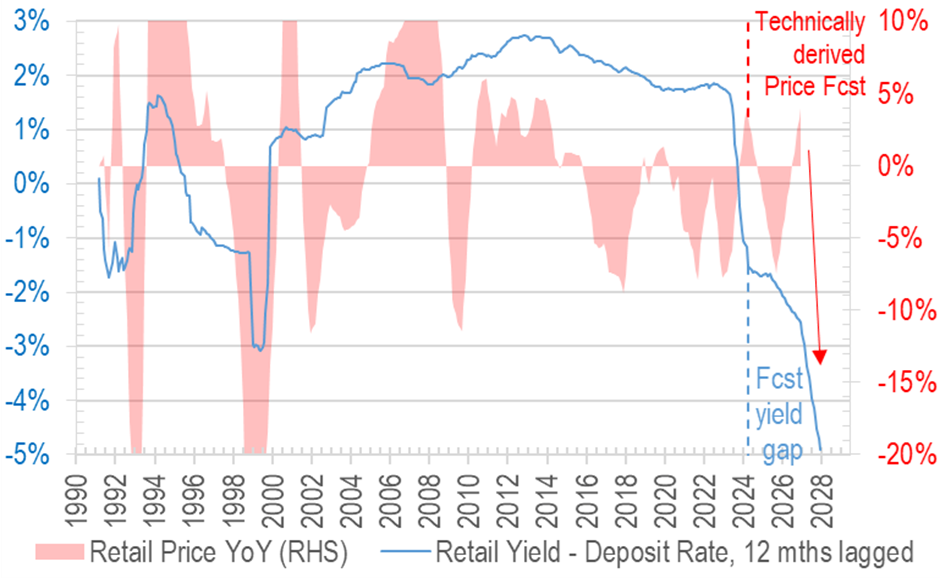
As a thought experiment, we believe this is probably as bad as it gets, because we are not factoring in the other capital flight which drove the rates higher - that from bonds. Perhaps the initial crack in bond market (when yields go north of 6%) will be negative for properties, but soon afterwards, the flight from bonds to real assets (may unfold as early 2026) will completely reverse price performances to the upside once more.

Based on this scenario, we think not all investors need to sell their safe haven assets (and indeed SGP shophouses are definitely safe haven in the world we live in now), if they can tolerate the price drops that happen before the final phase of the upcoming yield expansion cycle...

In the meantime, the very anaemic returns on retail property in SGP will continue to be a pain to tolerate, especially for leveraged up owners:


Could SGP retail further outshine HK in next few years?

The above wide gap between yield and funding cost does indeed support our near term bearish outlook on SGP retail assets, but if you look at the technicals vs HK retail property, SGP retail has broken out of the green downtrend, and could be hitting the blue channel top very soon (24% outperformance):

Should that level be also breached, there could be even more upside to the top red resistance (another 135% upside?).

Such a scenario probably can only unfold if HK retail see another major leg down, and that could only be driven by geopolitics rather than vanilla macro economics...


==================Article 1==================

Jack Ma’s Wife Buys Shophouses in Singapore’s Tanjong Pagar at Up to $37M

Beatrice Laforga | 2024/02/23

Despite stamp duties and investigations, wealthy mainland investors are still banking on Singapore properties, with the wife of the country’s best known tech tycoon having purchased a row of shophouses in the Tanjong Pagar area last month for a reported S$45 million to S$50 million ($33.5 million to $37.2 million).

https://www.mingtiandi.com/real-estate/finance/jack-mas-wife-buys-shophouses-in-singapores-tanjong-pagar/

==================Article 2==================

Shophouse sales surge and at higher prices in Q1 as high-net-worth investors return: Knight Frank

Samuel Oh | Fri, May 10, 2024 · 10:38 AM

In 2023, shophouse sales came to 132 units worth S$1.2 billion. The number of units was 31 per cent lower than the 191 units transacted in 2022 worth S$1.6 billion. Shophouse sales have fallen from their peak in 2021, when a total of 254 units worth S$1.94 billion changed hands.

[...]

Knight Frank projects the sales volume of shophouses to be between S$1.1 billion and S$1.2 billion for the rest of 2024.

https://www.businesstimes.com.sg/property/spotlight-1/shophouse-sales-surge-and-higher-prices-q1-high-net-worth-investors-return-knight-frank

==================Article 3==================

Bridgewater founder Ray Dalio joins billionaires snapping up Singapore ‘shophouses’

Investor’s family office bought two heritage properties for $19mn

Bridgewater Associates founder Ray Dalio’s family office has bought two multimillion-dollar “shophouses” in Singapore, as billionaires snap up the heritage properties in the city-state.

https://www.ft.com/content/9741784e-f69a-45cf-adf3-cc5b863c873f

==================Article 4==================

Singapore’s shophouses — hotter than Fifth Avenue?

Mercedes Ruehl / MAY 24 2024

Amid changing political dynamics in South-East Asia, these colonial-era buildings have become some of the world’s most expensive properties, home to Michelin stars and chichi retailers — and a target for money launderers

https://www.ft.com/content/e1a53cb8-5bf0-408a-91a0-bcdd738c0f11

2022年11月9日星期三

Bloomberg Talk - How Rate Hikes & Inflation Could Impact the Property Market in 2023

I would like to thank Bloomberg for the invitation to be on the panel on November 8, 2022. At the event, I highlighted the impact of rate hikes & inflation on global housing markets and discussed the opportunities that may lie ahead.

Below is a short extract of some salient points in the presentation.


Event overview:

Aggressive interest-rate hikes could worsen the outlook for global housing markets, particularly Hong Kong, which might continue to follow the U.S. in lifting mortgage rates aggressively until mid-2023. The Hong Kong housing market 2023 outlook versus other major markets like the UK and Singapore will be discussed, and explore if commercial and industrial properties could be an inflation hedge and outperform home prices in Hong Kong.

2021年9月29日星期三

Is it time to buy HK retail property yet? 20210921


Stand news 20210917

In the past two years, the retail market has been decimated by first the domestic protests and then by the global lockdowns.

One of the prime victims of this combination of circumstances has been retail properties of Hong Kong, where rents have fallen some 14% from the 2019 peak, and is still down 8.9% even now (blue line in Chart 1). The drop in retail property prices were even more pronounced, down 17% peak to trough and now standing at 13% off the 2019 highs (red line in Chart 1).

Anecdotal reports of drops of 70-80% in prime street shop rents have also been common, indicating that formerly tourist hotspots have been far worse hit than the overall indices suggest.

Chart 1: Retail rents up 4x vs price surging 29x since 1984

Looking further back in time, however, both rents and prices have risen by multiples over recent decades, so the question remains – are these mere single-digit drops, which take us back to levels 7-8 years ago, enough of a correction for the current downturn?


Consumption drives rents, but interest rates hold sway of prices

To explain the rise in retail property prices, we plotted on the same chart the various components that contribute to prices: a) retail sales (very dark area, Chart 2); b) domestic consumption beyond pure retail (dark area); c) change in property yields (light area); and finally d) financing costs as represented by mortgage rates (very light area):

Chart 2: bulk of price increase driven by yield compression


Chart 3: PRC shoppers drove 03-12 run up in retail, which reversed big time after 2019


It is clear from Chart 2 that the bulk of the contribution to retail price increases were yield compression, 4.2x the magnitude contributed by domestic consumption, but yields did not follow mortgage rate’s falls which would otherwise have doubled again the net impact on retail property prices. To view the various value drivers in a logarithmic view (all exponentially rising value series are best viewed this way ), the yield compression component remains highly significant (see Chart 3).

What Chart 3 also makes clear is how retail sales as a top line driver was boosted by opening of the PRC independent travel market in 2003, which propelled retail sales to almost equal total domestic consumption by 2012. However, this factor fell away rapidly after the 2019 protests and then the lockdowns in 2020. The changed retail habits in the lockdown era also decimated retail and pushed a lot of shopping activity online, which explains the widening gap between consumption and retail in the chart.

Rental underperformance compensated by drastic yield compression

In Chart 2 above, the difference between price (red line) and the yield compression implied price (top of light area) must be explained by rental not keeping up with increases in top line consumption takes. This kind of makes sense, as not all domestic consumption activities take place in retail premises – eg services, as well as online sales, take place in office or industrial space, or increasingly nowadays, in data centres, which are calculated under office/industrial rents but not retail rents.

Another way to illustrate this divergence is shown below:

Chart 4: retail rent tracks retail sales, but not consumption

Here the rent index (purple line) tracks retail sales (blue line) very closely, proving that retail rent does indeed shadow retail specific activities and very little else – the fact they almost entirely overlap for almost all of the past three decades is impressive, and echoes our analysis above that rent has underperformed consumption (here represented by orange line) at large.


Retail property price – bit more rebound, then another leg down?

In our assessment, the current favourable tailwind of low interest rates and rental rebound from deep lockdown lows may peter out by late Q4 21 or early Q1 22, resulting in a topping out of retail property price growth by then:

Chart 5: Retail price likely to grow into end-21 before declining again as interest rates are likely to spike into 2023

Retail a safer bet than HK resi?

Despite possible bearish outcomes, retail property prices may still be in safer territory than HK residential for these reasons:

a) the lifting of lockdowns brings back PRC visitors, which will benefit foot traffic and retail rents more than residential rents;

b) the ability by PRC buyers to purchase HK flats has not evaporated as severely as retail spending in the past two years, thus will see less rebound post reopening;

c) HK’s high finance sector salaries that has sustained high residential rents may not see as much upside going forward (eg when interest rates rise and negatively impacting finance related incomes); and

d) residential yields are at historic lows and could expand even more than retail yields (blue area in Chart 6). These factors combine to provide more safety margin for retail property prices than residential prices, ie retail prices will likely outperform in the next year or two (red arrow in Chart 6):

Chart 6: Investing in retail properties seem to be a better decision than residential properties.


The ultra low yields in HK will be a big headwind to strong price appreciations ahead, especially in view of the lowest interest rates in all human history, coupled with a worldwide inflationary wave. Even so, retail property does not seem the worse amongst the various subsectors in HK property, given its recent corrections.


The author would like to thank Samson Leung of Hong Kong Baptist University and Jacky Chau of The Chinese University of Hong Kong for assisting in data collection, analysis, and drafting this article.