2024年7月17日星期三

星洲舖價 是否見頂?20240717

本文亦於2024年7月16日在【信報】刊登: 星洲舖價 是否見頂?


過去數年,烏克蘭及中東戰爭導致的歐洲資本外流,加上香港新的國安法環境,令市場對新加坡資產的投資需求大大飆升,以至如下類別的新聞頭條不絕於目:

》馬雲妻子斥資3700萬美元購買新加坡丹戎巴葛商舖(見原文

橋水基金創立人達利奧與億萬富翁搶購新加坡商舖(原文

》新加坡商舖比第五大道更熱門原文

前兩個頭條尚可理解為「聰明錢」早著先機之舉,但最後的頭條卻有些少「市場見頂」的味道。

筆者繼續認為過去數年的零利率、高全球貿易增長、和生產力不斷提升的宏觀環境已一去不返。相反,迎面而來的將是中美脫鈎、去全球化和主權債務危機。這要歸功於地緣政治惡化、政治正確的零炭排政策、以及沒完沒了的防疫措施;這些趨勢必會進一步推高通脹破壞原有的經濟活力。

高通脹和債務違約的後果之一就是利率將居高不下,甚至重返九十年代的高位,或者更高的八十年代水平:

圖一:新加坡短息走勢:步步高陞

【圖一】中的新加坡同業拆息在過去兩年已經突破藍色的下降趨勢線兼且升穿3.6%的長線阻力位。如果政經環境一如意料地惡化,利率在兩三年間衝高至6.8%區間絕對不難。

若然租金回報追不上利率升幅?

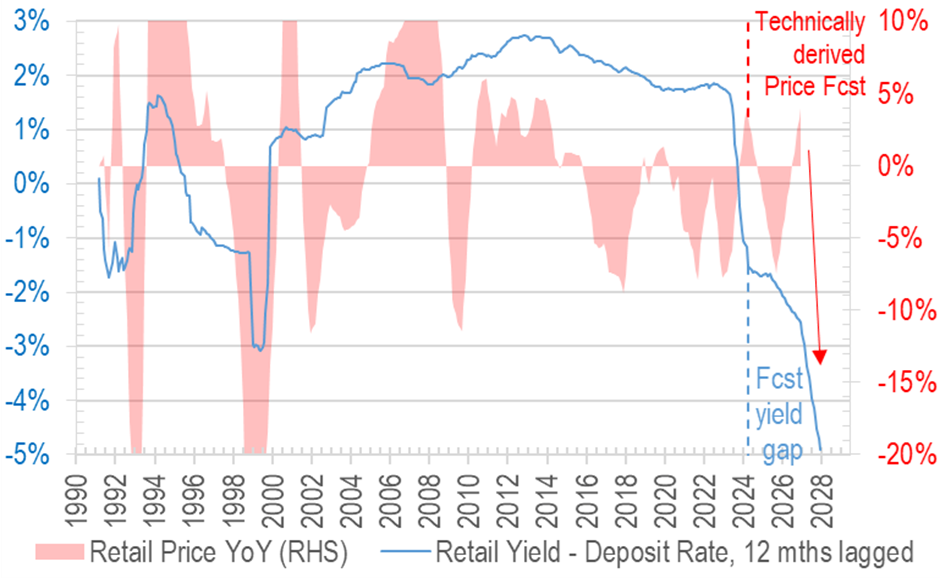
根據目前的租金和價格趨勢,筆者對2024-27年的新加坡舖租回報率粗作預測,但可惜回報的增長遠遠不及利率上調的幅度,導致回報率相對存款利率的折讓戲劇性地擴大

圖二:零售回報差(藍線)會否創出新低?

以上情景可能已接近大部分人可想像最差的極端;然而若果超高息率,是因為龐大的債券走資潮所致,為躲在實物資產內避險而令地產回報大大低於債券知識領域,又是否情有可原?就算債市爆破的初期(可能收益率會一瞬間抽升至6%以上)實物資產(如零售物業)會被拖累,但隨著債券資金逃逸,流向實物資產(可能早至2026年初發生),後者的價格可能大幅反彈,反而高於爆破前水平。

基於這種情況,可能並非所有投資者都須出售配置中的低風險資產(而環顧眾多資產類別,新加坡商鋪絕對當之無愧),但業主卻要作好準備,接受在如此規模的資產大轉移下必會發生的,波幅劇烈的價格先跌後升現象

在危機之前,新加坡零售物業極低的回報率仍是令人難以接受,尤其是高槓桿借貸下持有的業主:

圖三:短息利率已重奪高位,大幅拋離商舖回報

 獅城舖價能否一洗頹風,終於超越香港?

上述收益率與融資成本之間的巨大差距確實令人短線看淡星加坡舖市,但從技術分析層面與香港零售物業比較,獅城似乎已經突破綠色的下降趨勢線兼藍色阻力線,可能好快就會觸及藍色通道頂部(即跑贏香港24%):

圖四:新加坡舖價會否突破常規,拋離香港?

 如果【圖四】0.46紅線水平亦都升破,那下一個里程碑將是1.08區間,上升空間更加可觀(加升135%?)。但在星加坡當下昂貴的情況下,要跑贏香港是否意味著香港舖價須再大跌一輪?如此極端的波幅,似乎要賴於地緣政治原因而非由一般的宏觀經濟因素來推動…


筆者特別鳴謝香港城市大學計算金融及金融科技學系朱靜怡同學協助收集及整理本文相關數據及圖表

2024年7月9日星期二

東瀛樓市雖熱 深層隱憂不無 20240709

本文亦於2024年7月9日在【信報】刊登: 東瀛樓市雖熱 深層隱憂不無


過去數月,投資界餘飯後話題越來越多涉及「我們在二世古(港人可能較多熟悉Niseko英文稱呼)買樓」或「我們基金正又東京掃酒店」之類的言論,就彷如全他投資地點都不值一晒,被打入了冷宮

熟悉筆論點的都應記得吾等已至少兩年勸奉朋際勿沾手日本地產。本文且簡陳箇中道理,以拋磚引玉

線取勝 必須逆流而行

月市場對日本地投資的興日益增加(見),同時經指數不斷飆升,可謂股樓皆旺。地產領域似乎更為火熱,尤其是地基金界:

圖一:基金入市日本的新聞不斷湧現


誠然,過去兩年全球利率飆升殺了所有基金一個措手不及:其内部報率(IRR)計算如墮冰窟,由20+%常態一舉陷入零的邊緣,甚至更壞同時,在對聯儲局降息的希冀幻滅之際,日本資產價格止跌回升便不難成為投資界新的救命草,繼而引發當下的東瀛掘金潮

不過,未來幾年日圓大幅貶值的風險不容小覷,一不小心,少少資產升值反會被匯率損失吞噬。因此,筆者更偏好投資於貨幣和資產價格都會上漲的市場

跨境投資算計 不可忽略外匯

回顧歷史,賺價蝕匯的個案多不勝數,且以下圖為例

圖二:日本樓價以美元或日圓計價回報差天共地


在八十年代日本工業和文化雙雙崛起的鼎盛時期,論日圓或美金計價樓價都在上漲(見上圖左方綠箭嘴)。對海外業主來說,美元計算的回報(紅線)比日圓計價(藍線)的升幅更高(見紫三角)。

然而在隨後「遺失的20年」間,日圓基本上窄幅橫行(中間的綠箭頭),結果以日圓計和以美元結算的樓價指數幾乎亦步亦趨,跌幅非常相似(紫平行四邊形)。

由於日本受制於人口收縮(見),及新通脹周期下原材料價格飆升,日圓已處於一個結構性的貶值循環(第三個綠箭嘴)。正因如此,自2010年來儘管當地樓價上漲,但以美元計價卻錄得跌幅(紫梯形)。

筆者預計日圓的下一跌浪(右方綠箭嘴)將在未來三年展現,因而令海外投資者明升實跌(即藍箭嘴雖向上但紅箭嘴卻走低)。

以數字表達之,日圓的疲軟(第二列紅色區)對以美元計價的東京樓價實在有舉足輕重的影響(右列打勾年份)

表一日圓漲跌影響海外業主的實質回報


當然,上表中2025-29年的預測純粹基於【圖二】中憑判斷而畫的箭嘴,到時樓價和匯率皆未必完全跟隨,然而美元計回報為負數(右起第二列)的風險依舊是非常實在的。

日本前景 遠非樂觀

為了引進通脹、紓緩封關所帶來的經濟惡果、以及減輕日漸高築的政府債台(經合組織中最高),東瀛的貨幣/財務政策導致民眾的實質收入過去四年基本上都在下跌

圖三:日本實際工資長時處於下跌區間


同時,生活成本危機導致私人消費連續兩季下降,而最新的本地生產總值亦再度出現收縮情況

圖四:日本實際生產總值萎糜不振


同時,地緣政治的緊張局勢必將利率進一步推升

一)中國(13年内從8.9%降至2.2%,見【圖五】紅區)等傳統國債大戶似乎正在減低美國國債的持有量。事實上就連日本也在債主比重中一直下降(從9.5%高位跌至當前的3.4%,見藍區)

圖五:日本及中國持債量與比重逐季削減


二)烏克蘭及中東衝突蔓延引發商品價格上脹,作為一個資源貧乏但製造業密集型經濟體,較高的成本(例如油價,見【圖六】藍線)往往會引發經濟收縮(紅色區域)。綠線僅假設油價回到150美元/桶及所帶來的經濟收縮(紅箭嘴);若果國際戰爭再次爆發,油價甚至隨時大大抽升於筆者預算以上

圖六:高油價不利以製造業為本的日本


除了戰爭對成本造成的壓力,日本最近越趨明顯的軍事化動作,以及與日俱增的戰爭蔓延到亞太地區之風險,都會導致資本逃離日本市場

圖七:日本軍事化動作頻仍,令人擔憂


三)主權債務危機影響日本更甚於美國——隨著美國財政紀律敗壞(一年內增加了3.5萬億美元的債務!),長債息率除了上漲(【圖八】右方橙色線)別無選擇,從而將扯高日本債息(綠線)。就算假設地緣政治/主權債務一如既往,低到可笑的0.87%日本國債收益率在新的加息潮下就算大漲兩倍(至2.5%)都仍然遠遠不及美債吸引,因此資本外流美國的現象只會加速

圖八:加息周期下日本債息難免不升


在資金棄日赴美的情況下,日圓再跌25%200水平都不為過。最怕是日圓的貶值變得無序,因而出現日債息率(綠線)升至至高於美債(黃線)的極端情況

圖九:無序走資時日債收益率甚至會高於美債息率?


如此極端的情況下日圓可能須貶回到270以上的水平。這與市場在「錨定偏見」催眠下仍一廂情願地預測的150的水平大相徑庭。

實質回報低 日樓引力弱

再以地產相對收益率與其他市場比較,筆者較看好的金邊/雅典有更高的實質回報,同時悉尼/新加坡/東京卻敬陪末席(右起第三列)

表二:環球城市實質租金收益及相對債券溢價一覽


在主權債務危機下,美國市場應會成為資金的避風港,因而令歐洲和日本市場變得缺乏吸引力。從此角度看,似乎香港/紐約樓市因可避免債息無序飆升而顯得較低風險(右二列)。

基於上述不同的因素,若要沾手日本樓市,必須1)鎖定長期固定利率借款;和2)借日圓做槓桿或後備充分的對沖。但即使是大型基金,又有多少採取這些預防措施筆者對此存疑。無論機構在其他方面看起來多麼聰明,在某些重點上卻與凡人無異(見)。


筆者特別鳴謝香港城市大學金融學系潘明玥同學協助收集及整理本文相關數據及圖表


2024年6月25日星期二

【理財新世代】樓市寬鬆措施技術調整與港樓前景 20240622

 2024年6月22日


主題:


》金管局上周宣布,2月底提出的再調整周期宏觀審價監管措施,擴大涵藍範圍至「撤辣」前簽臨時買賣合約嘅自用業主,而按證保險公司將相應將按揭保險計劃現時合資格準則亦相應擴大適用範圍,令有需要買家可以申請最高七成按揭,希望為面對估價不足而要補差價上會做按揭嘅業主紓壓,用意明顯係要幫呢一班業主?


》但衣家呢個問題嚴重性係米已經去到連金管局都要出手的地步?
根據粗略統計,呢兩年買左樓花,選擇用建築期付款嘅買家比例都多,根據政府數據,截至5月,待審批樓花盤有27個,樓價未見有起色,新盤劈價影響一手樓佔價,樓花盤準業主要補估價差額上會個案會愈嚟愈多?今次措施實際上幫到幾多?


》劈價潮對香港樓市的影響?到底會令香港樓市健康定會無幫助?


》除了金管局出招幫手,嚟緊息口走勢又幫唔幫到手?市場料美國今年減息至少一次,香港跟減機會大唔大?減一次幫得幾多?


報導來源:香港電台【理財新世代】

https://www.rthk.hk/tv/dtt31/programme/investmentera_tv/episode/899962


特此鳴謝


主持: 黃瑋傑、徐家健


攝影及剪接: 香港電台公共事務組

2024年5月31日星期五

SGP - Is Retail Property Price Peaking? 20240531

The combined favourable factors from capital flight due to the Ukraine/Middle East wars and HK's new national security legislation regime have massively pushed up investment demand for Singapore assets, thereby prompting headlines such as these of late:

>> Jack Ma's wife buys shophouses in ...Tanjong Pagar for $37m (article 1);

>> Bridgewater founder Ray Dalio joins billionaires snapping up Singapore ‘shophouses’ (Article 3)

>> Singapore’s shophouses — hotter than Fifth Avenue? (Article 4)

Whilst the first two headlines might be interpreted as 'smart money' making early moves, the last piece could be read as a sign of peaking market...

We continue to forecast a new macro environment that is different from the good old days of near zero interest rates and continued growth in global trade and productivity gains. Instead, we believe the new reality is one of decoupling, deglobalisation, and debt defaults, thanks to geopolitics and net zero / pandemic measures which not only will drive further inflation, but will undermine high economic growth.

One of the consequences of the combined higher for longer inflation and debt default scenarios is rates staying high, or return to 90s highs, if not even 80s high levels:

Above SGP interbank rates have already broken out of both the blue down trend as well as the lower horizontal resistance over the past two years. If the worse outcome does pan out as we feared, it might not be inconceivable to see rates hit 6.8% or thereabouts in the next 2-3 years.


If Rent/Price moves can't match rate rises?

Using current trajectories in rent and price, we have modeled the near term yield increases, but sadly the rise in yields are not enough to offset the much more dramatic interest rate hikes, resulting in one of the more dramatic widening in retail yield discount vs deposit rates:

As a thought experiment, we believe this is probably as bad as it gets, because we are not factoring in the other capital flight which drove the rates higher - that from bonds. Perhaps the initial crack in bond market (when yields go north of 6%) will be negative for properties, but soon afterwards, the flight from bonds to real assets (may unfold as early 2026) will completely reverse price performances to the upside once more.

Based on this scenario, we think not all investors need to sell their safe haven assets (and indeed SGP shophouses are definitely safe haven in the world we live in now), if they can tolerate the price drops that happen before the final phase of the upcoming yield expansion cycle...

In the meantime, the very anaemic returns on retail property in SGP will continue to be a pain to tolerate, especially for leveraged up owners:


Could SGP retail further outshine HK in next few years?

The above wide gap between yield and funding cost does indeed support our near term bearish outlook on SGP retail assets, but if you look at the technicals vs HK retail property, SGP retail has broken out of the green downtrend, and could be hitting the blue channel top very soon (24% outperformance):

Should that level be also breached, there could be even more upside to the top red resistance (another 135% upside?).

Such a scenario probably can only unfold if HK retail see another major leg down, and that could only be driven by geopolitics rather than vanilla macro economics...


==================Article 1==================

Jack Ma’s Wife Buys Shophouses in Singapore’s Tanjong Pagar at Up to $37M

Beatrice Laforga | 2024/02/23

Despite stamp duties and investigations, wealthy mainland investors are still banking on Singapore properties, with the wife of the country’s best known tech tycoon having purchased a row of shophouses in the Tanjong Pagar area last month for a reported S$45 million to S$50 million ($33.5 million to $37.2 million).

https://www.mingtiandi.com/real-estate/finance/jack-mas-wife-buys-shophouses-in-singapores-tanjong-pagar/

==================Article 2==================

Shophouse sales surge and at higher prices in Q1 as high-net-worth investors return: Knight Frank

Samuel Oh | Fri, May 10, 2024 · 10:38 AM

In 2023, shophouse sales came to 132 units worth S$1.2 billion. The number of units was 31 per cent lower than the 191 units transacted in 2022 worth S$1.6 billion. Shophouse sales have fallen from their peak in 2021, when a total of 254 units worth S$1.94 billion changed hands.

[...]

Knight Frank projects the sales volume of shophouses to be between S$1.1 billion and S$1.2 billion for the rest of 2024.

https://www.businesstimes.com.sg/property/spotlight-1/shophouse-sales-surge-and-higher-prices-q1-high-net-worth-investors-return-knight-frank

==================Article 3==================

Bridgewater founder Ray Dalio joins billionaires snapping up Singapore ‘shophouses’

Investor’s family office bought two heritage properties for $19mn

Bridgewater Associates founder Ray Dalio’s family office has bought two multimillion-dollar “shophouses” in Singapore, as billionaires snap up the heritage properties in the city-state.

https://www.ft.com/content/9741784e-f69a-45cf-adf3-cc5b863c873f

==================Article 4==================

Singapore’s shophouses — hotter than Fifth Avenue?

Mercedes Ruehl / MAY 24 2024

Amid changing political dynamics in South-East Asia, these colonial-era buildings have become some of the world’s most expensive properties, home to Michelin stars and chichi retailers — and a target for money launderers

https://www.ft.com/content/e1a53cb8-5bf0-408a-91a0-bcdd738c0f11

2024年5月29日星期三

Is the big rush into Japanese property justified? 20240529

We have heard nothing other than 'we are buying Niseko ski flat' or 'our fund is adding Tokyo hotel' for the past few months, as if the rest of the world is all in the dog house...

Clients familiar with our arguments will know we have been negative for at least 2 years on the Japanese market, so this email seeks to give a more rounded exposition on why.

When crowds scramble one way, we go the other

The recent scramble for adding Japanese exposure (see Article 1) is in line with the concurrent rise in the Topix, but in property land there is even more momentum, especially amongst funds:


Granted, funds have been sitting on their hands in the past 2 years as interest rates globally spiked, and their IRR calculations were thrown into disarray. So the wishful hope that Fed rate cuts will be implemented (now proven wrong), plus a reversal of Japanese asset depreciation has sparked a sudden fad into pumping money into the land of the rising (may be now setting) sun...

We are very wary of the much more significant risk of Yen devaluation against whatever puny asset appreciation in the currency in the coming years however, and would prefer other jurisdictions where BOTH currency and asset prices will rise (regular readers will know where that is!).


FX should be central in investment decisions

The point of making price gains but adding translation losses is best illustrated with a view to history:


As shown above, during the haydays of Japanese industrial and cultural ascent, both asset prices in local currency (LC) and exchange rates were on the rise - see left green arrow. The combined effect for foreign investors is even stronger returns in USD terms (red line) than locals (blue line), shown by the purple enlarging triangle.

In the subsequent lost 2 decades, Yen basically went sideways (2nd green arrow), with price drops very comparable in LC and USD (purple parallelogram).

We are now probably into the next leg of Yen derating (see 3rd green arrow) thanks to shrinking population - see Article 3 - and the resurgent commodities complex when all input materials see price spirals. Unsurprisingly, since 2010, despite LC price gains, USD denominated values fell (purple trapezium).

We expect the next (final) down leg in Yen (4th green arrow) to unfold in the next 3 years or so, which can also destroy value for overseas investors (ie down red arrow despite up blue arrow).

To put it in numbers terms, below is a table showing the impact of Yen weakness (red shades) vs USD denominated Tokyo home prices:

Of course, the 2025-29 projections above are purely based on the arrows in chart above and may not play out the way we projected, but the risk that you get negative USD returns (2nd column from right) is very real indeed.


Macro picture for Japan: far from rosy

By the combined will to reintroduce inflation and to inflate away the mountains of govt debt (highest in OECD), the Japanese work force has been earning negative real income for the past two years:

In the meantime, the cost of living crisis left private consumption down for 4 quarters in a row, with little help to exports (net exports were increasingly negative in recent quarters) to contribute to GDP growth:


In the meantime, the geopolitical tensions between China and US is causing the rate environment to surge further, due to:

1) loss of demand for US debts by big traditional owners like China (fr 8.9% to 2.2% in 13 yrs) and HK, in fact Japan has also been falling in total proportion of US treasury holdings (fr 9.5% to 3.4% now):


2) Ukraine/Middle East conflicts likely to trigger more input price inflation, eg oil prices - and as a resource poor but manufacturing intensive economy, higher oil prices (blue line, down is higher prices) will tend to trigger economic contractions (red area). The green line is merely projecting prices returning to $150/barrel, which can easily be exceeded should international wars flare up again:


The result would be grim for Japanese economy. If wars spread to the APAC region, there is an added strong chance of capital flight from Japan given its recent militarisation movements might scare foreign investors away:


3) bond rout will impact Japan more than US - as US fiscal profligacy continues (yes, by adding $3.5tr debt in one year), long bond yields have nowhere to go but up (orange line), this will drag JGBs up with it (green line). Assuming totally benign geopolitical/sovereign debt calm conditions, the laughable 0.87% JGB yield will still nearly triple to 2.5%, and this 'benign' expansion of US-JP yield spread may trigger further capital outflows as money seeks higher returns in the US:


The result? Yen could drop another 25% to the 200 mark.

If this Yen drop becomes disorderly, it could result in JGBs trading at premium to TBs, leading to the much more nightmarish outcome of 10.5% JGBs vs say 8.5% TBs:


Such an outcome would mean Yen has to return to 270+ levels, much against the wishful sub-150 levels the 'anchoring biased' talking heads out there could imagine... or a 45%+ drop from current levels.


Real yields also too low to be attractive

Back to our usual real property yield table - Sydney/Singapore/Tokyo are some of the lowest returning markets on inflation adjusted basis (3rd column from right), compared to Phnom Penh/Athens which are our preferred investment destinations:


In a bond rout outcome, both European and Japanese markets will suddenly look much worse as US becomes the safe haven, thereby helping HK/NYC (2nd column from right).

Based on these various factors, we will only touch Japan if: a) long term fixed rate borrowing can be locked in; b) Yen leverage and/or hedge are put in place. But how many even the big institutions are taking these precautionary measures? We doubt many. On this note it is interesting to demonstrate how institutions are mere humans, however smart they otherwise appear: see Article 2.


==================Article 1==================

Interest in Japanese real estate grows despite rate rise prospects

Mar 8, 2024

Institutions and family offices are backing real estate for another strong year, despite the prospect of the country’s first interest rate rise since 2007.

​https://www.asianinvestor.net/article/interest-in-japanese-real-estate-grows-despite-rate-rise-prospects/494795​


==================Article 2==================

Hidden billions in Tokyo real estate lure activist hedge funds

Apr 16, 2024

The long-concealed market value of Tokyo’s largest skyscrapers is being unveiled by activist investors.

​https://www.japantimes.co.jp/business/2024/04/16/companies/headge-funds-urge-japan-real-estate-sales/​

==================Article 3==================

Japan’s Population Declines Again: Seniors 75 and Over Top 20 Million for First Time

Apr 24, 2024

An estimate published by Japan’s Ministry of Internal Affairs and Communications shows that the total population as of October 1, 2023, was 124,352,000. This was a drop of 595,000 (0.48%) from the previous year. It is the thirteenth consecutive year that the population decreased. The population of Japanese citizens was 121,193,000, for a record year-on-year decrease of 837,000, or 0.69%.

​https://www.nippon.com/en/japan-data/h01967/